

















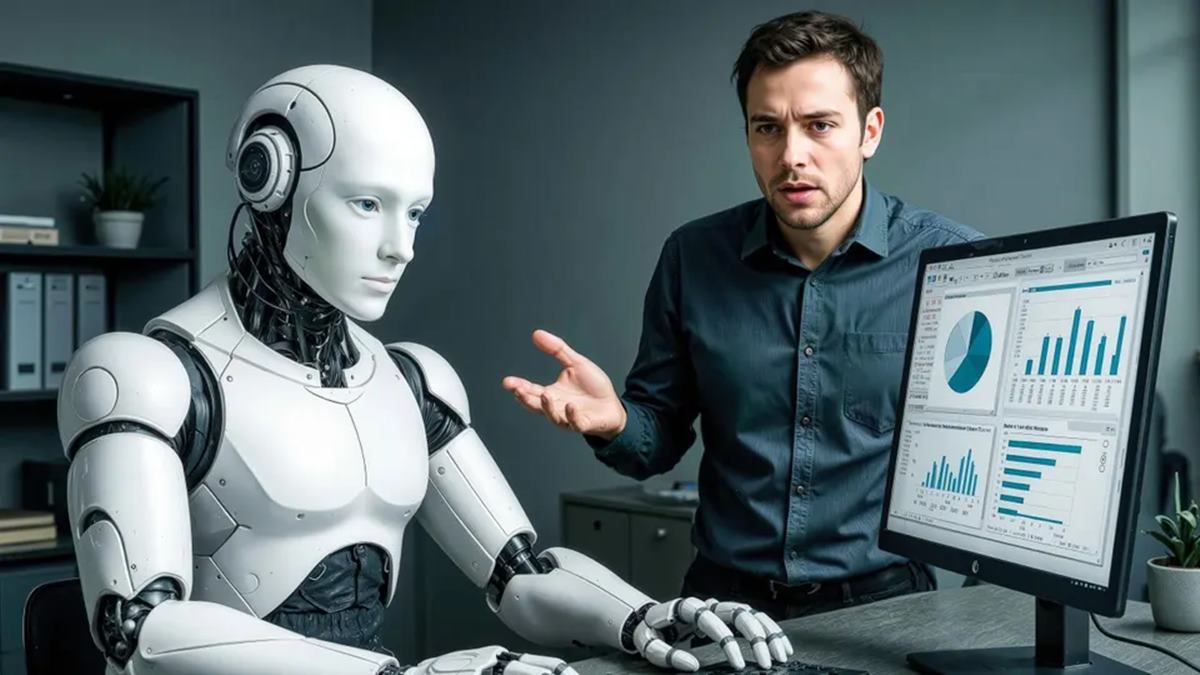
Few technology debates are as emotionally charged right now as the future of jobs in the age of AI. Headlines warn of mass unemployment, entire professions disappearing, and a coming wave of disruption that could upend the global workforce.
At the same time, many business leaders see something very different unfolding. AI is being used to boost productivity, augment human capability and remove repetitive work rather than replace people outright. In practice, the reality inside organizations is far more nuanced than the apocalyptic narratives suggest.
So, which view is closer to the truth? Is AI really driving a job apocalypse, or are we overstating the risks while missing the bigger opportunity?
In this article, I unpack what the evidence actually shows, where fears are justified, where they are overhyped and what leaders should focus on right now as AI reshapes the world of work.
How Were Jobs Impacted By AI In 2025?
Well, based on the available evidence, while “job apocalypse” might be an exaggeration, we certainly saw significant disruption.
A report by analysts at Challenger, Gray & Christmas found that AI was cited as a reason behind 48,414 job cuts in the U.S. during 2025. This made it the second most common cause of job loss, behind President Trump and Elon Musk’s DOGE initiative.
This suggests that AI was only to blame for a small portion of the estimated 1.1 million job cuts across the U.S. workforce during the year.
Worldwide, another paper put the total number of jobs lost to AI in just the first six months of 2025 at 76,440.
But what about new jobs created? A famous WEF study claimed that by 2030, although 92 million jobs will be displaced by AI, 170 million new roles will also be created. Specifically, it states that AI will create 12 million new jobs by 2025. Halfway through the decade, how is that prediction shaping up?
AI-related job postings, such as Artificial Intelligence Engineer, Prompt Engineer, and Model Tuner, continued to grow. Perhaps more tellingly, research by Indeed found existing roles such as coding and marketing, considered to be highly exposed to AI automation, grew fastest of all.
This can be taken as a sign that, rather than specifically hiring for specialist roles in AI, employers are looking to prioritize AI fluency in all employees.
What Jobs Were Affected?
According to research conducted by Revealera, the jobs with the biggest decline in hiring in 2025, compared to 2024, were computer graphics artists (32.7 percent), compliance specialists 29.2 percent), photographers (28.1 percent) and writers (27.9 percent).
Unsurprisingly, these are all jobs with extremely high exposure to automation by AI.
There was also bad news for graduates, with further research showing a sharp decline in entry-level opportunities, particularly within technology-focused roles. Again, these are roles that involve tasks such as junior coding and data entry that are frequently being automated.
Further up the career chain, however, there appears to be more resilience. Other research confirms the frequently cited belief that more strategic, leadership and people-focused roles, as well as roles requiring human presence, such as nursing, are less likely to be at risk.
In fact, mid-way through the year, Microsoft released its own research into the job impact of AI, stating that among the least-impacted professions are dredge operators, maids and housekeepers, roofers, massage therapists and highway maintenance workers.
For an example of an industry and profession that was particularly hard-hit, look no further than video game development. It was reported that one in 10 of the approximately 330,000 people working in the video game industry lost their jobs in the past 12 months. Of them, the most affected were voice-over artists; a profession uniquely exposed thanks to the advanced state of AI voice generation technology.
What Did Experts Say About The Impact Of AI On Jobs In 2025?
“AI could wipe out half of all entry-level white-collar jobs, and spike unemployment to 10 to 20 percent in the next one to five years.” Dario Amodei, Anthropic CEO
“We are fighting guerrilla warfare against irrelevance every day.” Puneet Chandok, President, Microsoft India
“AI’s rapid advance is not just reshaping industries, but fundamentally altering the workforce and the skills required.” Peter Brown, Global Workforce Leader, PwC
“In engineering this year at Salesforce, we’re seriously debating – maybe we aren’t going to hire anybody this year.” Marc Benioff, CEO, Salesforce
“This is like a tsunami hitting the labor market.” Kristalina Georgieva, MD IMF
“You’re not going to lose your job to an AI, but you’re going to lose your job to someone who uses AI.” Jensen Huang, CEO, Nvidia
Looking Ahead
Moving into 2026, it’s clear that rather than a sudden apocalypse, we’re facing a profound transformation of the nature of work itself. It’s a transformation that’s only likely to accelerate as technology continues to evolve.
The key takeaways? Entry-level positions are being affected first, jobs requiring human skills are proving the most resilient, and developing the ability to work with AI is becoming critical across every profession.
It’s still far from certain whether the 170 million predicted new roles will actually emerge by 2030. But what we can be sure of is that by the end of the current decade, the world of work will look very different from how it does today.
Source – https://www.forbes.com/sites/bernardmarr/2025/12/25/is-the-ai-job-apocalypse-real-or-overhyped/