
















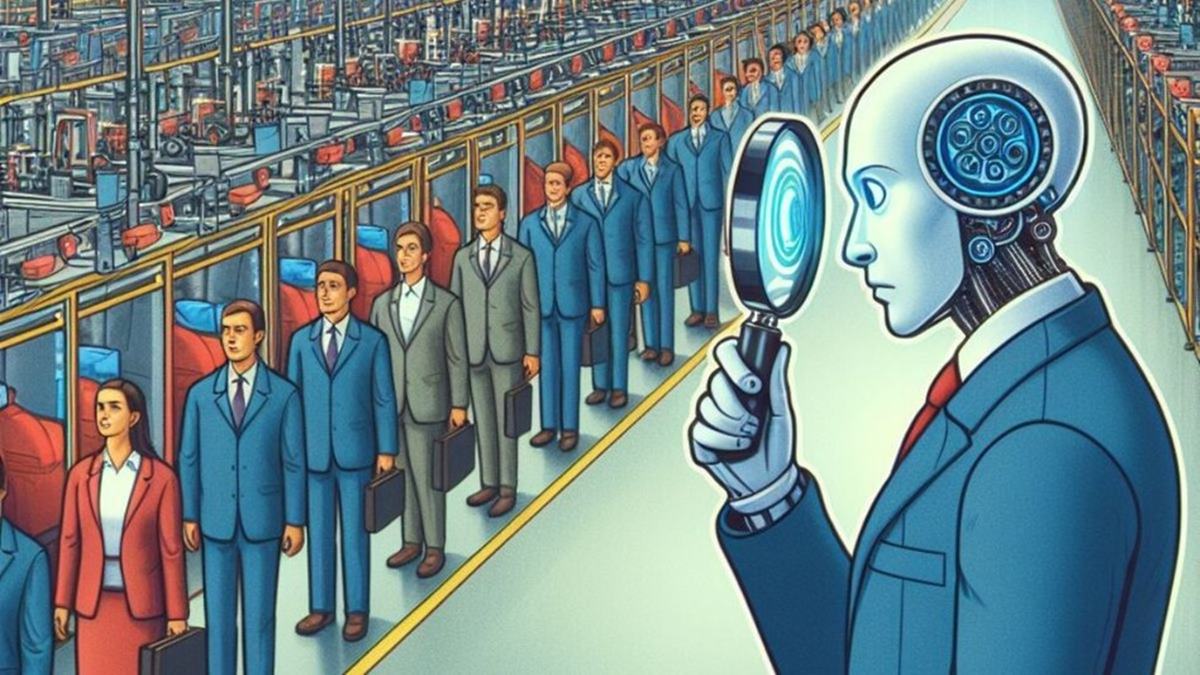
Companies that reduced staff during initial artificial intelligence deployment phases are now re-engaging former employees to stabilize operations, restore execution capacity, and recover institutional knowledge.
This trend, termed “boomerang hiring,” reflects an emerging corrective mechanism within AI-transformed organizations, indicating how AI adoption interacts with organizational systems over time. Early efficiency gains from automation absorbing tasks are giving way to secondary effects such as workflow friction, increased oversight, and slower decision cycles.
Workforce reductions attributed to AI were often based on task-level evaluations, removing automatable tasks from role definitions and reassessing associated roles. This approach viewed work as discrete activities rather than an interconnected system. Roles function as coordination structures, managing ambiguity, handling exceptions, translating outputs, and maintaining team continuity. Their removal redistributes responsibilities, increasing oversight, escalations, and decision concentration.
As AI systems accelerate execution speed, automated workflows generate outcomes more rapidly, increasing the volume of downstream decisions requiring human judgment. Remaining teams experience higher cognitive load and tighter capacity constraints, leading to accumulated execution strain despite productivity metric growth.
Rehiring addresses this strain by restoring coordination capacity not replaced by automation. Organizations facing execution pressure prioritize speed and reliability, favoring former employees who possess established understanding of internal systems, customer expectations, regulatory boundaries, and informal operating norms. This familiarity reduces onboarding time and limits operational risk, especially in AI-shaped environments where contextual knowledge is increasingly valuable as documentation often fails to capture the full scope of workflow assumptions, exceptions, and dependencies.
This preference shifts hiring behavior, with companies favoring the reacquisition of known talent to compress time-to-capability and restore execution confidence more quickly than net-new hiring. The decision emphasizes operational efficiency over sentiment.
The economics of workforce management are also changing; re-engaged employees return with updated information, having observed workflow impacts and responsibility redistribution due to automation. This awareness influences labor dynamics, broadening compensation discussions and emphasizing scope clarity, flexibility, and stability. Some boomerang hires return in advisory or contract capacities, while others negotiate influence over how automation interfaces with their roles.
This recalibration adjusts the economics of AI adoption, with automation continuing to deliver efficiency gains while human capability is priced more accurately as a stabilizing input. Consistent patterns observed across organizations include:
- Capability premiums for high-judgment roles.
- Scope renegotiation as returning employees seek clearer responsibility boundaries.
- Structural leverage derived from familiarity with systems, increasing bargaining power.
- Cost recalibration as AI savings narrow and human value is repriced.
The persistent human backbone of AI systems structures this trend, mirroring how large-scale AI platforms operate. Advanced AI products rely on sustained human involvement across multiple layers of design, operation, and governance, a dependence that is structural rather than transitional. OpenAI maintains extensive human teams for data curation, evaluation, safety review, policy enforcement, and incident response. Anthropic centers human oversight, and Google Gemini uses continuous monitoring, feedback loops, and governance processes. DeepSeek and xAI Grok also rely on human teams for system behavior, escalation handling, and strategic direction.
These systems rely on people because humans excel at contextual reasoning, creative problem framing, and value-based judgment, which are critical when systems encounter ambiguity, novel edge cases, or conflicting objectives. Automated systems operate within defined parameters; humans determine parameter suitability as conditions change. Creativity allows teams to anticipate failure modes, reinterpret signals, and redesign constraints. Human operators evaluate whether learned patterns and optimization targets continue to serve broader goals as systems scale and interact with real-world complexity.
Enterprises deploying AI inherit this dependency, shifting human involvement from routine execution towards supervision, exception handling, and decision governance. Reliability, trust, and adaptability continue to depend on human judgment. Boomerang hiring reflects that reality; aggressive removal of human judgment leads to lost flexibility and resilience, while rehiring restores the creative and contextual capacity needed for automated systems to function effectively at scale.
From a workforce intelligence perspective, this pattern indicates where AI adoption outpaced organizational design, as automation scaled execution while reducing human structures that absorb variability and maintain decision quality. Rehiring serves as a corrective action when this imbalance becomes operationally visible. Capability diagnostics, such as PLCD, surface which roles remain load-bearing as automation scales and where human judgment stabilizes systems, helping organizations avoid reacquiring talent at a premium. AI-driven efficiency gains remain real, with human involvement shaping system reliability and adaptability. Companies that integrate AI deployment with workforce design experience smoother transitions and lower reacquisition costs. Boomerang hiring signals a maturing understanding of how automation and human capability interact within complex organizations.
Source – https://dataconomy.com/2025/12/29/employers-regret-ai-layoffs-and-rush-to-rehire-former-talent/