



















The future of jobs is no longer a labor market question. It is a work design and leadership challenge unfolding inside organizations right now.
The debate around AI and jobs is still framed as a binary. Will artificial intelligence destroy work or create it. Will productivity gains save us, or destabilize society. The World Economic Forum’s new white paper, Four Futures for Jobs in the New Economy: AI and Talent in 2030, makes one thing clear: these questions are already obsolete.
The report outlines four plausible futures for jobs by 2030, shaped by two forces: the pace of AI advancement and workforce readiness. What is striking is that the futures diverge dramatically even when the technology is similar. Some scenarios deliver growth, resilience, and new forms of work. Others spiral into job displacement, inequality, and fragmentation.
The difference is not the AI model, the compute, or the breakthrough timeline. The difference is how leaders redesign work.
Same AI, Different Job Futures
What the World Economic Forum scenarios really show is not four futures driven by technology, but two fundamentally different outcomes that hinge on whether people are kept in sync with AI’s pace.
When AI accelerates at an exponential rate and workforce readiness is widespread, jobs do not disappear overnight. They shift. Work moves away from execution and toward oversight of AI-native ecosystems. People manage, direct, and shape fleets of intelligent systems. In that world, the primary pressure point is no longer employability. It is AI governance. Social safety nets, regulatory frameworks, and ethical guardrails struggle to keep up with the speed and scale of change.
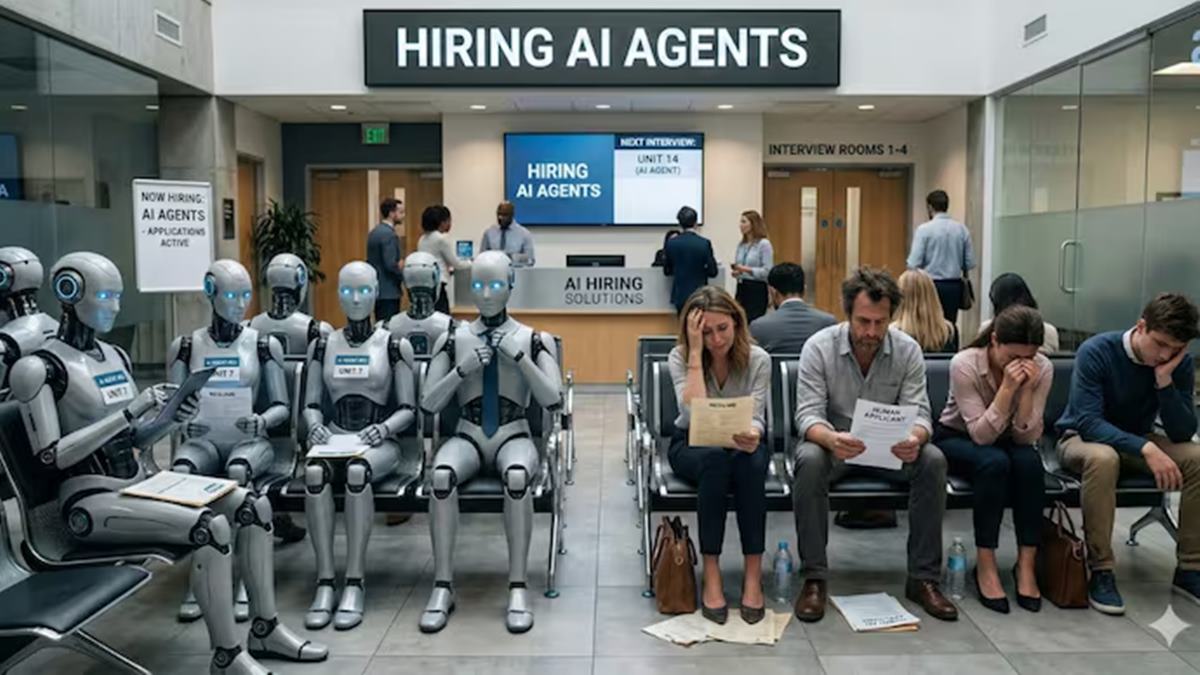
But when AI advances just as quickly without widespread workforce readiness, the picture flips. Technology outpaces people’s ability to adapt. Automation becomes a substitute for capability rather than a complement to it. Workers are displaced at scale, not because AI is inherently destructive, but because organizations move faster than their skills, learning, and talent systems can absorb. Displacement becomes systemic rather than transitional.
The same pattern holds when AI progresses more gradually.
If AI advances at an incremental pace and organizations succeed in bringing people along at the same speed, we land in the future that feels most familiar. AI is absorbed as an augmentation tool rather than a replacement force. Human–AI teams become the norm. Productivity improves steadily. AI is experienced as an opportunity, and value chains and business models are reshaped without breaking.
But if AI spreads incrementally while workforce readiness still lags, the result is not stability. It is stagnation. Adoption becomes uneven. Productivity gains remain patchy. AI-enabled prosperity never fully materializes. What was meant to be a transformation turns into frustration, as structural constraints limit growth, organizational resilience, and societal progress.
Why Workforce Readiness Determines the Future of Jobs
Seen this way, the scenarios diverge less on technology and more on whether leaders treat AI as a replacement engine for labor or as a redesign moment for human contribution. AI delivers real productivity gains in every scenario. Yet only some futures translate that productivity into shared value, trust, and long term resilience.
When organizations use AI to speed up the same work, they create pressure to do more of what already mattered less. When they use AI to strip away low-value activity, they create space for humans to do what only humans can do: judgement, context, creativity and accountability.
Four Leadership Choices Shaping the Future of Jobs in the Age of AI
Same AI. Same labor market. Radically different outcomes depending on leadership choices being made now, often without realizing it. This is why the report is less a map of 2030 and more a mirror for 2026. It forces leaders to confront an uncomfortable truth: AI will move faster than our institutions by default. Whether it moves faster than our people is still a choice.
That choice shows up in how leaders answer four questions today.
1. Do leaders redesign tasks, or just automate headcount?
In displacement scenarios, AI absorbs tasks because jobs were never redesigned. In the co-pilot economy, leaders deliberately separate what machines do well from what only humans can do.
2. Who owns judgement when AI scales?
In darker futures, decision-making migrates to systems. In healthier ones, humans remain accountable for context, trade-offs, and consequences.
3. Is learning embedded in work or outsourced to training?
Workforce readiness lags when learning remains detached from real work. Organizations that embed AI learning into daily workflows move toward augmentation rather than displacement.
4. Are careers defined by static roles or by evolving contribution?
Where jobs collapse, people are often locked into rigid roles. Where mobility thrives, work is modular, and people move across tasks, projects, and problem spaces.
By 2030, companies will not wake up to find themselves surprised by the future of jobs. They will arrive there gradually, through thousands of small choices made in 2025 and 2026. Leaders who say they were overtaken by AI were, in reality, overtaken by decisions they did not realize they were making. They automated before redesigning. They scaled tools before redefining judgement. They invested in technology faster than they invested in human capability. They treated learning as an HR problem rather than a work problem.
The work futures described in the report are still open. The path organizations take depends less on what AI can do next, and more on whether leaders are willing to rethink what work is for.