




















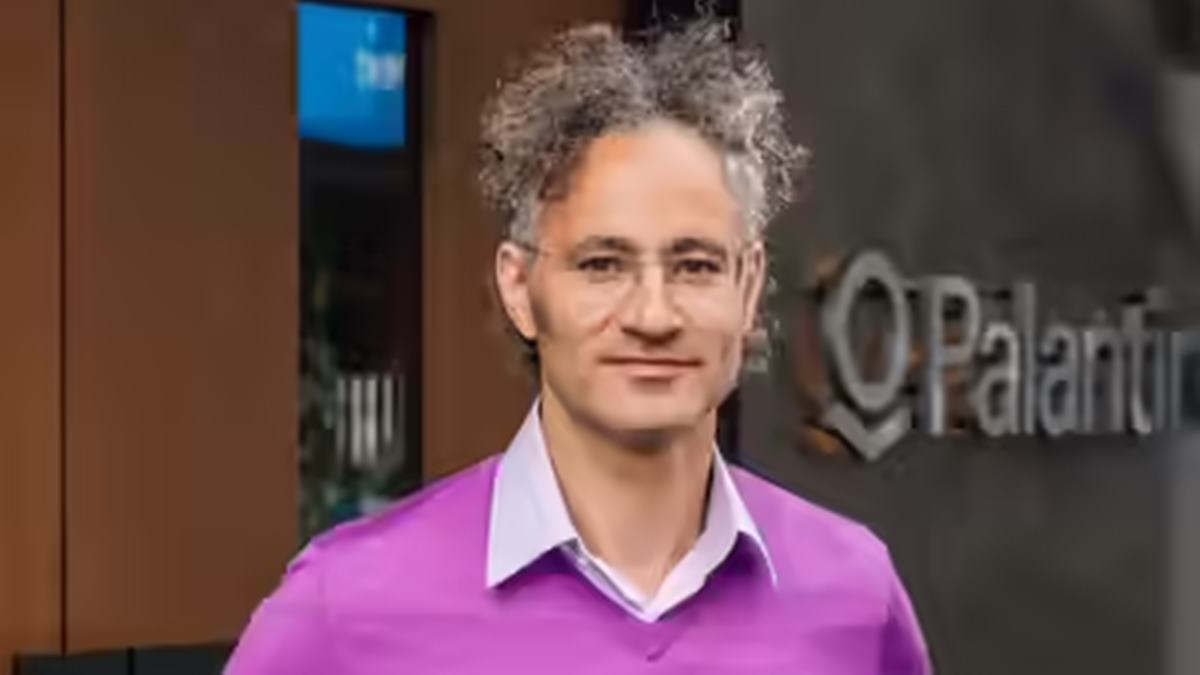
Every technological shift gives birth to two competing forecasts. One predicts new forms of creativity and expanded opportunity. The other warns that certain skills will lose economic value. In the debate over artificial intelligence, Palantir CEO Alex Karp has placed himself firmly in the second camp, at least when it comes to the humanities.
“It will destroy humanities jobs”
Speaking at the World Economic Forum’s annual meeting in Davos, Switzerland, in conversation with BlackRock CEO Larry Fink, Karp offered a direct look into how AI will affect parts of the labour market.“It will destroy humanities jobs,” Karp said.He made the argument personal too. “You went to an elite school, and you studied philosophy, I’ll use myself as an example, hopefully, you have some other skill, that one is going to be hard to market,” he said at Davos.Karp’s own academic background is the path he now questions.He attended Haverford College, earned a Juris Doctor from Stanford Law School and completed a Doctor of Philosophy in philosophy from Goethe University in Germany. Recalling his early career uncertainty, he told Fink, “I’m not sure who’s going to give me my first job.”
Generalised knowledge vs specific aptitude
His concern is not only limited to philosophy degrees. In an interview with Axios in November, Karp put the issue in terms of generalised elite education.“If you are the kind of person that would’ve gone to Yale, classically high IQ, and you have generalized knowledge but it’s not specific, you’re effed,” he said.The critique rests on a view of aptitude that privileges specificity over breadth. At Davos, Karp argued for alternative ways of identifying talent. “I think we need different ways of testing aptitude,” he told Fink. He used the example of a former police officer who attended a junior college and now manages the United States Army’s Maven system, an AI tool built by Palantir that processes drone imagery and video, Fortune reports.“In the past, the way we tested for aptitude would not have fully exposed how irreplaceable that person’s talents are,” he said.
Rethinking merit and hiring
Karp has also connected this philosophy to hiring and training. During a second quarter earnings call last year, he said, “If you did not go to school, or you went to a school that’s not that great, or you went to Harvard or Princeton or Yale, once you come to Palantir, you’re a Palantirian, no one cares about the other stuff,” according to various media reports.He described his role inside the company in operational terms.
“What I do all day is figuring out what is someone’s outlier aptitude. Then I’m putting them on that thing and trying to get them to stay on that thing and not on the five other things they think they’re great at,” he said.The company has acted on this belief. Palantir launched a Meritocracy Fellowship offering high school students a paid internship with the possibility of a full-time role. In announcing the programme, the company criticised American universities for “indoctrinating” students and having “opaque” admissions that “displaced meritocracy and excellence.”
Vocational training as labour market insurance
Karp has also emphasised vocational routes. Referring to the future of work, he told Fink, “There will be more than enough jobs for the citizens of your nation, especially those with vocational training.”His comments come at a time when employers are witnessing a gap between applicant skills and market demand. Karp’s intervention does not dwell on whether humanities disciplines retain cultural value.
Instead, it narrows the question to market survival.In Karp’s formulation, AI does not merely compete with certain tasks. It shifts the labour market towards specialised, demonstrable aptitude. Degrees that signal broad intellectual training without clear technical application, he suggests, will struggle to justify their economic return.For students weighing philosophy seminars against technical certification, the warning is not abstract. If AI performs more cognitive heavy lifting, the premium, in Karp’s view, will attach not to general intelligence but to what he calls “outlier aptitude.”