

















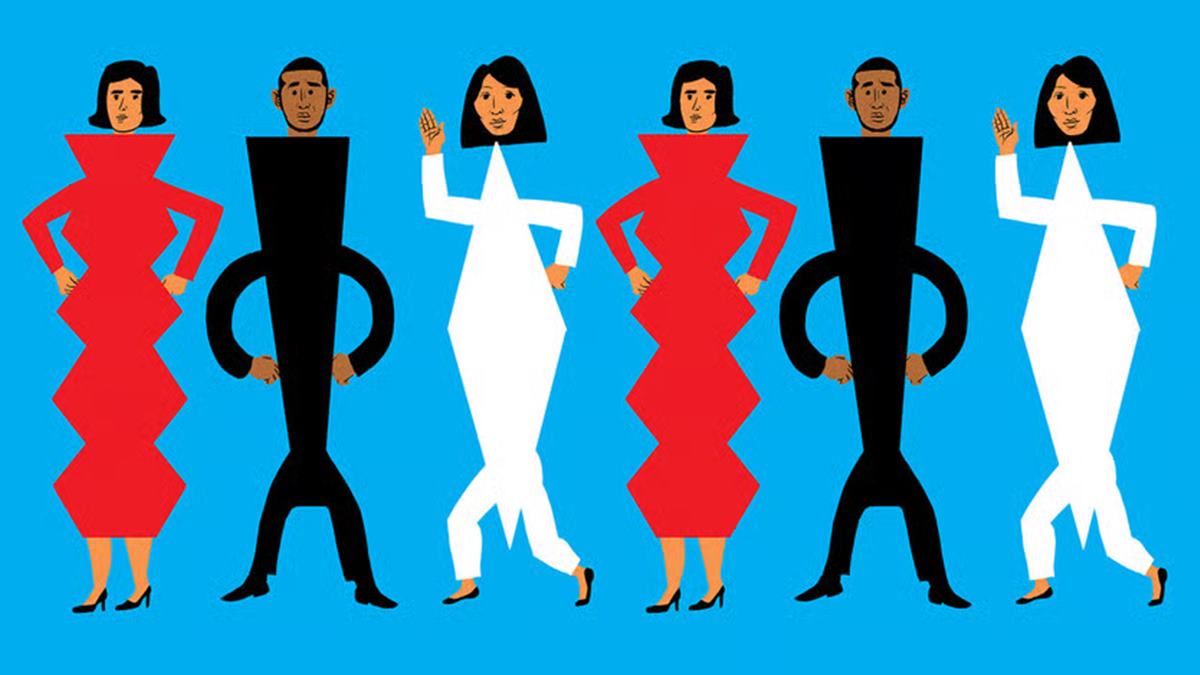
If you are interested in organisations and geometry, these are heady times. The classic shape of the company hierarchy is a pyramid: lots of people at the bottom, tapering to a single point at the top. But the possibility that firms will need many fewer people because of ai means that pyramids may become passé. Some reckon the organisation of the future will look like an obelisk, with a vaguely similar shape but fewer people at each level. If you believe that entrepreneurs will be able to create huge firms on their own, the shape of the future might end up being a dot.
But the one that captures the biggest near-term worry is the diamond. If entry-level and junior jobs are disproportionately affected by ai, white-collar organisations may end up narrower at the top and bottom and wider in the middle.
The data so far are inconclusive. A paper published late last year by Erik Brynjolfsson of Stanford University and colleagues found evidence of big drops in employment in America for 22- to 25-year-olds in software engineering and customer service. Another recent study, by Bouke Klein Teeselink of King’s College London, suggests that British firms which are more exposed to ai are more likely to reduce entry-level hiring.
But a new paper by Morgan Frank of the University of Pittsburgh and his co-authors cautions that graduate prospects in ai-exposed industries were worsening before the launch of Chatgpt in 2022. ai is not the only source of economic uncertainty; young workers always tend to get hit hard when older workers cling onto their current jobs.
There are, however, good first-principles reasons to be worried about ai’s impact on entry-level jobs (a topic we explore in the latest season of Boss Class, our podcast on work and management). Lots of junior staff spend their first years in the office inexpertly doing document-heavy grunt work in return for experience. Now there is a machine that can do document-heavy grunt work more efficiently and cheaply than humans—and that never asks awkward questions about your firm’s progress towards the Sustainable Development Goals.
If a junior employee is smart, they may well be using ai themselves to get the work done, so are they learning anything anyway? And if the diamond is the shape of the future, why not let someone else train early-career employees and lure them to your organisation a bit later?
In fact, managers have three very good reasons not to slash entry-level jobs. First, no one knows how ai is going to affect work over the longer term. Second, firms always run the risk of expensively trained workers leaving, but not having a pipeline of future talent can be even riskier.
Third, although attrition may seem like the least disruptive way to cut back on employees, it is not the best way to acquire an ai-literate workforce. Because entry-level employees have no experience of work, they lack ingrained habits. And although lots of young people regard ai with the sort of deep antipathy they normally reserve for their parents, they tend to use it more than older workers. According to Openai, 18- to 29-year-olds are more than twice as likely to use Chatgpt at work as those over 50.
“We think of our entry-level talent as a very interesting change lever,” says Hannah Calhoon, the head of ai at Indeed, a jobs marketplace. She encourages colleagues not to unthinkingly replace experienced leavers with equally seasoned candidates, but to at least consider the benefits of bringing in junior people with fresh perspectives.
In the optimistic case, entry-level jobs will actually get better. Trainee solicitors in Britain have traditionally spent a lot of time doing research, taking notes and drafting contracts, observes Samantha Hope of Shoosmiths, a law firm. But when ai starts doing much of the grunt work, trainees ought to be able to spend more time on higher-order things like talking to clients or negotiating. Shoosmiths is considering expanding the rotations that trainees undertake; a few months in its innovation or legal-technology teams might well be good preparation for bigger changes ahead.
Bosses are under pressure to turn ai adoption into profits. Many will be tempted to chop entry-level jobs in response. The better option would be to rethink what junior workers do.
Source – https://www.economist.com/business/2026/01/29/how-big-a-threat-is-ai-to-entry-level-jobs