
















For years, getting a college degree almost guaranteed a smoother start in the job market. College graduates usually had lower unemployment, found jobs faster, and earned more than those who stopped at high school. That gap gave higher education a clear value. But fresh data now suggests that this long-held advantage may not be as strong as it once was.
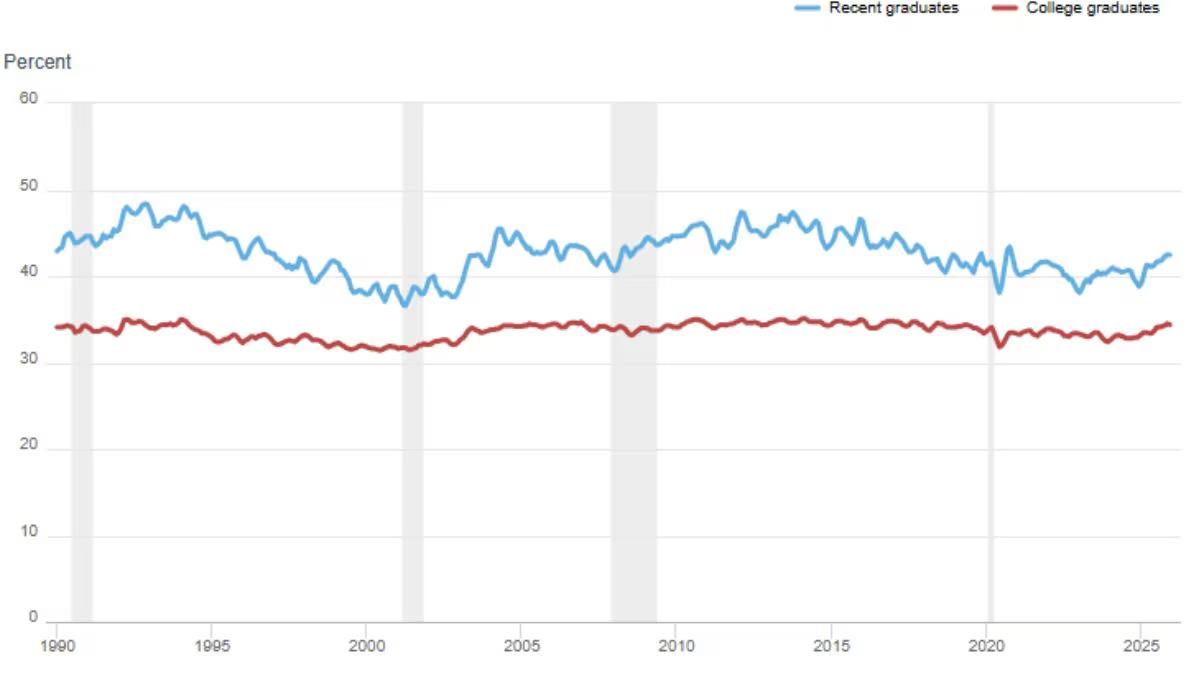
A recent analysis based on data from the US Census Bureau Current Population Survey (IPUMS), conducted by the US Department of Labor and titled Underemployment Rates for Recent College Graduates, shows that the underemployment rate for recent college graduates has climbed to 42.5%. This means nearly half of them are working in jobs that do not require a college degree. These levels were last seen at the height of the 2020 pandemic.
US college underemployment rate at crisis
According to The Kobeissi Letter, “The rate matches the levels seen during the 2008 Financial Crisis,” except this time, there is no global economic collapse to explain it away. Moreover, more than half of all new graduates, over 52.0%, enter the labour market underemployed. This suggests that someone with a Bachelor’s degree is working a job that only requires a high school diploma.
Ten years after graduating, 45.0% of those who started out underemployed are still in jobs that do not use their degree. For nearly half of them, the promised climb into the middle class never really begins. It is not just that the ladder is missing a few rungs. For many, the ladder simply is not there.
Not all degrees lead to the same outcome
The crisis does not affect every field equally. Some degrees are much more likely to lead to underemployment than others. Criminal Justice tops the list, with an underemployment rate of 67.2%. That means nearly seven out of ten graduates in this field are not working in jobs that require their degree. Performing Arts follows at 62.3%. Medical Technicians stand at 57.9%, Liberal Arts at 56.5%, and Anthropology at 55.9%.
College graduates are taking longer to find jobs
The underemployment numbers tell part of the story. But another trend shows why this pressure is building — young college graduates are also taking longer to find jobs in the first place.
An Economic Commentary from the Federal Reserve Bank of Cleveland looks at unemployment trends among young people aged 22 to 27. The authors, Alexander Cline and Barış Kaymak, say the unemployment gap between young high school graduates and young college graduates has narrowed to its lowest level since the late 1970s.
According to the data, before 2000, young college graduates exited unemployment faster than high school graduates. Between 1976 and 2000, college graduates had an average exit rate of 47 percent, compared with 41.2 percent for high school graduates. They also entered unemployment at much lower rates. But that pattern has changed.
In the 12 months ending June 2025, high school graduates were leaving unemployment at a rate of 41.5 percent. College graduates were exiting at just 37.1 percent. That marks nearly a 10 percentage point drop in the exit rate for college graduates compared with earlier decades.
Importantly, entry rates into unemployment have not changed much for either group. That means the narrowing gap is not because college graduates are losing jobs more often. It is because they are taking longer to find new ones.
More young people are earning college degrees than ever before. Larger graduating classes mean more competition for entry-level jobs. At the same time, technology trends may no longer favour college graduates in the same way they once did. There are also concerns about artificial intelligence affecting entry-level roles, especially in technology and professional fields.