














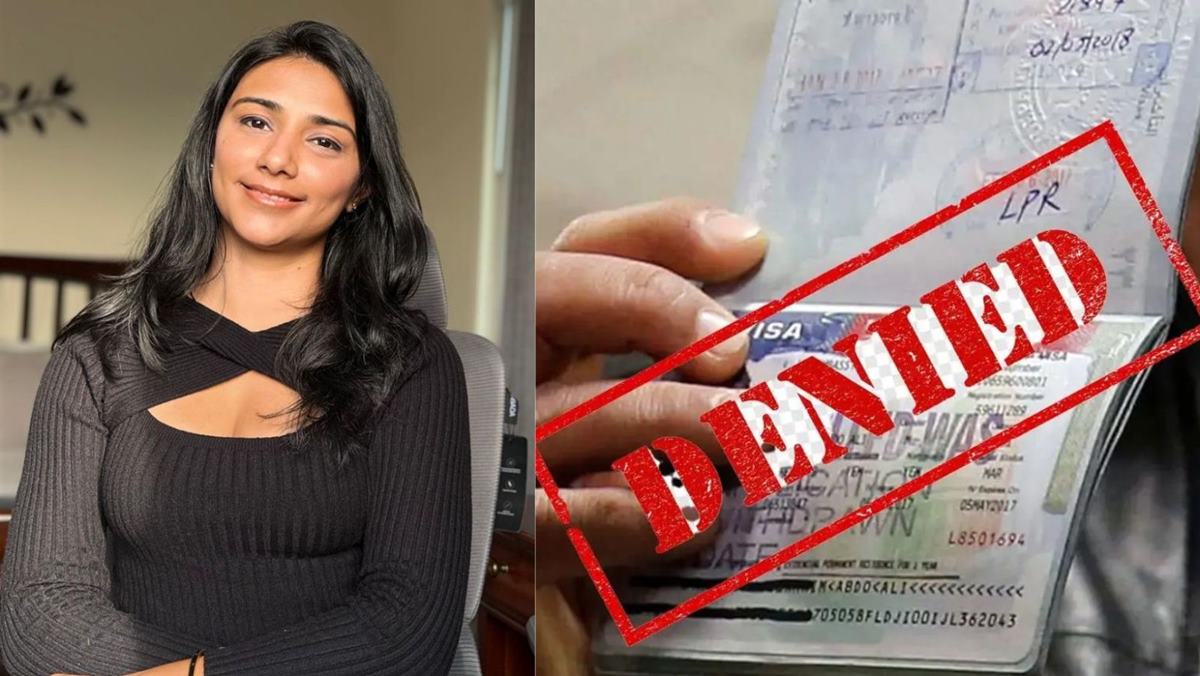
Many international students in the US used to follow a familiar script. They enrol in a degree, land an internship, secure a full-time job, and then wait for the H-1B lottery (which is now scrapped) to decide their future. Few pause to consider a different route, Saloni Thakkar did.
Like thousands of young immigrants, she arrived in the United States carrying ambition and anxiety. As she puts it, “Like many immigrants, I came to the United States with the American dream in my eyes and uncertainty in my suitcase.”
She completed her undergraduate degree at Vishwakarma Government Engineering College under Gujarat Technological University before moving to the US for a Master’s in Management Information Systems at Texas A&M University. She graduated in 2021, at a time when the pandemic had made the job market uncertain and uneven.
Saloni moved forward one step at a time. She interned at HP Inc. as a Data Scientist and later joined Barclays as a Data Engineer. By early 2023, she had reached a role she had been working towards since graduate school, Data Scientist within the Global Research team at Barclays’ Investment Banking division. Professionally, everything appeared to be in place. Immigration reality, however, told a different story.
In 2023, Saloni’s H-1B petition was rejected in the lottery for the second time. Until then, her path closely resembled that of many international students, study hard, build skills, secure a job, and hope luck plays along.
When luck did not, the questions became unavoidable. Was her future in the US going to depend entirely on chance?
The usual options after repeated lottery failures were clear. Enrol in another degree to gain more attempts, or move to another country through an internal transfer. Neither appealed to her. Another degree felt like a financial and time investment without real growth. Relocation meant rebuilding life yet again. She wanted a path that depended on work, not probability. That search led her to the O1A visa.
Considering the O-1A option
The O-1A visa, meant for individuals with extraordinary ability, initially felt intimidating. Saloni did not see it as a shortcut or a miracle solution. Instead, she began to understand it as a process that required proof of sustained professional impact.
She researched eligibility criteria, spoke to mentors, and identified gaps in her profile. At the same time, she began discussions with Barclays’ management and legal team. Employer sponsorship is mandatory for an O1A petition, and gaining that support was crucial.
Her timing was far from ideal. The tech and finance industries were witnessing layoffs, and sponsorship conversations were becoming more cautious. Some peers were told O1A sponsorship was reserved only for PhD holders. The pressure was real, but so was her resolve.
“To anyone considering this path, my advice is simple. Understand both the pros and cons. Start early. Seek the right guidance. Build consistently. Ensure you have contingency plans. Immigration journeys are rarely linear. Mine certainly was not. Sometimes setbacks push us to think differently, and that shift in thinking can change everything,” she explained
Building a case after office hours
For nearly a year, Saloni followed a demanding routine. After finishing her full-time job, she spent two to three hours every evening strengthening her O1A profile. She documented achievements, gathered evidence, worked on missing criteria, and sought expert guidance.
What once felt unrealistic slowly became structured and possible. The process did not become easier, but it became clearer. “I dedicated two to three additional hours to strengthening my O1A profile. I documented achievements, gathered evidence, pursued missing criteria, and sought the right guidance. What once felt unattainable slowly began to look achievable,” she said.
Then came 2024 and her final chance at the H-1B lottery. When her name was not selected again, the disappointment was familiar. This time, it passed quickly. She had prepared for this outcome.
By then, Saloni had management approval, legal alignment, and a strong evidence portfolio. She gave the go-ahead to file her O1A petition. The stakes were high. Her Employment Authorisation Document was set to expire in the first week of July.
As a backup, she had already secured admission to another degree program in case the petition failed. Multiple plans were in place.
In mid-June, just weeks before her deadline, the approval came through.
“That approval did more than secure my work status. It gave me control over my career decisions and my personal life. I was able to travel to India for visa stamping and for my wedding without the looming uncertainty that had defined previous years. For the first time, my future did not feel dependent on a lottery number,” she explained.
Saloni is clear that the O1A route is not for everyone. It demands planning, documentation, employer support, and an honest understanding of eligibility and timelines. It also requires backup plans. For her, the journey represented a shift in mindset from waiting for chance to building on merit.
Experts weigh in
Immigration attorney I spoke to confirmed Saloni’s views, O-1A isn’t for everyone.
Kevin J Andrews, Immigration Attorney tells me, “O-1A visa is for individuals with extraordinary ability in science, education, business, or athletics. There is no lottery and no annual cap. Although USCIS reports approval rates above 90% for the O-1A, those figures aggregate first-time petitions that have a higher denial rate with extensions and amendments which usually have a lower approval rate.
Even as it comes with high approval rates the initial O-1A petitions are likely lower.
He says, if one has the qualifications it’s still one of the strongest employment-based visa options available. “It is absolutely a viable path for professionals who cannot get through the H-1B lottery. In my experience, clients in this situation move forward with O-1A or back to F-1 depending on where they are in their careers”
Meanwhile, Attorney Gnanamookan Senthurjothi and Attorney Veena Vijay Ananth, founders of The Visa Code opined, “The rise of O-1A filings is not about bypassing the system, it is about using the system as it was intended: to retain extraordinary talent and keep the US globally competitive.”
They also added, “Over the last few years, O-1A visa filings have risen sharply, and this isn’t accidental. The surge shows growing frustration with H-1B lottery uncertainty, unexpected visa stamping delays, layoffs that disrupt employer-tied status, and long employment-based green card backlogs. For many accomplished professionals, the question has fundamentally shifted: if their work qualifies on merit, why should their future depend on chance? The O-1A is not about taking US jobs; it’s about creating a more competitive, merit-driven immigration system.”