
















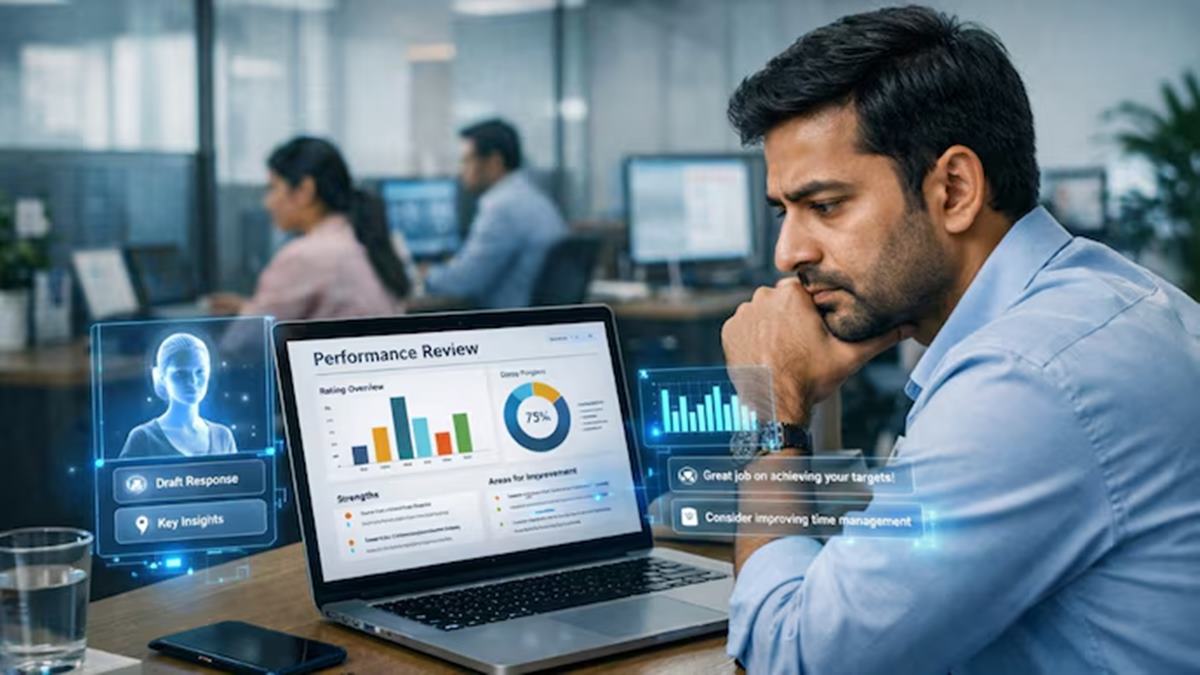
For many employees, the appraisal season is usually about one question: did I do enough? But in 2026, a new layer is entering that calculation: did I use AI well enough to get a good appraisal?
From writing emails to analysing data and building presentations, artificial intelligence has become a silent co-worker in offices across India. And increasingly, it is not just helping employees work faster, it is changing how companies evaluate them.
A growing body of evidence shows this shift is already underway. According to the EY Work Reimagined Survey 2025, 86% of employees in India say generative AI has improved productivity, while 75% believe it enhances decision-making at work. Nearly 62% already use AI tools regularly in their jobs.
In other words, AI is no longer experimental, it is embedded in daily work routines.
And with this, many worry about how much the use of AI is enough, and if it’s now an official co-worker, will it impact the appraisals?
APPRAISALS ARE SHIFTING, QUIETLY BUT CLEARLY
So, is AI already affecting your appraisal?
Shantanu Rooj, Founder and CEO of TeamLease Edtech, says early signals are visible, even if companies have not fully formalised it yet.
“Today’s employers understand very seriously that AI is going to have a huge impact on productivity and business models,” he explains.
According to him, organisations are already beginning to reward employees who use AI tools effectively, not through separate “AI marks”, but through output and efficiency.
“If I am hiring a developer, I need to know whether they can write code using AI tools. If I am hiring a designer, I want to know whether they can design using AI tools,” he says.
The message is subtle but powerful: performance is no longer just about effort, but about enhanced effort powered by AI.
FROM EFFORT TO OUTPUT: THE BIG SHIFT
Traditionally, appraisals were built around effort: hours worked, tasks completed, responsibilities handled. But AI is changing that equation.
Now, companies are increasingly measuring:
- How effectively AI is being used
- Quality of output and decision-making
- Speed of execution
- Ability to refine AI-generated results
- Integration of AI into daily workflows
As Rooj puts it, “AI is not doing the work on its own. It is a tool. Humans still guide it, prompt it, and refine it.”
This shift is crucial. AI is not replacing contribution, it is redefining what contribution means.
Employees are no longer evaluated just on what they produced, but on how intelligently they produced it.
THE NEW CAREER PREMIUM: AI FLUENCY
One clear trend emerging is that AI-skilled employees are already seeing better outcomes in performance cycles.
Rooj is direct about it: “People who understand and use AI will definitely be seen as more productive. Productivity will drive promotions and increments.”
This aligns with broader workplace trends. EY’s survey shows companies are increasingly prioritising AI skill development, with employers linking productivity gains directly to AI adoption.
In simple terms: faster workers who use AI effectively stand out.
And that gap is only expected to widen.
SALARY TALKS ARE ALSO CHANGING
The impact does not stop at appraisals. It is also entering salary negotiations.
According to Rooj, employees with AI capabilities are now able to “signal higher productivity, speed and accuracy”, which allows them to command a premium.
“Those who can use automation and AI to their advantage will command better pay than those who cannot,” he says.
This is leading to two emerging trends:
- Skill premium: AI-fluent employees getting higher offers
- Experience compression: younger professionals negotiating stronger roles based on capability rather than years
The result is a workplace where skill matters more than tenure.
THE REAL QUESTION: HOW DO YOU MEASURE HUMAN WORK NOW?
One of the biggest challenges for companies is not adoption, but measurement.
If AI is helping everyone work faster, how do you fairly evaluate individual effort?
The answer, according to experts, is a shift in thinking:
It is no longer just about what you did, but:
- Your judgment
- Your interpretation of AI outputs
- Your ability to apply results meaningfully
- Your accountability in decision-making
AI raises productivity, but it also raises expectations.
FRESHERS AT THE FRONT LINE OF CHANGE
For freshers, this shift is even sharper.
Early-career professionals are now expected to ramp up faster, adapt quickly to AI tools, and deliver outcomes with minimal supervision.
In many ways, the first job is no longer about learning slowly, it is about learning fast and with AI assistance from day one.
THE AI APPRAISAL ERA HAS ALREADY STARTED
The biggest misconception is that this change is coming in the future.
It is not.
With nearly 90% of Indian professionals saying AI improves productivity, and companies actively rewarding efficiency gains, AI is already influencing how people are evaluated, promoted and paid.
The appraisal discussion is no longer just about performance.
It is about AI-augmented performance.
And as workplaces evolve, one thing is becoming clear: employees are no longer competing only with each other.
They are also competing with how well they work with their new co-worker: AI.