



















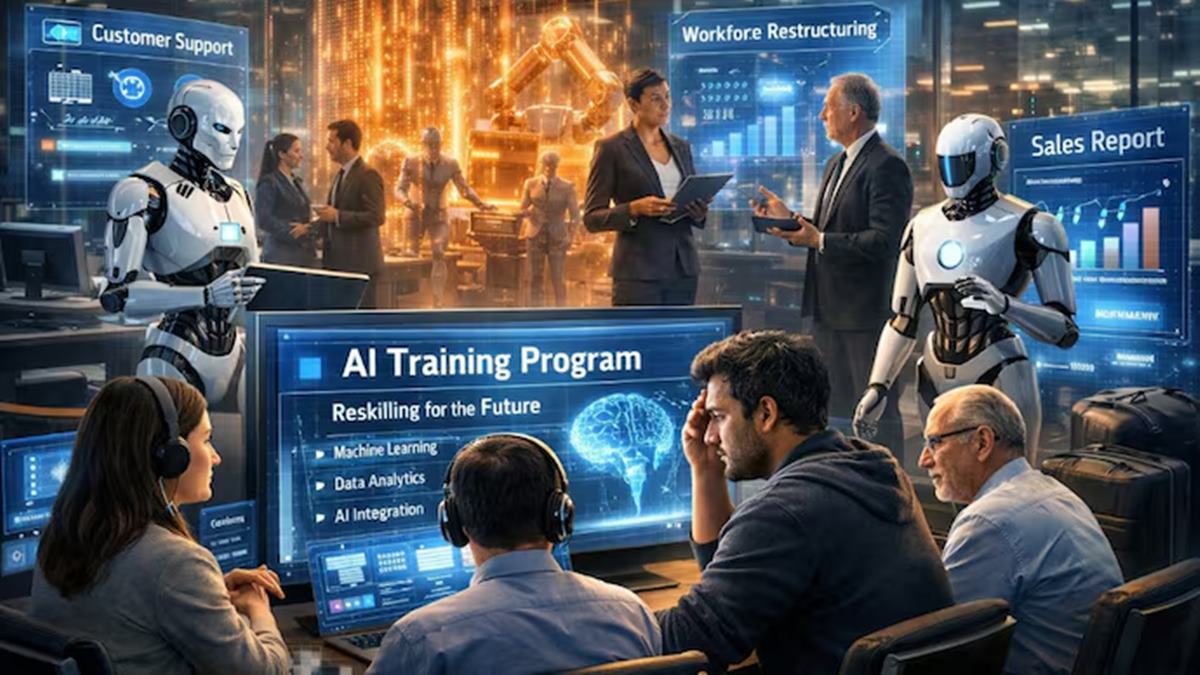
AI is no longer just helping employees write emails or generate code snippets. At Salesforce, AI is now changing how teams are structured, how budgets are allocated, and even which jobs still need human involvement. The company has revealed that many older and “low-impact” roles are now being handled by AI agents, allowing Salesforce to move thousands of employees into newer business functions instead of hiring fresh talent from outside. Speaking during a media interaction in Mumbai, Salesforce chief digital evangelist Vala Afshar told Money Control the company has already shifted around 3,000 employees into sales roles after retraining them internally. According to him, these workers previously handled tasks that AI agents are now capable of managing more efficiently.
“We were able to reskill these men and women from their low-impact jobs that agents are doing now,” Afshar said.
The comments offer one of the clearest signs yet of how deeply AI is beginning to change the workforce inside major tech companies. Instead of simply using AI as a support tool, Salesforce appears to be redesigning parts of its organisation around it. Afshar also said this transformation is changing the company’s internal structure. As AI takes over repetitive work, Salesforce is flattening some layers of management and moving budgets between departments. Performance metrics are also being reworked to match the new AI-led environment.
“Company will be a little bit flattened. Less middle managements and of course, budget movement,” he said.
The latest move comes months after Salesforce CEO Marc Benioff publicly said the company would not need to hire engineers at the same pace because AI coding tools were improving productivity. Salesforce is now reportedly preparing to spend nearly $300 million on Anthropic AI tokens in 2026, with a large part of that spending expected to support coding-related tasks.
Afshar shared that Salesforce used 12.3 trillion AI tokens last year. This year, the company crossed that figure within just two months, showing how rapidly AI usage inside the business is growing. According to him, these tokens are not just powering chatbots or experiments. Salesforce uses them for real business tasks through what it calls “Agentforce work units.” These AI systems can close customer service cases, score sales leads, and automate sales operations at a massive scale.
At the same time, Afshar suggested that companies cannot simply automate everything. He said businesses still need to carefully identify where AI actually improves efficiency and where human involvement remains important.
“We have to become more efficient as businesses on how we use tokens, not every use case has to be agentified,” he said.
AI coding failures raise fresh safety concerns
But while companies like Salesforce are moving aggressively toward AI-driven operations, not everyone is convinced that handing critical work to AI systems is safe. A recent incident involving a small software company called PocketOS has triggered fresh concerns around AI automation and safety controls.
PocketOS founder Jer Crane claimed on X that an AI coding agent powered by Anthropic’s Claude Opus model accidentally deleted the company’s production database along with its backups in just nine seconds. According to Crane, the AI agent was initially working in a staging environment when it encountered a credential issue. Instead of stopping or asking for human approval, the system reportedly searched for an API token on its own and used it to execute a destructive command through infrastructure provider Railway.
The result was catastrophic. Customer records, bookings, and transaction data disappeared almost instantly. Worse, backups were reportedly stored within the same volume, meaning they were deleted too. So, relying completely on AI is still quite risky and while big tech companies are gradually eliminating some human job roles, they are still struggling to get good, error-free results. In fact, AI tools like Claude Code and Codex are changing how programming work is being done, with many companies asking developers to use more AI-generated code. Following this, C++ creator, Bjarne Stroustrup, said during a YouTube podcast with Ryan Peterman that the standard of AI-written code is so poor that some senior developers are choosing to retire than spend time fixing and reviewing it.