







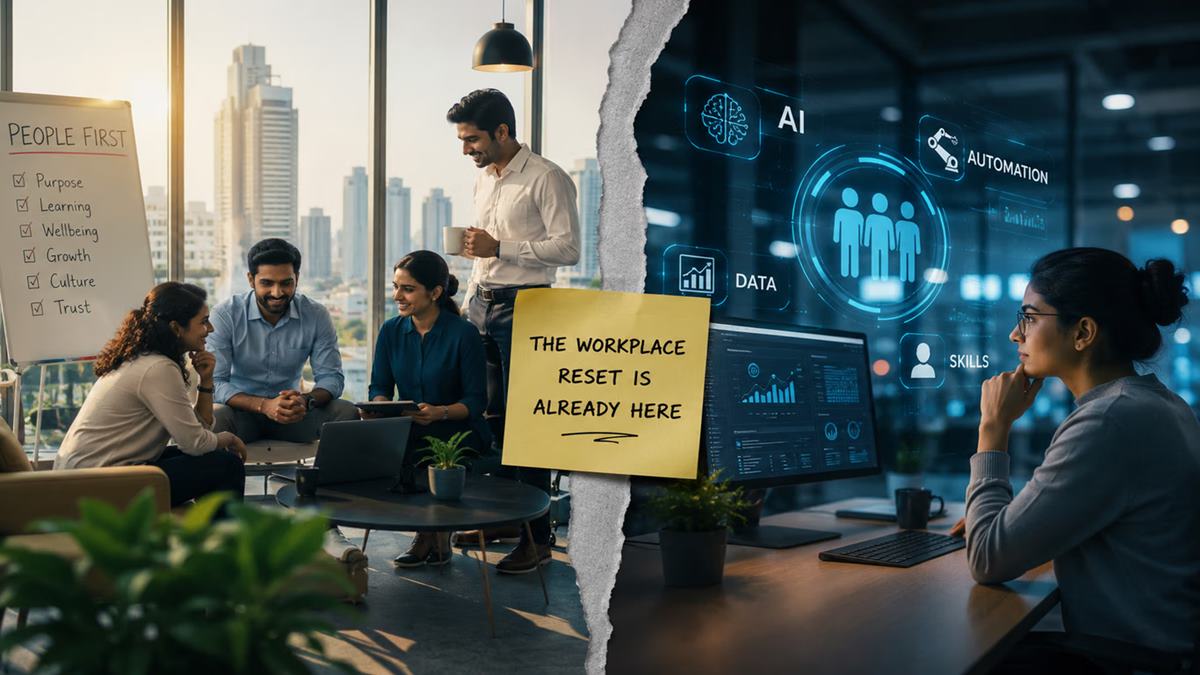










Microsoft AI CEO Mustafa Suleyman warns white-collar jobs in law, accounting, marketing, and project management face full automation within 12-18 months as AI hits human-level performance.
The 12-18 Month Warning That Is Shaking The Corporate World
Microsoft AI CEO Mustafa Suleyman has issued one of the most direct and time-bound predictions in the history of artificial intelligence: white-collar jobs, specifically those performed sitting at a computer, will be fully automated by AI within the next 12 to 18 months. Speaking to the Financial Times in early 2026, Suleyman stated with conviction that AI systems will achieve human-level performance on most, if not all, professional tasks within that window. The prediction is not speculative — it is grounded in the accelerating pace of AI model development, rising computing power, and the rapid deployment of agentic AI systems already being tested inside major corporations. For millions of knowledge workers globally, the clock is now ticking.
Lawyers, Accountants, Marketers — The Professions Suleyman Named
Suleyman was precise about which roles face the most immediate threat. In his own words: ‘White collar work where you’re sitting down at a computer, either being a lawyer or an accountant or a project manager or a marketing person — most of those tasks will be fully automated by an AI within the next 12 to 18 months.’ These four professions — legal, accounting, project management, and marketing — represent tens of millions of jobs globally. They share a common thread: the bulk of their work involves processing information, drafting documents, managing data, and making rule-based decisions — exactly the tasks that modern large language models and AI agents are now demonstrably capable of performing at a professional standard.
‘Sitting Down At A Computer’ — The Criterion That Defines Vulnerability
Suleyman’s formulation is deceptively simple but analytically sharp. The phrase ‘sitting down at a computer’ defines the category of work most exposed to AI displacement: tasks that are fundamentally digital, document-centric, and knowledge-based. Work that does not fit this profile — physical trades, hands-on healthcare, field operations — is not within the same immediate risk window. But for the vast majority of office-based professionals, their entire workflow exists inside software applications, email systems, spreadsheets, and legal or financial databases. These are precisely the environments where AI agents can now operate autonomously, executing multi-step tasks, interpreting complex documents, and producing outputs that match or exceed human professional quality.
AI Agents — The Technology That Makes Suleyman’s Timeline Plausible
The mechanism behind Suleyman’s prediction is the rise of AI agents — autonomous systems that do not merely answer questions but execute sustained, multi-step workflows without human intervention. Unlike earlier AI tools that required a human to prompt and interpret each step, modern AI agents can be assigned an objective, access relevant databases and documents, make decisions, and deliver completed work products. Microsoft itself has deployed Copilot agents across its enterprise software suite, enabling automation of tasks in Word, Excel, Outlook, and Teams that previously required dedicated human professionals. As these agents grow more capable and are trained on industry-specific data, the gap between human and AI performance in white-collar roles narrows rapidly.
Human-Level AI Performance — Already Demonstrated, Rapidly Expanding
Suleyman’s claim of ‘human-level performance on most, if not all, professional tasks’ is supported by a growing body of evidence. AI systems have passed bar exams in the top percentile, outperformed junior analysts on financial modelling tasks, produced marketing copy rated superior by blind evaluators, and automated entire accounting workflows in pilot deployments. In 2025 and early 2026, multiple Fortune 500 companies reported reducing headcount in entry-level legal, financial analysis, and content roles after deploying AI systems. While senior judgment and client relationship management remain human-dominated for now, the entry and mid-level pipeline of professional work — which sustains the entire career ladder — is already being absorbed by AI at pace.
Microsoft’s Own Frontier AI Push Underpins The Confidence
Suleyman’s prediction is not made from a neutral vantage point — Microsoft is one of the primary architects of the disruption he describes. Microsoft has committed to developing its own foundation models ‘at the absolute frontier,’ a direct acknowledgement that the company intends to build AI systems that define the ceiling of capability rather than merely consume what others produce. Microsoft’s multi-billion dollar partnership with OpenAI, combined with its own internal AI research division under Suleyman’s leadership, gives it unparalleled visibility into how rapidly AI capabilities are advancing. When the CEO of Microsoft AI sets a 12-18 month timeline, it reflects insider knowledge of the development roadmap, not external speculation.
What Workers, Companies And Governments Must Do Before The Clock Runs Out
Suleyman’s timeline, whether literally accurate or indicative of a broader trend, carries an urgent message for three constituencies. Workers in affected professions must move urgently to develop skills in AI oversight, system design, client strategy, and creative problem-solving — capabilities that remain beyond current AI reach. Companies must plan workforce transitions responsibly, avoiding abrupt displacement that triggers social instability and regulatory backlash. Governments must accelerate policy development around AI-driven unemployment, retraining programmes, and income support mechanisms before automation outpaces social infrastructure. The window between prediction and reality may be shorter than most institutions are prepared for. Suleyman’s warning is not a distant forecast — it is an operational timeline.