














Artificial intelligence (AI) is rapidly reshaping human life. With Big Tech companies investing billions into AI research, and AI startups such as OpenAI and Anthropic introducing increasingly powerful AI capabilities, concerns over mass job displacement and security risks are growing. As a result, the world remains divided over the unchecked and unprecedented pace of AI development, as well as the responsible use and deployment of the technology.
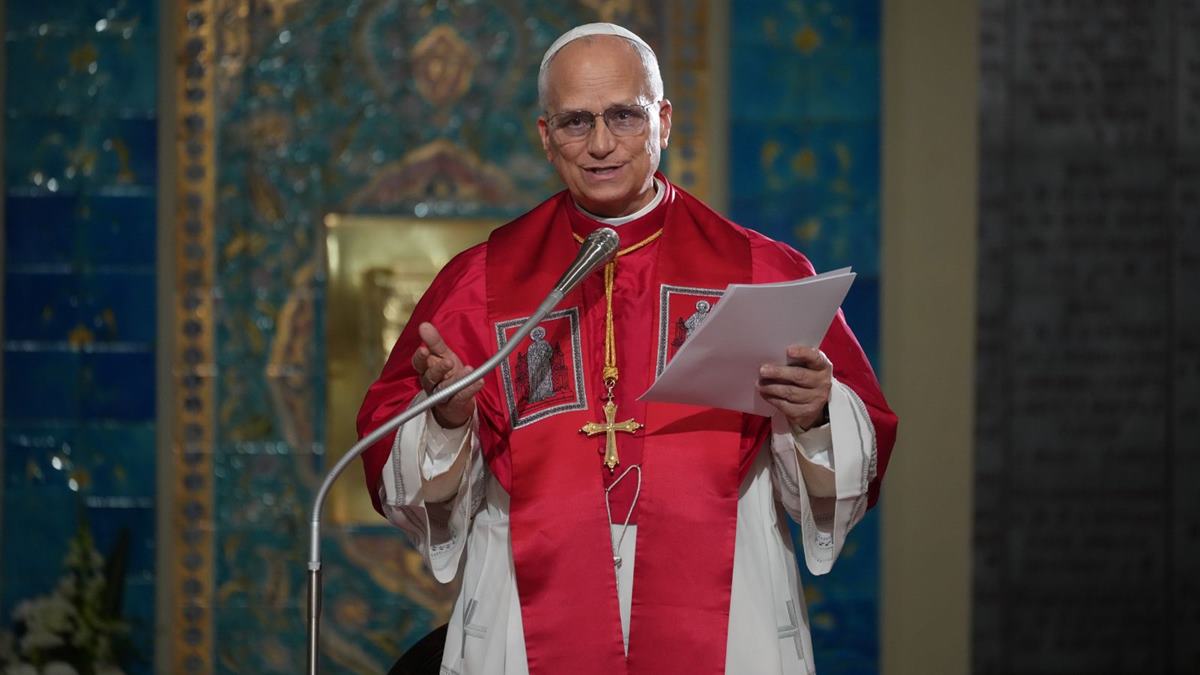
Joining the growing chorus of voices raising concerns about AI’s rapid growth and potential misuse, Pope Leo XIV on Monday, May 25, said AI must be “disarmed” so that it does not dominate human beings. In his first major encyclical (an official papal letter) since his election, titled Magnifica Humanitas, the Bishop of Rome underscored the ethical risks posed by AI and the responsibility of both its creators and those in positions of power. He further shared his views on the same at an event in Vatican.
An encyclical is the highest-authority official document that the Pope uses to address Catholics worldwide. Among other papal documents, encyclicals carry the strongest binding force. The document titled ‘Magnifica Humanitas: On Safeguarding the Human Person in the Time of Artificial Intelligence’ begins by outlining the moral and social challenges posed by AI.
What does the Pope’s encyclical say about AI?
In the section ‘The Grandeur of Humanity in Light of the Promise of AI,’ the Pope has deemed AI among challenges that ‘profoundly shape our way of living today.’ With technology rapidly transforming languages, relationships, institutions, and forms of power, the Pope bats for choice. He says that people must be able and should choose projects that safeguard and value the grandeur of humanity. “This is a choice not only for our future but also for our present, since artificial intelligence and other emerging technologies are already part of our daily lives.”
While refraining from offering a comprehensive view of AI, the pontiff recalled a few elements for a moral and social discernment that safeguards the primacy of the human person. This is to ensure that it will always be human intelligence, with its conscience and freedom, that guides technical innovations and responsibly determines their use and limits.
The Pope also cautioned about equating AI with human intelligence. “We must avoid the misconception of equating this type of “intelligence” with that of human beings. These systems merely imitate certain functions of human intelligence. In doing so, they often surpass human intelligence in speed and computational capacity, offering tangible benefits across many fields.” However, this power remains heavily dependent on data processing.
The Pope wrote that AI does not possess a body, does not feel joy or pain, and does not mature through relationships. Most importantly, it intrinsically does not know what love, work, friendship, and responsibility mean. They do not possess a moral conscience.
Beneficial yet needs vigilance
Even though the Pope assumes a critical view of AI, he also acknowledges it as a valuable tool that requires vigilance. “In light of what has been said, we can better understand why AI can be a valuable tool and, at the same time, why it calls for a measured and vigilant approach.” The Roman Pontiff said that, today, AI has become embedded in decision-making processes across many sectors at multiple levels—in communication, management, and control.
However, he cautioned that despite the efficiency gains, ‘rapidly and uncritically adopting’ them exposes the world to a range of risks, including the tendency to overlook the environmental impact. At present, AI systems require enormous amounts of energy and water, significantly influencing the carbon dioxide emissions, and place heavy strain on natural resources. With large language models becoming more complex, the need for computing power and storage capacity too is growing by leaps and bounds. Resultingly, there is a greater need for energy-intensive infrastructure. Owing to this reason, the Pope is calling for more sustainable technological solutions.
When it comes to governance, the document argues that AI is not morally neutral, and this can lead to it reinforcing exclusion, bias, and inequality. The Pope asserted that since AI systems reflect the values and assumptions of their creators, accountability, transparency, and ethical oversight are key.
On warfare, the Pope said that lethal decisions should never be delegated to AI and that ‘no algorithm can make war morally acceptable.’ Based on the encyclical, it is clear that the holy father views AI as the industrial revolution of our time. “…the development and use of AI in warfare must be subject to the most rigorous ethical constraints, to guarantee respect for human dignity and the sanctity of life and to avoid a race to develop such arms.”
At the recent Vatican event where he shared his views on AI, the Pope was seen thanking Anthropic co-founder Christoph Olah, indicating a future collaboration between the church and the Frontier AI lab. Pope Leo said that the Church and the AI lab would work together to find a way for humanity in this time of AI. With Anthropic, the Pope has chosen a partner who has been among the most vocal proponents of AI safety and an advocate of no unrestricted AI use by the military.
Further, the Supreme Pontiff seeks strong legal frameworks, public participation, and political responsibility for responsible AI governance. The Pope also warns against the monopolistic control of data, and computational power. He urged that technology should serve common good and not commerical and geopolitcial dominance. The Pope also appealed to AI developers to design systems with human dignity, justice, and solidarity in mind.