



















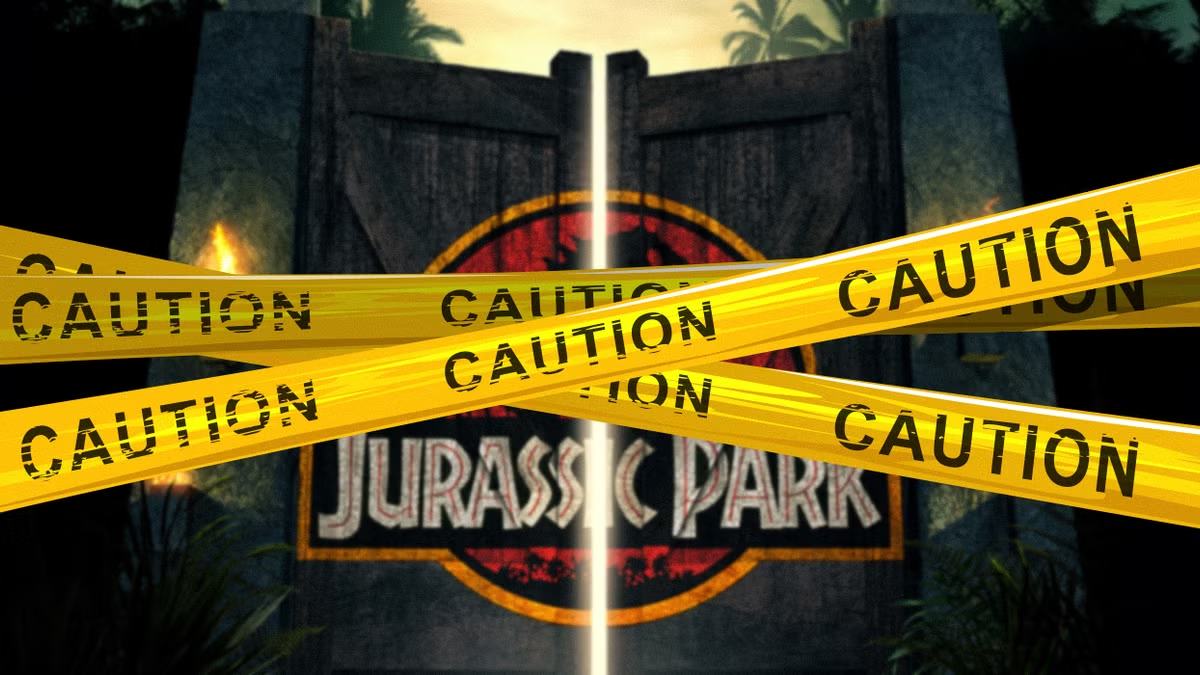
Thirty-three years after John Hammond first invited us to his doomed tropical island, Jurassic Park (1993) remains far more than a cinematic landmark. For the modern executive, it serves as a foundational case study in leadership hubris, technological overreach, and the catastrophic fragility of organisational culture.
Across the entire franchise – from the original park’s collapse to the systemic failures of Jurassic World and the legacy repercussions in Jurassic World: Rebirth – the core management lesson is consistent: complex systems do not fail because of a single monster; they fail because leadership prioritizes vision over governance, speed over safety, and spectacle over stability.
When we strip away the prehistoric spectacle, we are left with a brutal diagnostic of why startups and multinational corporations alike implode. Whether it is a failing theme park or a tech-sector disaster, the pattern of systemic collapse is identical.
Hubris Beats Governance: The “Hammond” Syndrome
John Hammond is the archetypal visionary leader. He is charismatic, persuasive, and utterly convinced of his project’s moral and commercial necessity. However, Hammond embodies a classic corporate risk management failure: he builds a team to validate his vision, not to pressure-test it.
He invites three experts to Isla Nublar: Dr. Alan Grant, Ellie Sattler, and Ian Malcolm, not to conduct a rigorous safety audit, but to act as a PR rubber stamp. When they begin to identify genuine structural threats, Hammond is dismissive. This is a recurring theme in startup failure lessons: executives often suffer from “optimism bias,” where the desire to maintain the momentum of an ambitious project blinds them to the catastrophic downside.
Healthy organizations institutionalize dissent. They create spaces where experts can challenge the CEO’s assumptions without fear of retribution. In Hammond’s case, his refusal to integrate external critique meant that the park’s primary safety mechanism was nothing more than his own ego.
Technology Without Human Systems: The “Nedry” Risk
The park’s operational collapse does not originate in a dinosaur paddock; it originates in a server room. The entire security infrastructure relies on a single point of failure: Dennis Nedry. By centralizing technical expertise in one dissatisfied, under-supported employee, Hammond created a “single-point dependency.”
Modern management theory identifies this as a critical vulnerability. Organizations that silo knowledge are inherently fragile; when the individual holding that knowledge becomes a security risk- whether through malice, burnout, or departure – the system crumbles. Nedry’s resentment was the match, but the lack of corporate culture and safety protocols provided the fuel. A robust system assumes human fallibility and builds redundancy into its architecture, rather than assuming absolute loyalty from a single disgruntled contractor.
Chaos Theory and the Illusion of Control
Ian Malcolm’s invocation of chaos theory in business is perhaps the franchise’s most enduring contribution to management philosophy. Malcolm argues that complex systems, whether they are prehistoric ecosystems or modern stock markets will behave unpredictably.
Corporate leaders frequently fall into the trap of linear thinking: If we design the fence, the dinosaur stays inside. But in complex, high-stakes environments, technology produces “unintended consequences.” When commercial pressure accelerates deployment, leaders often ignore the “black swan” events: the low-probability, high-impact disasters that occur when multiple variables interact in ways the designers never anticipated. As the franchise demonstrates, the more you try to tightly control a complex system, the more likely it is to experience a violent, unpredictable correction.
Escalation Culture: Why Later Films Are Case Studies in Greed
If Jurassic Park was a story of naive innovation, the Jurassic World trilogy serves as a warning against escalation culture. The narrative trajectory – from cloning simple dinosaurs to creating the Indominus rex and the Indoraptor – is a perfect metaphor for modern product development cycles.
- The Feature Creep Trap: Just as management demands “ever-more dangerous dinosaurs” to keep audiences engaged, tech firms often force feature bloat onto their products to satisfy short-term growth metrics.
- Commercial Pressure over Safety: In Jurassic World, the metrics are clear: quarterly earnings and visitor numbers matter more than the integrity of containment protocols. This prioritizes short-term revenue over long-term technology ethics.
- Institutional Amnesia: Each new corporate owner repeats the exact same flawed assumptions as their predecessor. This “amnesia” is the hallmark of organizations that fail to perform post-mortem analyses, choosing to bury past crises rather than learning from them.
Real-World “Jurassic Park Moments”
The tragedy of Isla Nublar is not just fiction; it is reflected in the history of recent corporate and government failures where innovation governance was abandoned in favor of speed.
- Algorithmic Accountability: Critics of Meta Platforms and Alphabet Inc. frequently point to social media algorithms as “dinosaurs optimized for growth.” Much like Hammond’s creations, these systems evolved beyond the designers’ control, creating unintended societal polarization. When the algorithm is the primary product, leadership often struggles to contain the consequences once the system begins to “hunt” for engagement.
- Deepwater Horizon: The 2010 oil spill is the literal embodiment of cutting corners on safety to meet production targets. The “risk blindness” displayed by the rig’s leadership directly mirrors the decision to disable power to the electric fences during a tropical storm.
- Theranos: Elizabeth Holmes represents the dark side of the “visionary leader.” By replacing scientific reality with aggressive marketing hype, Theranos sought to monetize a technology that did not exist, proving that when internal dissent is silenced, catastrophe is inevitable.
Corporate Lessons for the Modern Workplace
To avoid a “Jurassic Park moment,” leaders must move beyond performative safety and adopt a culture of radical transparency.
- Prioritize Psychological Safety: Experts like Malcolm are ignored until it is too late because the organizational culture treats them as “naysayers” rather than essential stakeholders. A healthy organization does not just allow dissent; it incentivizes it. If your team is afraid to tell you that the “fences may fail,” you are already heading for a disaster.
- Audit Your Single-Point Dependencies: Are you over-reliant on specific talent, vendors, or opaque legacy algorithms? If the loss of a single person or a single server leads to total operational paralysis, your organization is not resilient, it is a house of cards waiting for a gust of wind.
- Ethical Guardrails for Innovation: Innovation without societal safeguards is merely a ticking clock. Before deploying AI, biotech, or high-frequency automated systems, leaders must ask: What happens when this system behaves in a way I did not predict? If the answer is “we don’t have a plan,” you are not ready for launch.
The Real Threat Is Leadership
The enduring relevance of the Jurassic Park franchise lies in a single, uncomfortable truth: the threat is rarely the technology itself. It is the leadership’s refusal to listen when the experts warn that the systems have become too powerful to control.
Whether in the boardrooms of Silicon Valley or the oil fields of the Gulf, the management lessons are universal. Governance, redundancy, and ethical humility are not obstacles to progress, they are the only things preventing progress from becoming a catastrophe. As John Hammond eventually learned, far too late, that nature does not care about your quarterly projections. Innovation without governance is not growth; it is merely the slow-motion collapse of the status quo.
In both fiction and corporate reality, the fences will fail. The only question is whether your leadership is prepared for the chaos that follows.