
















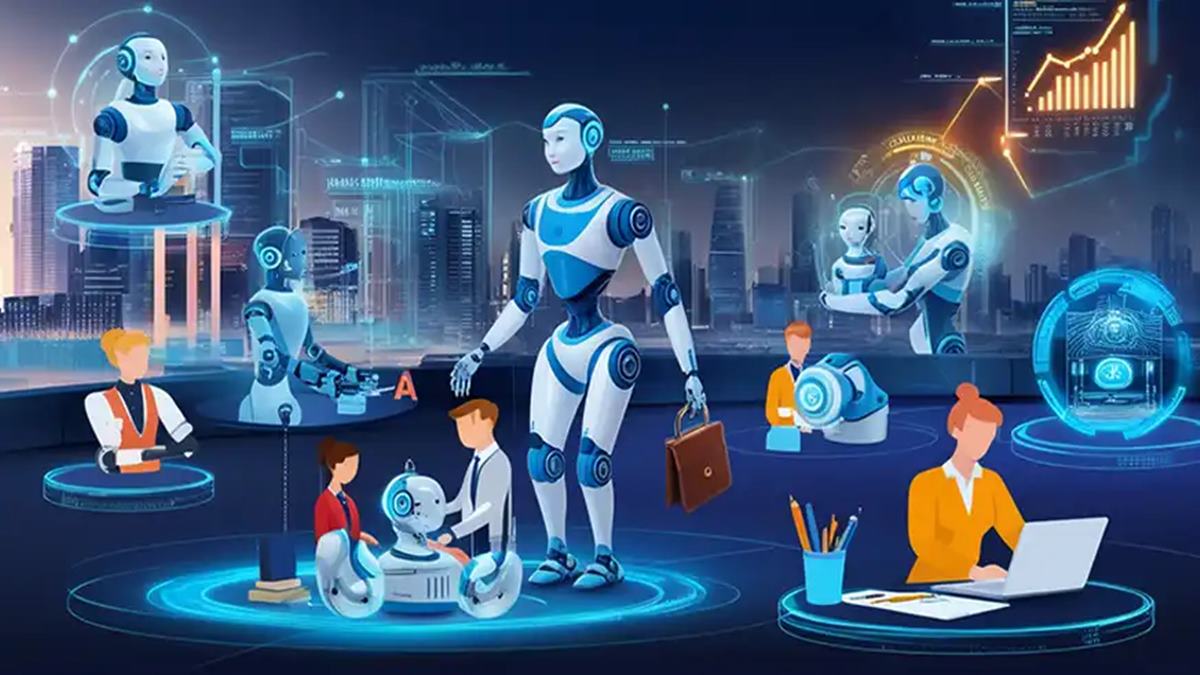
The American workforce is under silent revolution. AI, which used to be a laboratory and tech start-up game, is becoming a common aspect of business activities. AI tools are integrated into web development, video editing, data analytics, and creative design in their various forms; they are transforming workflows and changing the way work is done in industries.
However, despite the apprehensions of lost jobs, human talent that is of a skilled nature is still very strong.What is coming out is not the substitution of human beings by machines; it is the coexistence of human skills and AI. Enterprises are turning to individuals who can integrate creativity, problem-solving as well as domain knowledge with artificial intelligence devices. AI is being operationalized by companies not to take away jobs, but to improve productivity, innovate, and aid complex decisions, which is a change that is quietly transforming the most sought-after skills throughout the United States.
AI is here, but people still lead
In 2025, AI software such as ChatGPT started redefining workflows. They are fully operational by the year 2026 across companies. According to the most recent report provided by Upwork, the number of skills that mention AI specifically increased by 109 percent annually, with AI video editing increasing by 329 percent and AI integration by 178 percent.Nevertheless, humans are not being replaced by such tools. The demand for video editors, graphic designers, and web developers remains high.The use of AI in businesses is not to replace human labour but to supplement it.
Human skills are more sought after than before
Talent acquisition and retention have always been on the frontline list of the business leaders in comparison to technology adoption. Almost fifty percent of them would pay a premium on creativity and innovation. The most demanded skills, such as full-stack development, data analytics, virtual assistance, and graphic design, have not experienced any change, meaning that despite the growth of AI, people have remained core to the success of companies.Interestingly, 77 percent of companies say that AI has raised their request of fractional or specialized talent. Businesses do not need to be without full-time positions but seek professionals capable of making contributions of deep and focused talent according to the Upwork report.
Fastest-growing domains
According to Upwork data, six areas of work boom will be highlighted:
- Creative Work: Video editing, illustration, and design are continuing to be sought after, and AI is not the solution but an enhancing tool.
- Technical positions: Full-stack development and AI integration is booming.
- Data and Analytics: The data labeling and annotation are on the rise as AI becomes integrated into the processes.
- AI-Specific Work Chatbot development, generative AI modeling, and AI-produced media are rapidly expanding niches.
- Marketing and Communications: SEO, content generation and lead generation are processes that continue to involve a lot of human judgment.
- Consulting and Strategy: Workforce planning, business strategy, and talent sourcing are becoming increasingly popular as companies adjust to AI.
The shared element: AI is transforming the how, and the what is still determined by people.
Why humans still matter
Robots are able to deal with monotonous work, yet they cannot substitute judgment, creativity, and situation. Research indicates that human knowledge and AI output are much better results than AI. Flexibility, creativity, and problem-solving are now more useful than ever.In the case of professionals, this is that rather than learning AI, they should use AI to improve their current work. Career value will be driven by creative thinking, domain knowledge, and flexibility.The takeawayThe labor force in the United States is not reducing; it is changing.
AI will transform functions, though humans take center stage. Companies are in search of a fresh compromise: special skill with smart tools. The future belongs to those who are capable of marrying human abilities with AI capability to add value in a manner that machines cannot.