


















Introduction
Every few months, a new study drops predicting how many millions of jobs AI will erase. LinkedIn explodes. Twitter spirals. People start Googling “recession-proof careers” at 2 am and your cousin is asking for money to start a construction company because it’s “artificial general intelligence-proof” for the third time this year.
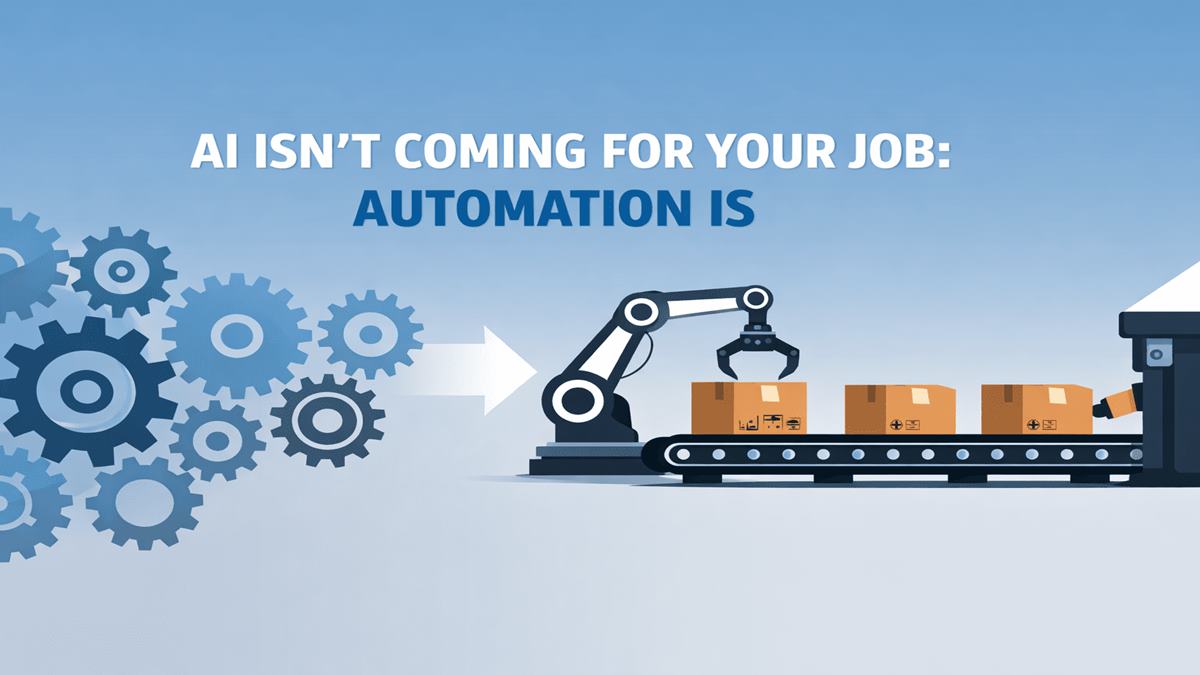
But here’s what nobody’s actually saying out loud: the threat everyone keeps attributing to AI belongs more specifically to automation.
And before you think that’s just a semantic argument, stick with me, because the distinction matters more than most people realize, especially if you’re trying to figure out what skills to actually invest in right now.
Damaging the Professional Landscape Through Confusion
People keep treating “AI” and “automation” as synonyms, and that conflation is sending a lot of professionals in the wrong direction. AI is a capability. Automation is what happens when that capability gets plugged into a workflow to replace a repeatable human action. They’re related, sure, but they’re not the same thing, and the gap between them is where most of the misunderstanding lives.
Think about it this way: AI can write a first draft of a product description. But it’s the automated pipeline, the trigger, the template, the routing logic, that decides whether a human ever sees that draft at all. The AI generated the content, but it’s the system built around it that decided what happened next.
When you frame it that way, what’s actually eating into jobs becomes much clearer. Blaming the model is like blaming the engine instead of the assembly line.
Identifying What Automation Actually Targets
Automation targets tasks, not entire jobs. Specifically, it goes after the ones that are predictable, high-volume, and follow a clear set of rules. Data entry, invoice processing, ticket routing, and basic content formatting are all deeply vulnerable — they’ve been set up for obsolescence by their superiors. Junior developers are also incredibly important — it’s just that the archaic view that they’re “code monkeys” is making people believe AI is replacing them when it’s not.
There’s a useful mental exercise here: go through your own job and identify the tasks you could hand to a reasonably smart intern working from a checklist. Those are your exposure points. The work that genuinely requires relationship context or real-time judgment sits on much safer ground, at least for now.
The tricky part is that most people are bad at this self-assessment. They either panic about everything or feel falsely secure because their job title sounds sophisticated. A quality assurance (QA) tester who thinks critically is more valuable than a chief technology officer (CTO) who just flips a coin on every decision.
Understanding Why Learning AI Barely Scratches the Surface
The whole “learn AI or get left behind” narrative is useful but incomplete. Yes, the AI market is growing 120% year-over-year, but the skills that will actually protect you aren’t just technical. They’re the ones that make you valuable in a world where automation handles the mechanical parts of work, and humans are expected to handle everything else.
That means judgment. Knowing when the AI output is plausible but wrong. Understanding context well enough to catch what the model can’t. Being the person in the room who can explain a decision to a stakeholder who doesn’t trust the algorithm and won’t just take your word for it.
It also means understanding failure modes. An automated system that works 95% of the time sounds great until you realize what happens in the remaining 5%, and who’s responsible for catching it. That’s almost always going to be a person, and that person needs to actually # Tracking the Jobs That Are Actually Growing
It’s worth paying attention to where headcount is actually going up. Roles in AI oversight, workflow architecture, process automation consulting, and pipeline design are seeing real demand. These are real roles posted on LinkedIn right now, not theoretical future jobs, and the salaries reflect how badly companies need people who can actually do them well.
What they share is that they sit at the intersection of human judgment and automated systems. They require someone who understands both the capability and the context well enough to make the whole thing work in production, where things are messier and more ambiguous than any polished demo. The supply of people who can both think and handle agentic automation is smaller than you think.
There’s also a quieter trend worth noting: companies that automate badly are generating cleanup work. Roles focused on quality control, exception handling, and human-in-the-loop review are multiplying fast in spaces where automation got deployed too aggressively without enough oversight built in.
Final Thoughts
Here’s what the “AI will take your job” conversation keeps missing: the real shift isn’t about intelligence, it’s about leverage. Automation gives companies the ability to do more with fewer hands on the mechanical parts of work.
That’s not inherently bad. But it does mean the value of genuine judgment, contextual thinking, and real oversight is going up, not down. If you’re figuring out where to invest your time right now, don’t just learn the tools. Learn how to think about the systems those tools live inside. That’s the skill that’ll still matter when the next wave of tools arrives.
Source – https://www.kdnuggets.com/ai-isnt-coming-for-your-job-automation-is