



















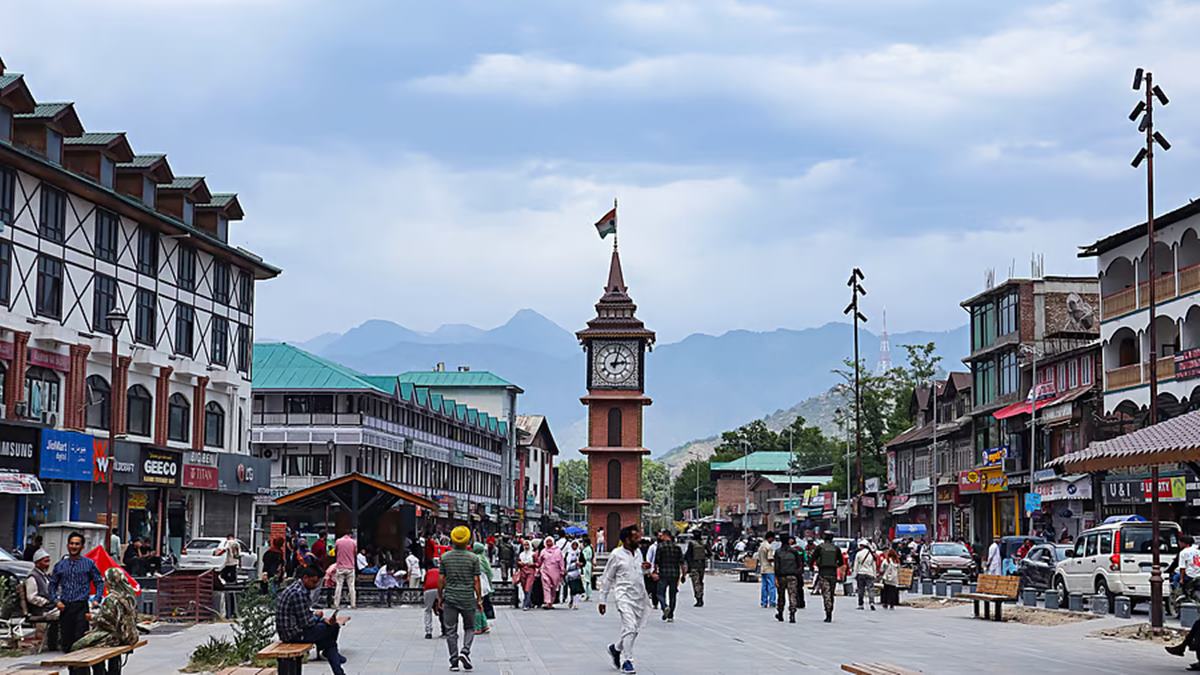
Srinagar: On a grey winter morning in Srinagar, the queue had already begun to snake along the compound wall of a government office by the time Aamir (name changed) arrived, his breath visible in the cold.
In his hands was a plastic folder—creased at the edges, heavy with certificates: a master’s degree in Political Science, mark sheets, identity proofs, years of quiet hope. He took his place among hundreds of others. Some clutched engineering diplomas, others science degrees; one man said he had a PhD. They had all come for the same thing—a Class IV government job.
No one spoke of qualifications. Only of chances.
In Kashmir, this quiet lowering of expectations has become its own kind of crisis. It marks a generation that chose classrooms over conflict, only to find the promise of education thinning at the edges.
Over the past decade, the Valley has undergone a subtle but significant shift. Where the language of anger once dominated, there is now a quieter vocabulary of exams, cut-offs, and results awaited.
Universities have expanded, coaching centres have proliferated across Srinagar’s neighbourhoods, and families—often at great personal cost—have placed their faith in education as the safest path forward.
But that faith is colliding with an economy that has not kept pace.
Figures presented in the Jammu and Kashmir Assembly in 2026 reveal a contradiction difficult to ignore: 77,099 government posts remain vacant across departments. Yet, lakhs of young people continue to search for work, many of them overqualified for the few openings that do appear. The distance between opportunity and access has rarely felt wider.
The scale of that gap was laid bare in 2020, when more than five lakh candidates appeared in interviews for just 8,500 Class IV posts. It was a number that stunned even officials—over 60 applicants for a single position. Degrees, it seemed, no longer guaranteed mobility; they merely crowded the starting line.
Employment, unsurprisingly, became a central promise in the 2024 Assembly elections. Chief Minister Omar Abdullah pledged one lakh jobs, a figure that resonated across households where education had become both investment and expectation.
The government has since announced plans to fill around 30,000 vacancies in phases, but for many, the pace of hiring has yet to match the scale of the promise.
The years after 2019 have reshaped not just Kashmir’s politics, but its administrative rhythms. Recruitment processes have become more centralised, more tightly regulated and by many accounts, slower.
Examinations are delayed, results contested and vacancies released in smaller, fragmented batches. For those waiting, time stretches in uncertain ways.
“When the notification came, I didn’t think twice,” said Shabir Ahmad, a postgraduate in Economics. “Now it’s not about dignity. It’s about getting anything.”
That shift—from aspiration to adjustment—runs quietly through the lives of many young Kashmiris. Years are spent preparing for exams that may or may not arrive on time. Families dip into savings, sell land, postpone decisions. There is a cost to waiting, and it is not always visible.
Experts speak of a slow accumulation of strain: anxiety that lingers, confidence that erodes, futures that feel indefinitely deferred. Marriage is delayed, independence postponed, ambition recalibrated into something more cautious, more immediate.
“Beneath it all lies a deeper structural constraint. Outside government employment, opportunities remain limited. The private sector is thin, industry minimal, and tourism—often held up as an economic lifeline—moves with the unpredictability of seasons and circumstance,” said Dr Farrukh Faheem, a sociologist at the University of Kashmir’s Institute of Kashmir Studies.
In such a landscape, he said, a government job is not just employment; it is certainty. And certainty, here, is scarce.
The paradox is stark. “We are seeing a generation caught in prolonged transition,” Dr Farzana Gulzar, an associate professor at University of Kashmir’s Management Studies, told DH.
“They (youth) have done what was expected—pursued education—but the system has not created enough pathways for absorption,” she added.
As the queue inches forward, candidates waiting outside the recruitment centre adjust their grip on folders thick with certificates, the edges pressing into their palms. Around them, the line tightens, then pauses again. No one leaves.
In Kashmir today, the crisis is no longer just about unemployment. It is about the slow unravelling of a promise—that education would be enough.