

















Rajasthan has no shortage of young people. What it does not have, at least not yet, is enough jobs that can keep pace with them.
Rajasthan’s unemployment rate stood at 4.7 per cent, according to the data from Periodic Labour Force Survey (PLFS) for July 2023–June 2024, released in 2025.
That’s why Rajasthan is now betting big on startups. The government is funding new ventures, pushing innovation policies, and hoping entrepreneurship will create jobs at scale. But here is the question that sits quietly behind all of this: can startups really absorb the sheer number of young people entering the workforce every year?
Because the numbers are hard to ignore.
According to the All India Survey on Higher Education, Rajasthan had 26,89,340 students enroled in colleges in 2021–22. Every year, several lakh of them graduate and step into the job market, joining an already crowded queue.
The state has hundreds of colleges: 589 government, 1,897 private, and 1,479 BEd institutions, producing degree holders at scale.
But are there enough jobs waiting for them?
The answer, at least for now, seems uncertain. Rajasthan’s unemployment rate at 4.7 per cent in 2023–24, is far above the national average of 3.5 per cent in the same year.
So, this is where the real story begins.
If lakhs of students are graduating every year, and startups are being seen as the next big job creators, can the two actually meet in the middle? Or are we simply creating more degrees without creating enough opportunities?
A RESULT SHEET THAT KEEPS GROWING
Let’s begin at the starting point: schools. In 2025 alone, over 10 lakh students passed Class 10 and more than 8.7 lakh cleared Class 12 in Rajasthan. That is nearly 18.8 lakh young people stepping into the next phase of life in just one year.
Pause for a moment and think about it: if even a fraction of them are looking for jobs in the next few years, can the system absorb them?
Or are we simply moving from one waiting line to another?
WHEN DEGREES LINE UP FOR PEON JOBS
The clearest answer to that question came not from a report, but from a recruitment drive.
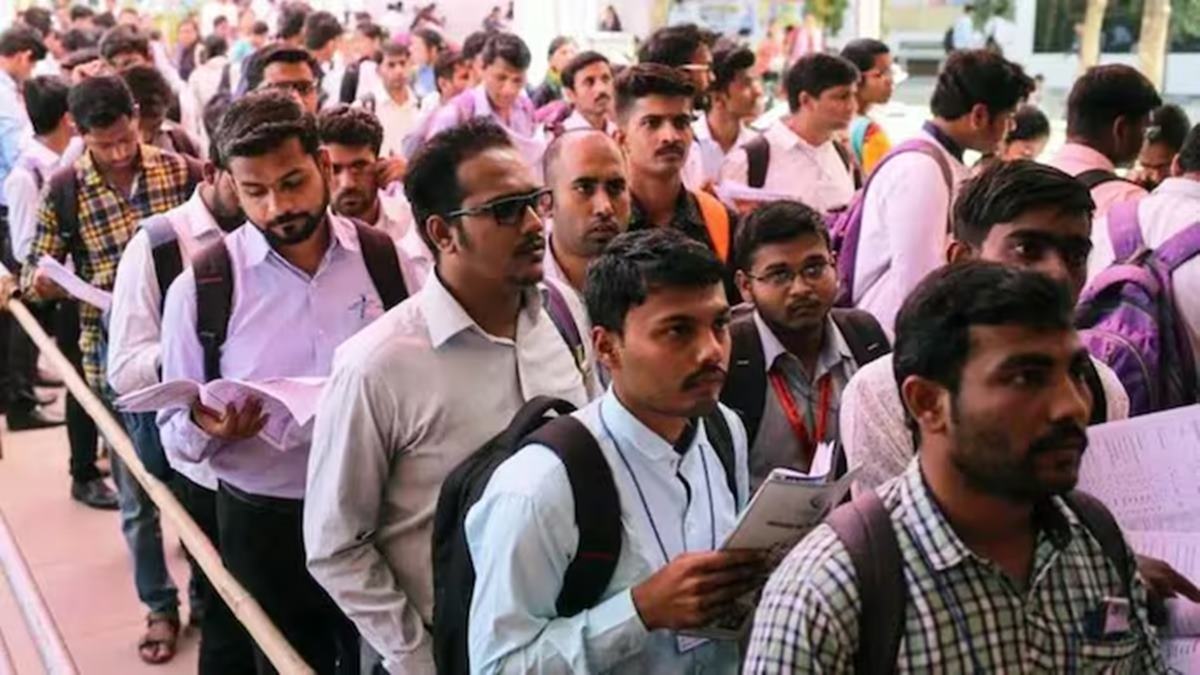
Last year, more than 2.5 million candidates applied for just around 53,000 peon posts in Rajasthan. What is even more striking is this: nearly 90 per cent of these applicants were overqualified, including graduates, engineers and even PhD holders.
For every single post, there were dozens of applicants.
These were jobs that required only a Class 10 qualification. Yet, candidates with MSc, BTech and BEd degrees stood in long queues, many quietly hoping no one from their village would recognise them.
Some had spent years preparing for competitive exams. Others were still chasing bigger dreams. But all of them were there for one reason: a job, any job.
So, the real question is not just about unemployment numbers. It is about this: what happens when even the most basic jobs become out of reach?
STARTUPS: A NEW HOPE OR JUST A SMALL WINDOW?
This is where the government is placing its bets.
In Jaipur, Chief Minister Bhajan Lal Sharma recently extended financial support to 403 startups and said more than 9,400 youths have received skill-upgradation certificates under government-supported training programmes.
The support totalled Rs 11.45 crore through viability gap funding, and the startups came from sectors including technology, manufacturing, services and social enterprises.
It has backed the VIBRANT programme, the iStart Ambassador Programme, a Rajasthan State Testing Agency, 3 next-generation technology techno hubs, and an interest subsidy loan scheme for 1 lakh youth.
But how many jobs can a startup really create and how quickly?
A new startup may hire five people. A growing one may hire 50. But Rajasthan needs jobs not in the hundreds, but in lakhs.
So, can startups scale fast enough to match the pace at which young people are entering the workforce?
The Rajasthan government also rolled out a comprehensive framework, the Rajasthan Employment Policy 2026. The policy sets an ambitious target of generating 15 lakh employment opportunities by March 2029 through a blend of wage employment, self-employment and entrepreneurship promotion.
The policy goes beyond traditional job creation. It emphasises digital platforms that connect jobseekers with employers, districtlevel employment plans, inclusion of tribal and aspirational regions, and datadriven tracking of employment outcomes.
Programmes focus on strengthening industries like hospitality, IT/ITeS, textiles and services, while driving support for micro, small and medium enterprises (MSMEs); sectors that can hire at scale if supported well.
Under the state budget for 2026–27, Rajasthan also proposed schemes for vocational education, foreign language training, and skill impact bonds linked to job placements, aligning skilling efforts with market demand.
SO, CAN STARTUPS REALLY DO IT?
The honest answer is: not alone.
Startups can create jobs, but they usually do it in stages. A new venture may hire a handful of people first, then expand only if the business survives, raises money and finds customers.
That is useful, but it is not the same as absorbing a lakh of fresh jobseekers at once. The startup push can help Rajasthan, but only if it is matched by stronger skilling, more local industry, better college-to-work links and faster private investment.
So the better question may be this: is Rajasthan trying to solve unemployment with startups alone, or is it trying to build a whole job ecosystem around them?
Because with 18.8 lakh school passouts, 26.89 lakh higher education enrolments and a still-pressured labour market, the state needs more than hope.
It needs employers, skills, internships, entrepreneurship and scale, all working together. That is the only way the numbers stop looking like a queue and start looking like an opportunity.