


















Their conclusion does not just sting a few managers. It challenges decades of assumptions about where work should happen, who benefits from flexibility, and why so many leaders still cling to the office like a security blanket.
Researchers spent four years tracking remote workers’ lives
Instead of quick polls or one‑off snapshots, the research followed thousands of employees over four years, across sectors ranging from tech and finance to public services. Researchers compared people fully on site, fully remote, and in hybrid setups, while measuring mood, stress, productivity and work–life balance.
They combined surveys with digital diaries, time‑use logs and performance data when companies agreed to share it. This long horizon allowed them to watch what happened after the novelty of working from the kitchen table wore off, and when companies started nudging staff back into offices.
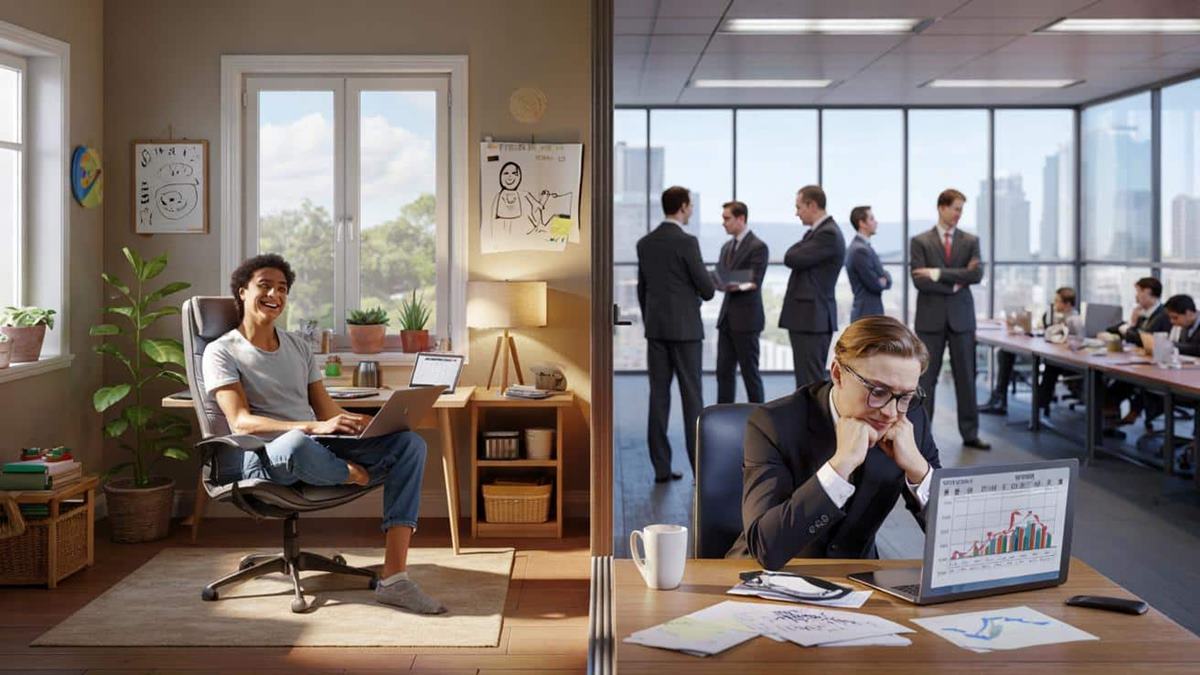
The clearest pattern: people who worked from home at least part of the week consistently reported higher happiness and lower stress.
Happiness in this context did not mean vague vibes. Researchers tracked self‑reported daily mood, sleep quality, sense of control over time, and feelings of exhaustion. Remote and hybrid staff scored better on all four measures across the study period.
What actually makes home working feel better
The report points less to beanbags and more to basic conditions: time, autonomy and body comfort. Rather than dramatic perks, small daily wins added up.
- Commuting hours shrank or vanished, freeing one to three hours a day for many workers.
- Noise levels dropped for people used to open‑plan offices, which eased fatigue.
- Parents and carers handled school runs, medical appointments and deliveries with less panic.
- People could adjust lighting, temperature and breaks without asking permission.
These factors fed into one key indicator: perceived control. When workers felt they could shape at least part of their day, happiness jumped. The office did not disappear from the picture; many still valued it for certain tasks. But mandatory, full‑time office presence correlated with lower mood scores and higher reports of burnout symptoms.
For many staff, the question was not “home or office forever”, but “why am I forced into one rigid pattern when my work doesn’t require it?”.
Why some bosses hate what the data is saying
Leadership reactions inside participating firms fell into two broad camps. Some executives saw higher reported happiness and stable performance as a green light to keep flexible models. Others read the same charts and felt deeply uneasy.
Several managers told researchers they feared a “loss of culture” and “erosion of loyalty” if staff stayed away from the office most of the week. A few admitted they simply did not know how to manage people they could not physically see.
The control problem behind the office nostalgia
The study quotes one senior manager who said, off the record, “When I walk the floor, I know who’s working.” That line crystallises the real tension. Data‑driven productivity metrics never fully replaced visual supervision in many organisations.
Switching to remote work pushes leaders to judge output instead of presence. That shift threatens managers whose authority historically rested on attendance monitoring and informal corridor checks. Losing that lens can feel like losing part of their job identity.
Remote work data challenges a quiet assumption in corporate life: that sitting near your boss equals doing meaningful work.
Researchers also noticed a generational gap. Younger managers who grew up with digital tools adapted faster to remote supervision. Some older executives rejected the results, saying they did not “believe” the happiness figures, even when the numbers came from their own workforce.
Productivity: myth, fear and what the numbers show
Most headlines about remote work swing between two extremes: the lazy pyjama worker and the hyper‑productive hermit. The four‑year study paints a more grounded picture.
On average, productivity stayed the same or rose slightly for knowledge workers who went remote or hybrid. The change varied by role, but the data did not support the idea of a broad collapse in output.
| Work pattern | Average productivity trend | Reported happiness trend |
|---|---|---|
| Fully on site | Flat to slight decline | Flat to decline |
| Hybrid (2–3 days home) | Slight increase | Clear increase |
| Fully remote | Stable to slight increase | Strong increase for carers and commuters |
In roles with heavy collaboration needs, hybrid setups often worked best. Teams met in person for planning or sensitive conversations, then used remote days for deep, focused work. People doing highly individual analytical tasks saw the biggest gains in quiet home environments.
Where productivity dropped, the issue usually stemmed from poor tools, chaotic processes or unclear expectations, not from the physical location of the worker. Companies that simply replicated office habits over video – endless meetings, constant pings, no boundaries – struggled the most.
The hidden costs of forcing people back in
The study period included the phase when many firms rolled out “return to office” mandates. Researchers watched what happened when policies tightened: more days on site, stricter badge checks, subtle or open pressure.
Three patterns emerged quickly:
- Resignations rose among people with strong caregiving duties or long commutes.
- Remaining staff reported more stress, even if their actual workload did not change.
- Cynicism toward leadership increased, especially when mandates claimed to be “for collaboration” while calendars stayed full of video calls.
When employees were told to return for teamwork but ended up on headphones all day, trust eroded faster than any office layout could fix.
Several companies then faced unexpected recruitment headaches. Candidates who had experienced remote or hybrid work treated strict office rules as a red flag. Firms that held on to flexibility quietly started attracting talent away from more rigid competitors.
Remote work, class and geography
The research also underlined who actually gets to enjoy home working. Higher‑paid knowledge workers benefited most, while many lower‑paid roles remained tied to physical locations. This divide risks hardening existing inequalities.
People in smaller towns and rural areas used remote options to access better‑paid jobs without moving. That shift could rebalance some regional economies over time, but only if companies maintain flexible policies instead of concentrating roles back in major cities.
At the same time, not everyone has a calm home office. Crowded housing, shared rooms and patchy broadband still limit the quality of remote work for many. Researchers suggest that if governments and employers want lasting gains, they will need to treat home infrastructure as part of the workplace conversation, not a private problem.
What workers can do with this new evidence
For employees negotiating with managers, the study offers more than slogans. It gives concrete angles to discuss, beyond “I just prefer working from home”. Workers can point to specific benefits linked to performance and wellbeing.
- Highlight tasks that need quiet, uninterrupted time and show how home days protect that focus.
- Track personal output on home days versus office days for a few weeks and share the patterns.
- Suggest trial periods rather than permanent arrangements, giving managers data without a big leap of faith.
These conversations will not magically convert every sceptical boss. But they shift the debate from impression and fear to something more measurable, where compromises become easier.
Why leadership habits must change with the workplace
The four‑year project hints at a bigger transition in how leadership works. Command‑and‑control styles based on physical presence no longer fit well with distributed teams. Managers now need to communicate goals clearly, trust staff between check‑ins, and judge work on outcomes.
This change demands new skills: better writing, more deliberate one‑to‑one conversations, careful meeting design and a sharper focus on priorities. Training programs for managers rarely covered these areas before 2020. Many still don’t.
Remote work is not just a location shift. It exposes weaknesses in leadership that were easier to hide when everyone sat under the same fluorescent lights.
Some firms in the study responded by investing in coaching for middle managers, redesigning meetings, and simplifying approval chains. Where leadership adapted, frustration about remote work dropped on both sides. Where leadership stayed the same, arguments about “the office” kept resurfacing, even when the real issue was trust.
Looking ahead: hybrid futures and uneven adjustments
The researchers do not claim that every job can move home or that offices should disappear. They do argue that forcing a pre‑2020 model onto a post‑2020 workforce ignores clear evidence about how people function best.
Expect a patchwork future: sectors like finance may keep leaning on office rituals, while parts of tech, design, consulting and media normalise flexible patterns. Governments will watch how this affects city centres, transport systems and housing markets. People planning careers will need to weigh one quiet factor alongside salary and title: how much control they get over where and when they work.
For anyone still weighing a move to a more flexible role, the study gives a way to think about trade‑offs. Commuting time can be treated like a hidden pay cut. Better sleep and more control over your day function like a quiet raise in health and energy. None of these appear on a contract, yet they shape how long you can do a job without burning out.
The research also hints at something more personal. When location becomes negotiable, people can redesign their routines: shifting workouts to daylight hours, fitting in care work without constant guilt, starting a side project in the time once lost on trains. These small rearrangements rarely trend on social media, but over years they change how work and life fit together.
Source – https://www.hairdressersbrownsbay.co.nz/12-165685-researchers-studying-remote-work-for-four-years/