




















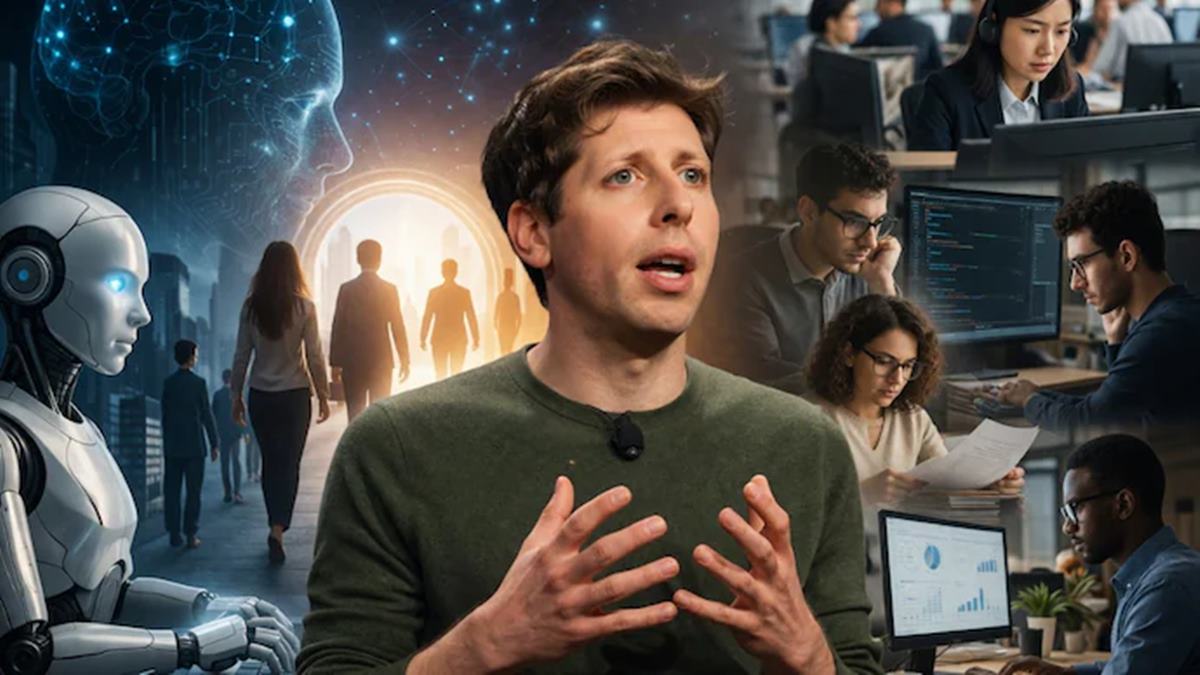
The conversation around AI is no longer about “if” it will change jobs, but how fast that change will arrive. In a recent interview, Sam Altman shared that the world is already moving into a new phase of computing, one where machines are not just assisting humans but actively changing how work gets done. At the same time, fresh data from Anthropic shows that while new opportunities may emerge, several existing roles are already seeing high exposure to automation.
Altman, speaking to Axios, suggested that the change is happening faster than most people expected. “We are close enough to AGI that the precise definition matters,” he said, adding that AI is already capable of discovering “legitimately new scientific knowledge” and performing “serious, valuable economic work at real scale.” According to him, this signals that the industry is already “quite far along” in what he described as a “new paradigm.”
He pointed out that even within a year, the nature of some professions has changed noticeably. Coding, for instance, is no longer what it used to be at the start of 2025. While he did not directly say jobs will disappear overnight, his comments suggest that roles are evolving quickly, with AI taking over repetitive and structured parts of work.
Despite growing fears, Altman maintains that AI will not simply replace humans but will recreate the balance between labour and technology. He indicated that “there will be new jobs,” but also admitted that society may need to rethink how economic value is distributed if AI pushes too much power towards capital over labour. His latest statements hint at a future where traditional employment structures may not remain the same, even if new kinds of work emerge.
At the same time, he emphasised that not everything about human life will change. According to Altman, the core of being human – relationships, time spent with others, and personal fulfilment – will remain intact. AI, in his view, could free up time for these aspects rather than replace them.
Anthropic data shows multiple career options not safe from AI
However, data shared by Anthropic presents a more grounded picture of what this transition could look like on the ground. The company analysed how often AI systems are already performing tasks linked to different professions and identified about 10 career options that appear most exposed to automation.
Topping the list are computer programmers, with an estimated 74.5 per cent of their tasks potentially handled by AI. This includes writing, updating and maintaining code — areas where AI-powered coding tools have rapidly improved. Customer service representatives follow closely, with over 70 per cent exposure, as chatbots and automated systems increasingly handle queries, complaints and order processing.
Data entry roles are also among the most vulnerable, with about 67.1 per cent of tasks being automatable. These jobs largely involve repetitive input work, which AI systems can now perform faster and with fewer errors. Similarly, medical record specialists show high exposure, as AI tools are becoming capable of organising and summarising patient data.
The impact is not limited to routine roles. Anthropic’s data suggests that analytical and business-oriented jobs are also at risk. Market research analysts and marketing specialists show around 64.8 per cent exposure, with AI already being used to analyse data and generate reports. Sales roles in wholesale and manufacturing are also affected, with automation tools assisting in outreach and order management.
Even financial and tech-focused jobs are not entirely safe. Financial analysts show over 57 per cent exposure, while software testers and quality assurance professionals stand at nearly 52 per cent. Roles in cybersecurity and IT support also appear on the list, although with relatively lower exposure compared to others.