




















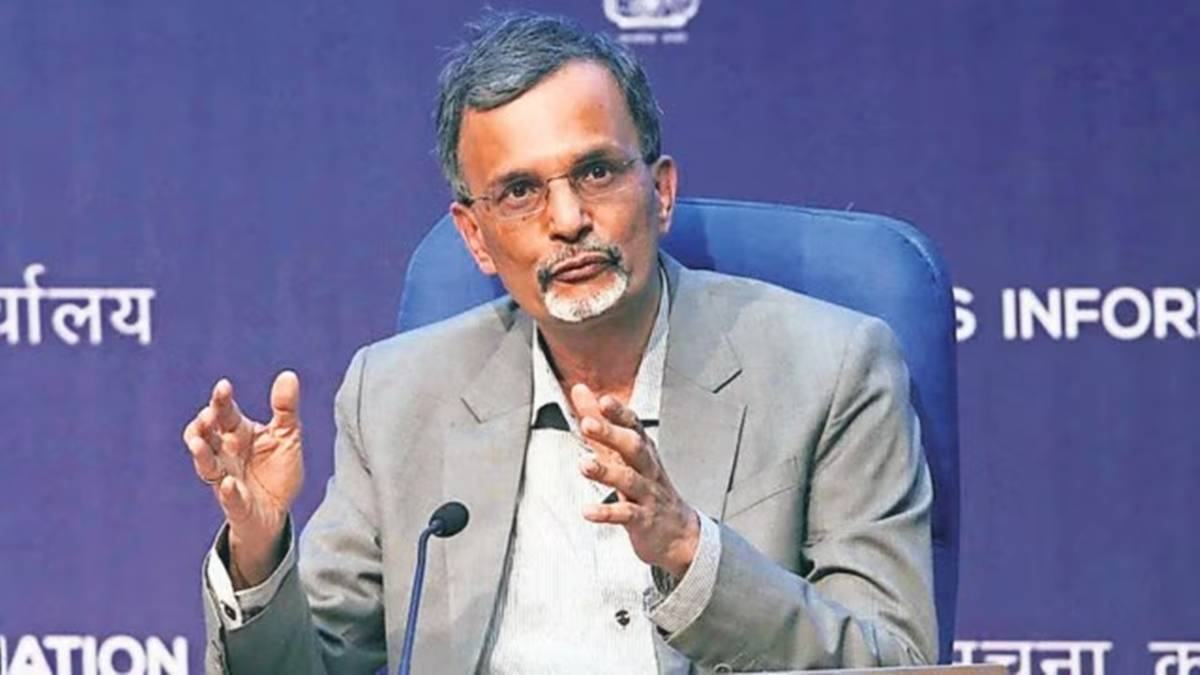
Emphasising that technology adoption must go hand in hand with job creation, Chief Economic Adviser V. Anantha Nageswaran on Monday warned that India’s artificial intelligence (AI) push should be aligned with mass employability to avoid widening inequality and social stress.
Speaking on the future of work in the age of AI, Nageswaran said the scale of the employment challenge remains formidable, noting that India needs to create at least eight million jobs annually to absorb its growing workforce.
Demographics not only create opportunity but also urgency. Yet today, only a small proportion of our workforce has received formal skill training,” he said, virtually addressing the AI Impact Summit 2026 here.
He cautioned that the skills deficit is not merely a statistical concern but a structural vulnerability. If automation advances faster than workforce reskilling, productivity could rise without corresponding employment growth, undermining the country’s demographic advantage.
“For advanced economies facing demographic decline, AI may serve as a supplement. For India, it is a stress test of our state capacity. Time for us is not abstract. Every year, we must generate millions of productive, dignified jobs or livelihoods. Every year of delay compounds pressure,” he cautioned.
Without decisive action to strengthen foundational education, expand high-quality skilling, and remove regulatory bottlenecks that restrict labour-intensive sectors, the country risks missing a historic opportunity. Such a failure, he warned, could lead not only to slower growth but also to social and economic instability.
He underscored that technological transformation should not be viewed solely through the lens of efficiency gains. Instead, policy must ensure that innovation supports livelihoods at scale. This requires calibrated deployment of AI, institutional reforms, and stronger integration between technology policy and employment strategy.
On the way forward, Nageswaran called for a coordinated “Team India” approach involving government, industry, academia, and civil society. With foresight, discipline, and sustained execution, he said, India can demonstrate that human abundance and machine intelligence can reinforce each other rather than compete.
“For India, this is not a debate about the future of work. It is a decision about the future of growth, social stability, and cohesion. We must act, and act now,” he said.
The first step lies in reforming education systems and pedagogy to ensure universal foundational skills, which he described as the starting point for co-creating prosperity in the AI era, he added.