



















From the steam engine to today, every single invention has led to profound changes in the world of work. Recently, this process – or perhaps even “progress” – has been, seemingly, cranked up by artificial intelligence (AI).
AI is increasingly presented as shaping global markets and working methods and as having an ever-accelerating impact on Germany’s world of work – with or without accelerationism.
Elsewhere, as in Germany, large language models (LLMs) – ChatGPT, Gemini, DeepSeek, LLaMA and chatbots – are used by more and more workers for ever more, ever new, and ever more complex tasks.
The most common term Germans tend to use for this is “the fourth industrial revolution” or “Industry 4.0”. As so often, it promises enormous opportunities but also includes very serious challenges for Germany’s labour market.
In its most simplified version, AI describes algorithm-driven computer programs that can perform some – and by no means “all” – tasks that traditionally required, and still require, human intelligence. Human intelligence and artificial intelligence are not the same. Many argue they will never be the same.
Yet, with the help of machine learning and neural networks, these systems are continuously improving their performance.
Basically, two positions can be identified on the impact of technological innovations, including AI, on the working world:
- Negative: On the one hand, automation potentials in occupations with a high degree of repetition are assessed as high.
- Positive: On the other hand, labour-saving and job-creating effects are emphasized, which indicate a balanced or positive employment effect.
Without much scientific proof so far, it is assumed that the use of AI “can” significantly increase productivity – the code word for “ corporate profits” – in many industries.
For example, AI systems can analyse large amounts of data in a very short time, recognize patterns, and make informed decisions. This “can” lead to more efficient (the magic word of management) processes, cost savings, and therefore and most importantly: profit maximization. For companies to achieve higher profits, six levels of AI can be identified:
No AI: standard management and traditional work regimes prevail and no AI is used at all.
Assistant AI: AI is used to support management and workers in decision-making.
Partial AI: parts of work are done using AI; real workers remain decision-makers.
Conditional AI: most decisions are handed over to AI systems – AI offers conditional use and assistance.
High AI: most functions, work tasks, and performance are handed over to AI.
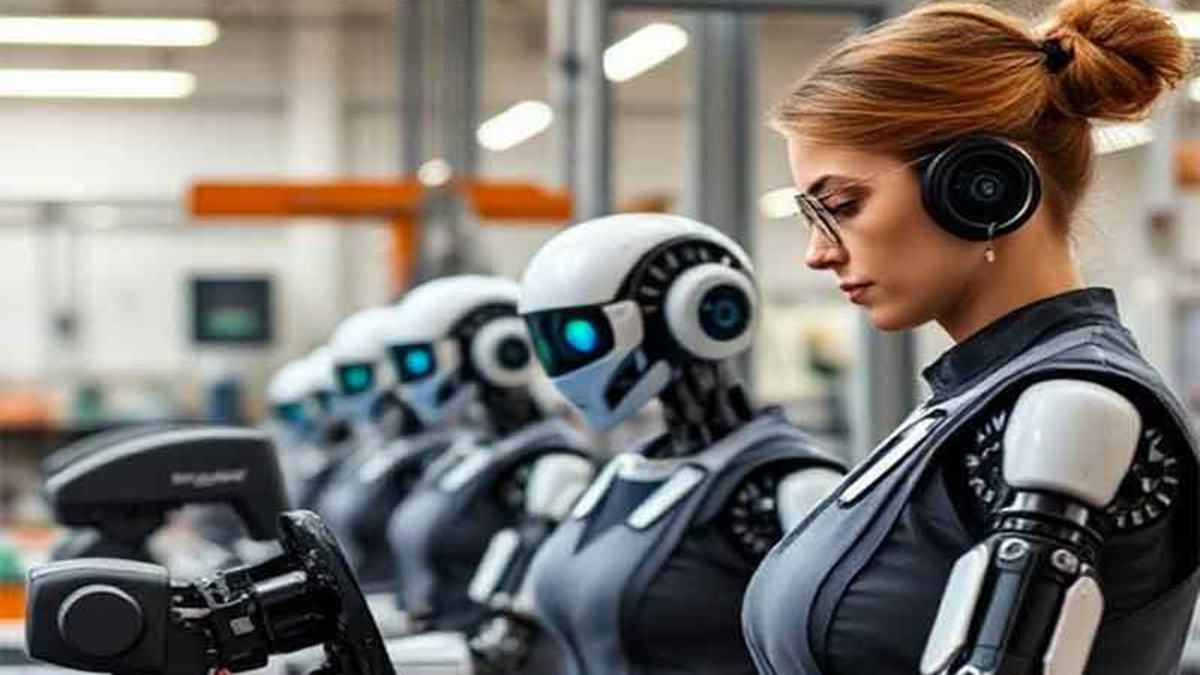
Total AI: AI defines work, management, and workers; AI has total control – no human involvement.
At whichever level AI comes to pass, AI systems can relatively easily automate repetitive and perhaps even dangerous work activities. Inevitably, this will lead to job losses in certain areas.
On the other hand, new professional fields are emerging, especially in the development, implementation, maintenance, and application of AI technologies.
Germany has already seen a rapid development of AI in medical diagnostics, where deep-learning algorithms are making seemingly unlimited progress in the automated diagnosis of diseases. This enables the faster development of drugs, for example, and thereby handsome profits for “Big Pharma”.
Recently, it has been estimated that up to 70% of all work-related activities, even among professionals, can potentially be carried out by AI. In 2022, that number was 38% throughout Germany, and in 2019 it had been 34%.
This share remains highest in Germany’s more specialist professions. Yet the strongest increase is observed among the highly qualified in expert professions. Above all, the use of AI “could” automate activities even of highly qualified employees. Meanwhile, more conventional software “could” take over activities of workers with lower qualifications.
In Germany, the potential for “substitutability” (read: replacement) has increased most strongly in IT and related professions since 2019. Interestingly, such activities were previously not seen as “substitutable” or replaceable.
Meanwhile, AI skills are most in demand for highly qualified expert activities. However, it is still somewhat unclear what this means for future employment.
Given past developments, there has hardly been any reduction in employment levels even in professions with the potential for technologically driven replacement.
Yet there might be a tendency towards “lower growth” – perhaps not quite de-growth, but at least an end to the neoliberal ideology of never-ending economic growth, presented as the ultimate measure of all that is good. With a finite Earth on our hands, belief in infinite growth borders on the pathological.
Within “The Limits to Growth”, employment in Germany has grown rather strongly in highly substitutable jobs. Meanwhile, the fundamental substitutability of work activities by AI is only one side of the coin.
The legal, business, and labour relations side must also be in place for these activities to actually take place. For example, the implementation of AI technologies in existing workflows requires time, investment, planning, and negotiation with Germany’s works councils and trade unions.
Beyond that, one of the more relevant prerequisites for the development and application of AI is high computing power, as well as data-processing centres and their resulting – and ever-increasing – energy demand.
Similar to previous technological changes – such as, for example, the electrification of Germany – it can take years for the promised productivity gains of AI to be realized, never mind all the hype about the next industrial revolution.
In Germany’s setting, the contribution of innovative AI technologies may even lead to a reduction of Germany’s very serious skills shortage, which is currently still compensated – at least partly – through mass migration, despite far-right political parties and right-wing populism.
On the other hand, most professions do require activities that cannot be taken over by AI, but many tasks can be supported by AI. The increased use of AI is more likely than not to change these work activities – perhaps even for the better.
This leads to changed job profiles and sometimes also to new jobs. Germany’s negative demographic development and the marked decline in skilled workers present on the labour market are slowing down Germany’s growth and – potentially – its prosperity.
By the year 2040, about 4.0 million jobs in Germany will be eliminated compared to 2023. At the same time, 3.1 million new jobs will be created. This is 0.9 million fewer people in employment than in 2023.
This development is mainly because of Germany’s demographic trajectory – not so much AI. Yet the shrinking supply of labour can prevent the growth of gainful employment.
This limiting effect of labour supply leads to “bottlenecks” in many sectors of the German economy. Because of the increased application of AI, it is commonly hoped that this will compensate for an already retired workforce.
Despite all this, Germans expect that productivity will increase and that the general population will benefit from higher added value. Consumption – an all-important imperative in consumer capitalism – is set to increase. This may come with very serious environmental costs.
Meanwhile, Germans also expect that the state’s debt will decrease because of higher revenues – the eternal growth model prevails.
All of this comes with the premise that there will be no, or at least “next to no”, increases in emissions (read: pollution). In other words, Germans expect that with the use of AI – and along the current development pathway – overall emissions will actually increase.
This will be cranked up by the operation of ever more and larger data centres – construction is currently underway around Frankfurt, Berlin, and Munich. Worse still, higher production levels enabled by AI will require additional energy resources to feed capitalism, causing additional emissions (read: rendering planet Earth increasingly uninhabitable).
This is what a New Yorker cartoon expressed as: “Yes, the planet got destroyed. But for a beautiful moment in time we created a lot of value for shareholders.” And the head of the United Nations warns: “We are on a highway to climate hell with our foot still on the accelerator.”
Meanwhile, the increased use of AI and its successful integration into work are projected to lead to annual economic growth of, on average, 0.8% compared to no AI application. Cumulatively, and distributed over the next 15 years, €4.5 trillion (US-$5,287,725,000,000.000)of additional added value “could” be generated.
All in all, Germany’s GDP might well be 12.8% higher after twelve years with AI than without it. In the first year of the AI scenario, around 100,000 jobs will exist that did not previously exist.
At the same time, around 50,000 jobs will be lost. On balance, this means around 50,000 net jobs created in the first year. Conversely, after 15 years, around 790,000 jobs will have been created by AI. These are jobs that did not exist previously.
On balance, job creation and job loss because of AI might well turn out to be “almost balanced” in the 15th year of the projected AI period.
Meanwhile, structural change – highly influenced by increased AI development and its integration into the world of work – is set to intensify over time.
While around 830,000 jobs will be affected in Germany by AI-related “upheavals” during the next five years, this number will increase to around 1.6 million jobs over the next 15 years.
Virtually all of this points in a similar direction to studies on “Industry 4.0”. Overall, consistent digitization of Germany’s world of work – both in the classical IT sense and through AI-based innovations – is very likely to have a positive effect on the labour market.
Meanwhile, structural change – the move from manufacturing to services – will intensify further because of increased AI development and integration into work systems.
As a consequence, there will be significant shifts in the German labour market that, although the overall number of employees may hardly deviate over time, will nevertheless lead to changes in its composition.
As demand for skilled employees increases in many sectors because of AI, jobs in other areas – such as manufacturing – will be reduced.
While the “Industry 4.0” scenario predicts that many assistants and even specialists will be taken over by computer technologies or robotics, AI applications tend to affect expert activities.
This highlights a significant difference between AI on the one hand and robotics or simple cloud computing on the other. In the future, it will be above all cognitive work activities that can be performed by AI. These will become more replaceable in the longer term. In other words, it may not be entire jobs, but specific activities within jobs, that become redundant.
In any case, job reductions will be offset by job creation elsewhere – always on the premise that the necessary specialists are available to fill these positions.
On the aforementioned 1-to-6 scale – no AI; assistant AI; partial AI; conditional AI; high AI; total AI – very few white-collar jobs will remain unaffected by AI (option 1 will be rare). Similarly, it is hard to imagine that many work functions will be totally replaced by AI (option 6).
In other words, most workers will – in one way or another (options 2–5) – work with AI in settings where AI supports workers, where workers collaborate with AI, or where AI does most of the work while humans move into coordinating roles.
Overall, AI shows a development path capable of combining demographic shrinkage with growth. However, this requires a willingness to adapt on the part of employees, trade unions, corporate management, and companies.
All of this means that AI cannot be left to its own devices under the mythical assumption that “the free market” will take care of everything.
Instead, the transition towards a more AI-based world of work can best be achieved when key labour-relations actors – the state, companies, workers, and trade unions – work together within Germany’s already established institutional framework to facilitate a change that is presented as inevitable and upcoming – if not already underway.
Source – https://countercurrents.org/2025/12/the-future-of-ai-work-in-germany/