



















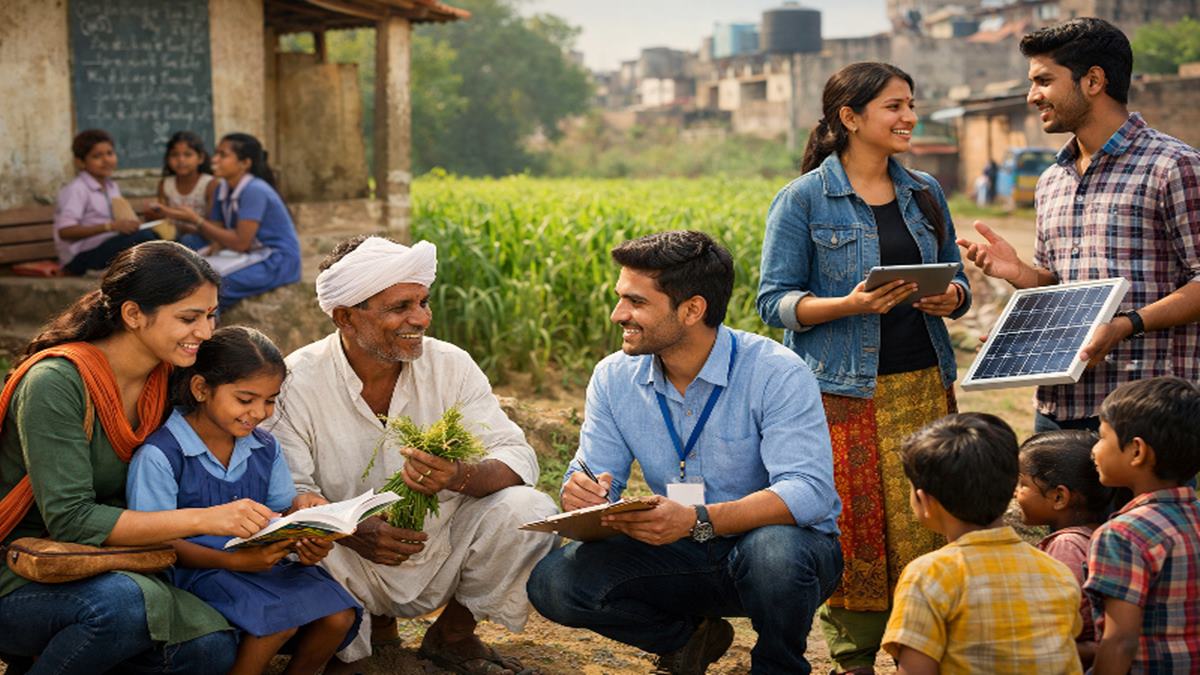
On a humid afternoon in a small village school in Assam, a young professional sat with a group of teachers under a banyan tree. She had arrived only a few months earlier after completing her postgraduate degree and joining an organization working with the public education system in the state. Her role sounded straightforward: to support teachers so that children in government schools could learn better. In practice, however, the work was far from simple.
When she first began visiting the school, the teachers were hesitant. They had seen many “projects” come and go. Some had lasted only a few weeks; others had left behind reports but little change in classrooms. Trust had to be built slowly—through conversations, classroom observations, and long discussions about how children learn.
Over time, things began to shift. One afternoon, a teacher excitedly shared something remarkable: a group of students who had earlier struggled to read were now confidently reading stories aloud in class. For the young professional, the moment was deeply meaningful. It was not a headline-making achievement or a corporate milestone, but it was a reminder that a career could be about transforming lives in quiet, meaningful ways.
Stories like these are increasingly common across India as young people explore careers in what is broadly known as the social sector—a space dedicated to addressing societal challenges such as education, health, livelihoods, and environmental sustainability. Working in such fields allows professionals to directly contribute to improving lives while gaining exposure to diverse communities and social realities.
For decades, Indian students grew up with a fairly predictable set of career choices. Engineering, medicine, management, finance, or government services dominated conversations in schools and colleges. These professions continue to be respected and attractive, offering financial security and social recognition. Yet something is slowly changing.
Many young people today are beginning to ask a different question: Can my career also contribute to solving real problems in society? This shift in thinking has opened the door to the social sector as a viable and meaningful career path. Instead of viewing development work only as charity or voluntary service, students increasingly see it as a professional field where they can apply knowledge, skills, and innovation.
The social sector itself is broad and diverse. It includes non-profit organizations working directly with communities, philanthropic foundations that fund social initiatives, research institutions studying public policy, and think tanks influencing governance. It also includes Corporate Social Responsibility (CSR) teams within companies, as well as a growing number of social enterprises that combine business models with social impact. Together, these institutions form an ecosystem of organizations working to improve lives and strengthen public systems.
Let us consider the context in which these organizations operate. India’s development story is remarkable in many ways. The country has experienced rapid economic growth, technological progress, and expanding opportunities across sectors. At the same time, the realities on the ground remain complex. Millions of children still struggle with malnutrition and limited access to quality education. Farmers face unpredictable weather and unstable incomes. Urban areas grapple with pollution, water scarcity, and overcrowded infrastructure. Many young people entering the workforce feel that available opportunities do not always match their aspirations.
These are not problems that can be solved through technology alone. They are deeply connected to social systems, institutions, public policies, and economic structures. Addressing them requires professionals who can understand communities, analyze policies, and design programs that work in real-world conditions. The social sector plays a crucial role in bridging this gap by combining research, policy insights, and grassroots engagement.
One of the biggest misconceptions about the social sector is that it is limited to voluntary work. The reality is that it is a professional field with a wide range of roles and career paths. Some professionals work directly with communities—supporting teachers in schools, strengthening public health systems, or helping farmers adopt sustainable practices. Others design and manage large development programs that operate across districts or states. There are also professionals who conduct research on social issues, evaluate the impact of development programs, or advocate for policy reforms.
In corporate settings, CSR teams design and implement initiatives that contribute to community development alongside business operations. This diversity means that people from many academic backgrounds—economics, education, public health, law, engineering, management, and data science—can contribute meaningfully to the sector.
The social sector is also becoming a space for innovation. Across India, young changemakers are experimenting with new ideas that combine technology, entrepreneurship, and community engagement. Some start-ups are developing digital learning tools to improve access to education. Others are designing sustainable farming models that increase farmers’ incomes while protecting natural resources. Many of these initiatives fall under the growing field of social entrepreneurship, where enterprises aim to address social challenges through sustainable business models.
Despite growing interest in the sector, students often raise an important question: Is a career in the social sector financially viable? It is true that salaries in entry-level roles may not always match the highest-paying corporate jobs. However, the sector increasingly offers structured career pathways, competitive compensation at senior levels, and opportunities for leadership in large programs and organizations. More importantly, many professionals speak about something that is difficult to measure in numbers—the sense of purpose that comes from their work.
Working in the social sector often involves collaboration with communities, governments, and civil society organizations. It requires creativity, empathy, and resilience while addressing complex problems. For many young professionals, this combination of challenge and purpose makes the work deeply fulfilling.
Passion alone, however, is not enough. Building a meaningful career in this field requires a combination of perspective, skills, and practical experience. Professionals need to understand how societies function—how institutions operate, how policies affect communities, and how cultural and economic factors shape people’s lives. They also require practical skills such as research methods, program management, data analysis, communication, and evaluation. Development organizations increasingly rely on evidence-based approaches and data-driven decision-making.
Recognizing this need, many universities now offer specialized programs in areas such as development studies, education, public health, public policy, and social entrepreneurship. These programs often combine classroom learning with field exposure and internships, allowing students to engage with real-world challenges even before they graduate.
In India, institutions such as the Tata Institute of Social Sciences, Azim Premji University, the Centre for Development Studies, and several IITs offer programs designed to prepare young professionals for careers in the social sector.
Returning to that village school in Assam, the young professional who worked with teachers eventually moved on to another project. Development work often involves moving from one location to another, addressing new challenges and working with new communities. But the change she helped initiate did not disappear. The teachers continued experimenting with new teaching methods. The students continued reading their stories with growing confidence.
And that is often how change happens in society—not always through dramatic announcements, but through patient work, through committed professionals who choose careers that place people, communities, and human dignity at the center of their efforts.