

















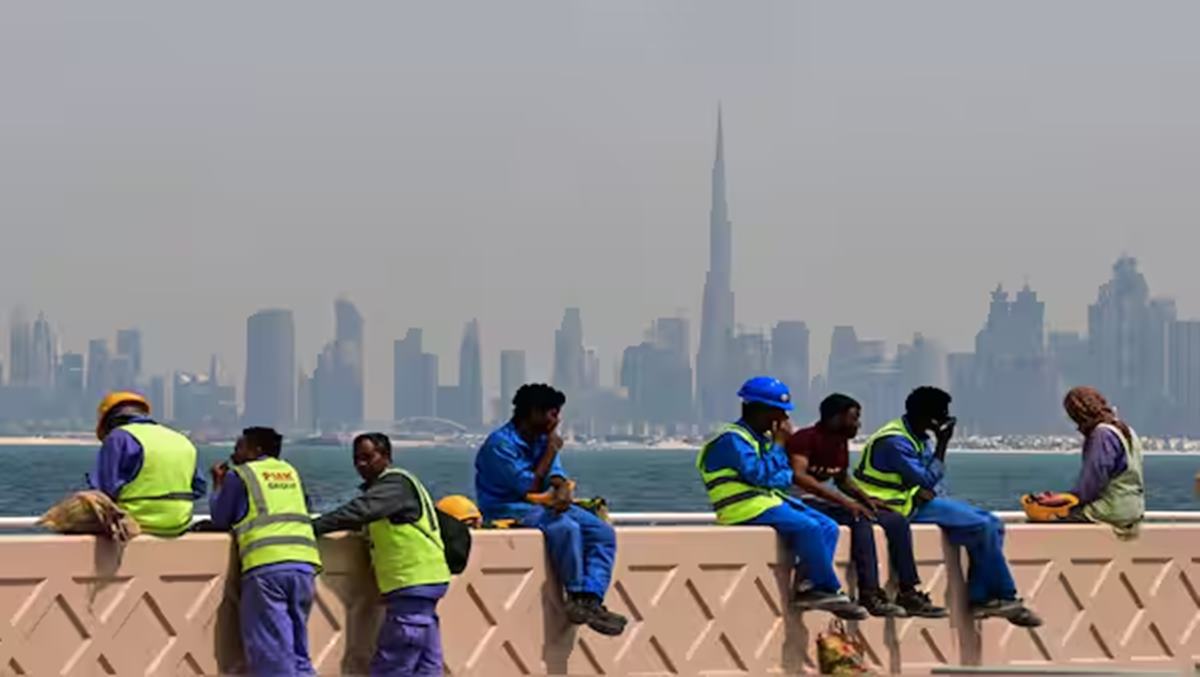
“Without money, we will die here as well,” said 37-year-old Dilip Yadav from Bihar’s Saharsa, who has been working as a mechanical fitter in Dubai for nearly a decade. His sentiments echo the feelings of many Indians who have chosen to stay behind in the Gulf countries even as they come under attack by Iran amid the West Asia conflict.
Despite the intensification of the war, Iran continues to target the United Arab Emirates, Saudi Arabia, Bahrain, Kuwait, Qatar, and Oman — many Indian blue-collar workers are staying put in the war-struck nations rather than return home, with the hope of protecting their jobs and supporting their families back home.
Many like Yadav believe that the rain of missiles and drones are not enough of a reason to quit jobs that they view to be more lucrative than what they would find back home.
The many Indians living across the Gulf
As of early 2025, there were over 8.5 million Indians residing and working in the Gulf Cooperation Council (GCC) countries. Figures reveal that the UAE hosts the highest number of Indians — over three million — followed by Saudi Arabia (over 2.7 million), Kuwait (a little more than one million), and Qatar with 0.8 million.
Many of these Indians employed in the Gulf are blue-collar employees — hotel employees, labourers, and drivers.
Ever since the war began on February 28 — with the US and Israel striking Iran, killing Ayatollah Ali Khamenei, prompting Tehran to hammer down on the Jewish nation and other West Asian countries — the Indian blue-collar workers have been disproportionately affected.
As Uday Chandra, a professor at Ashoka University in India’s Haryana explained, “For lower-income migrants, the war is not just an inconvenience. They tend to have limited savings, depend on scheduled leave, and cannot simply pay for higher ticket prices, extra hotel nights, lost workdays, and uncertainty over their future visa and employment status.”
Indians caught between war and work
For the millions of Indians living in the Gulf countries, it’s become Sophie’s choice: to continue to stay there or return home to India.
And many of them are opting for the more dangerous option — of staying back in the Gulf to work. As Faraz Wamiq, who works in the retail sector in Riyadh, told India Today, “We are more worried about our jobs than our lives right now. We want to come back, but if we leave now, there’s no guarantee we’ll get this opportunity again.”
Mohammad Ahmed, an automobile engineer in Jeddah, echoed similar sentiments. “My family calls me every day, asking me to come back. They say we’ll manage somehow even if it’s just bread and salt.
“But if I return, what job will I do in India? How will I fund my children’s education? That fear is bigger than the war right now,” he added.
And despite the Iran war escalating — until now, eight Indians have died as Tehran continues to hammer down on the Gulf nations — many Indians are choosing their jobs over safety, saying it’s not really a choice.
Moreover, the demand to work in the Gulf hasn’t waned despite the dangers. Twenty-two-year old Jagdish from Jharkhand told Times of India, “My mother and unmarried sister are at home. We are poor, and need to build a house and get my sister married. I have no option but to go.”
When asked if he’s worried about the war, he added, “If death has to come, it can come here as well.”
Mohammad Asif, who is heading back to Dubai, was also quoted as saying, “My family doesn’t want me to go, but what choice do I have? If I lose my job, everything collapses. We are going back to work under the shadow of war because survival depends on it.”
Harsh Ramaswamy, an independent political commentator based in India, summed it up perfectly to the South China Morning Post. “Once they leave, they won’t know where to go.”
They further point to the difference in wages. As Yadav explained to the Times of India, “Here I get Rs 10,000 a month. There, the pay can go up to Rs 45,000. Overtime is extra, and accommodation and food allowances are provided. Dubai is better.”
Jageet Singh, 40, a heavy-duty driver from Punjab’s Sangrur district preparing to travel to West Asia for the fourth time, said the earnings difference remains significant. “People go there out of compulsion. Without money, we will starve here as well,” he told TOI. “You get overtime, insurance, and hospital facilities abroad. Here, drivers work round the clock but most of them aren’t paid extra.”
Even Indians who work in white-collar jobs in the Gulf cite the wage difference as the primary factor why they choose to work amid the war. “In India, I earned Rs 40,000-50,000 a month. In Dubai, I earn close to Rs 2 lakh. I support my entire family. If I go back now, can I earn that much? No. So I stay, even if missiles are flying overhead,” said a telecom professional to India Today.
But some Indians choose to return home
However, not all Indians are choosing to risk their lives. Since the partial reopening of airspace in some war-affected areas, more than 52,000 Indian citizens stranded in the Gulf region have returned home between March 1 and March 7, said the Ministry of External Affairs.
Returnees have also shared their troubling accounts of the war. Sanjeev, who was in Dubai, recalled sirens and drone alerts. “Interceptions took place mid-air. The sound caused panic because many of us were experiencing this for the first time,” he told NDTV.
Until the war, the Gulf countries were considered safe havens where people could build their lives. However, as the war stretches into the 35th day, many Indians are asking if it still can be a safe and viable option for them.
Source – https://www.firstpost.com/explainers/iran-war-indians-gulf-countries-job-safety-risks-13996213.html