













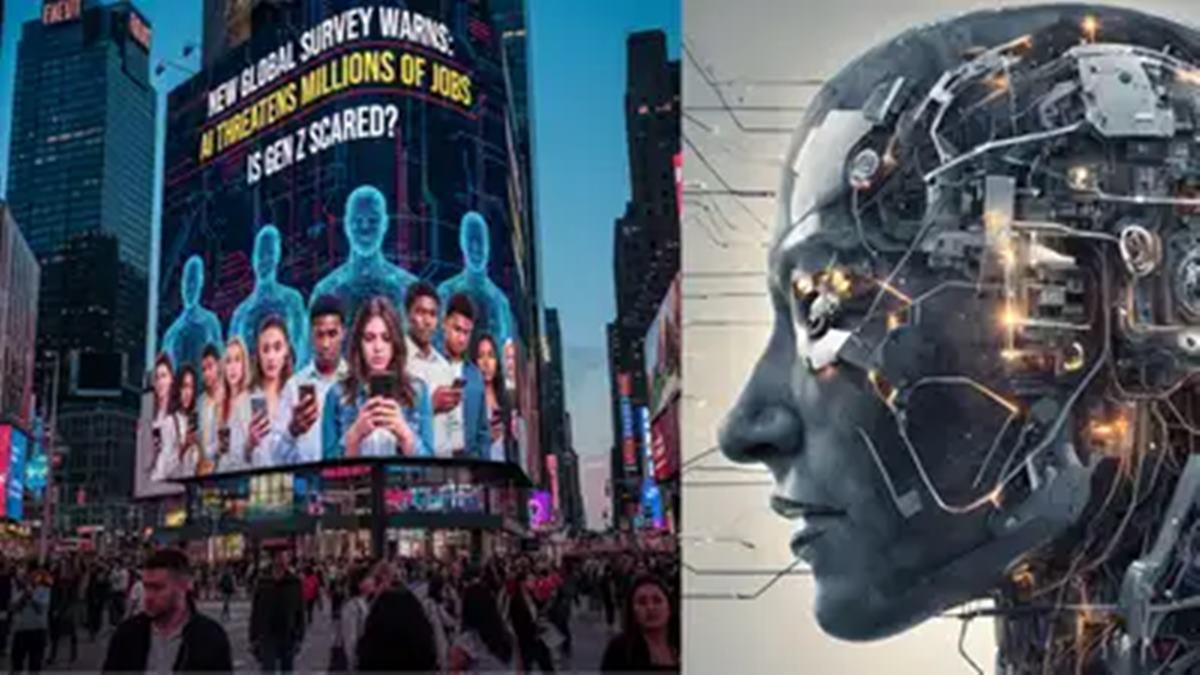


Artificial Intelligence is no longer just reshaping industries — it is rewriting the rules of employability itself. Across sectors such as technology, banking, retail, healthcare, marketing, logistics, and customer service, companies are rapidly hiring for AI-related roles at a pace that traditional education systems are struggling to match.
The result is a growing gap between what universities are teaching and what employers actually need.
The Rise of the AI-First Workforce
Over the past two years, the explosion of generative AI tools, automation platforms, AI copilots, and machine learning applications has created an entirely new category of jobs. Roles such as Prompt Engineers, AI Trainers, AI Auditors, Conversational Designers, Automation Specialists, AI Ethics Consultants, and GenAI Product Managers barely existed a few years ago. Today, they are among the fastest-growing positions across global markets.
According to industry reports, AI-related job postings have surged significantly since the mainstream adoption of generative AI. Companies are not just hiring engineers anymore — they are looking for professionals who can work alongside AI systems, train them, monitor outputs, optimize workflows, and improve customer experiences.
What is surprising is that many of these jobs do not necessarily require a traditional computer science degree.
Instead, employers are increasingly prioritizing adaptability, practical AI skills, problem-solving ability, and domain expertise over formal qualifications.
Degrees Are Struggling to Catch Up
Universities and academic institutions traditionally take years to redesign curriculums. AI, however, evolves every few months.
By the time a new syllabus on machine learning or generative AI gets approved, the tools, models, and business applications may already be outdated. This lag has created a mismatch between graduates entering the workforce and the expectations of employers.
Many colleges still focus heavily on theoretical learning, while companies need hands-on familiarity with tools such as AI copilots, automation platforms, large language models, and workflow orchestration systems.
As a result, organizations are increasingly turning toward certifications, boot camps, online learning platforms, and skill-based hiring models.
In many cases, self-taught professionals with strong AI portfolios are being preferred over candidates with traditional degrees but limited practical exposure.
The New “Skill Economy”
The AI boom is accelerating the shift from a degree-based economy to a skill-based economy.
Employers now value:
- AI literacy and tool familiarity
- Data interpretation skills
- Prompt engineering capabilities
- Critical thinking and creativity
- Human-AI collaboration skills
- Communication and adaptability
This change is especially visible in industries beyond core technology.
Banks are hiring AI operations specialists to improve customer support automation. Retail companies are recruiting AI-driven demand forecasting experts. Media firms are onboarding AI-assisted content strategists. Healthcare providers are using AI workflow analysts to streamline patient operations.
Even non-technical roles are evolving rapidly because AI is becoming embedded into daily workflows.
AI Is Not Just Replacing Jobs — It Is Changing Them
The conversation around AI has largely focused on job displacement. However, a more nuanced reality is emerging: AI is transforming jobs faster than it is eliminating them.
Rather than removing humans entirely, many organizations are redesigning roles so employees can work with AI systems instead of competing against them.
For example:
- Customer service executives now manage AI chatbots and handle escalations.
- Marketing teams use AI tools for campaign ideation and personalization.
- HR professionals rely on AI for screening and employee engagement analysis.
- Financial analysts use AI-assisted forecasting tools for faster decision-making.
This evolution means workers must continuously upgrade their skills, regardless of their educational background.
The Pressure on Educational Institutions
The rapid pace of AI innovation is forcing universities and business schools to rethink how education itself is delivered.
Several institutions are now introducing:
- AI-integrated curriculums
- Industry partnerships
- Project-based learning
- Short-term certification programs
- Real-world AI lab environments
However, experts believe the challenge is bigger than simply adding AI subjects.
The real shift requires teaching students how to learn continuously, adapt quickly, and work alongside intelligent systems in dynamic environments.
In the AI era, learning is no longer confined to a four-year degree. It has become an ongoing professional requirement.
The Future Belongs to Fast Learners
As AI adoption accelerates globally, the workforce is entering an era where skills may matter more than static qualifications.
Degrees will still hold value, especially for foundational knowledge. But employers are increasingly rewarding candidates who can demonstrate agility, curiosity, and practical AI fluency.
The future workforce may not be defined by who has the best degree — but by who can adapt the fastest.
And in a world where AI evolves every quarter, continuous learning could become the most valuable career skill of all.
Source – https://cxotoday.com/media-coverage/ai-is-creating-jobs-faster-than-degrees-can-keep-up/