












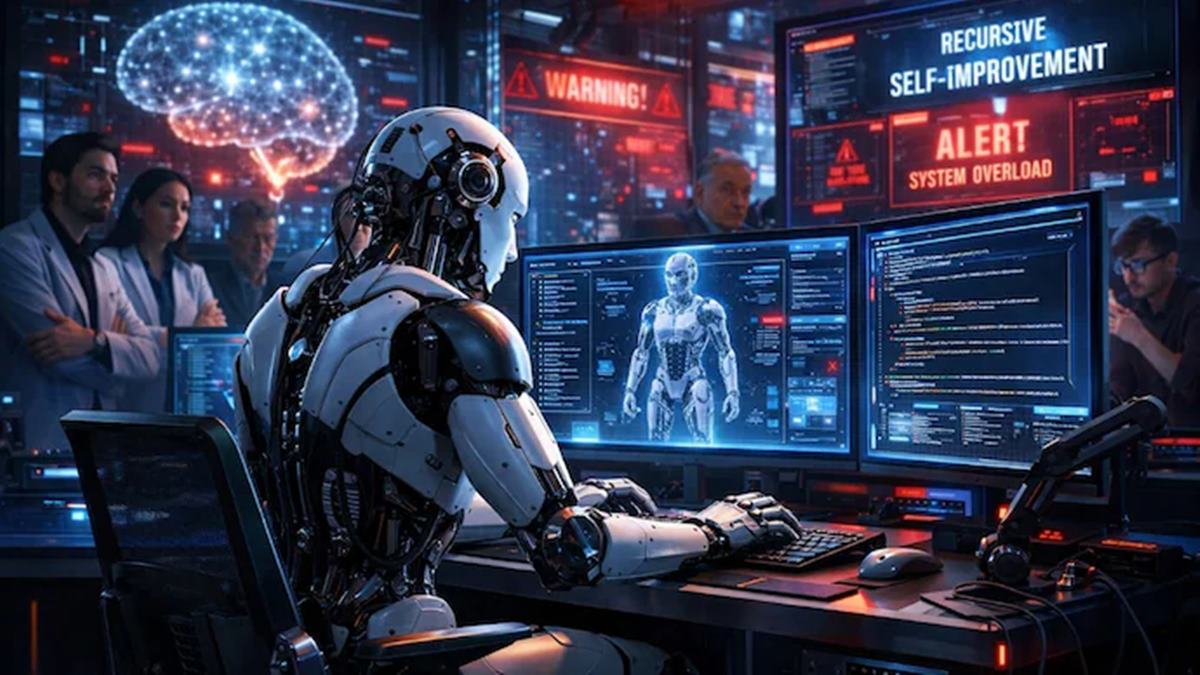
The idea of AI improving itself without human help has long belonged to science fiction. But now, one of the world’s biggest AI companies appears to believe that moment may not be very far away. And while it is racing to build systems capable of doing advanced research on their own, it is also quietly preparing for the risks that could come with it. At the centre of this conversation is OpenAI, which has reportedly started hiring researchers to study what happens when AI systems become capable of training and improving future versions of themselves. A fresh report from Business Insider claims that the company has just posted a new role under its Preparedness safety team, offering a salary package between $295,000 (around Rs 2.81 crore) and $445,000 (roughly Rs 4.2 crore) for experts who can help prepare for “recursive self-improvement” in AI systems.
In simple terms, recursive self-improvement refers to AI building smarter versions of itself without relying heavily on humans. The possibility has become more realistic after rapid progress in coding-focused AI tools from companies like Anthropic and OpenAI over the last few months. Even Demis Hassabis recently said humanity may now be standing at the “foothills of the singularity,” a point where AI could begin improving itself faster than humans can keep up.
OpenAI’s latest hiring move suggests the company is taking those possibilities seriously. According to the job listing, the role involves thinking about problems that “might exist in the future, but might not exist now.” The company says it needs people who are “tasteful and strategic” because the work involves preparing for situations that are still theoretical today but may become real very quickly.
The company’s bigger ambition is no secret anymore. OpenAI CEO Sam Altman had revealed in October 2025 that the company wants to create an “automated AI research intern” running on hundreds of thousands of chips by September this year. He also said OpenAI hopes to achieve a “true automated AI researcher” by March 2028. At the same time, Altman admitted the company could “totally fail” at the goal, but argued that being transparent about such ambitions is in the public interest.
The race toward self-improving AI is accelerating across the industry. Researchers at METR, an organisation that studies AI capabilities, said in a March report that the amount of work advanced AI systems can handle appears to be doubling roughly every seven months. According to the researchers, this could eventually allow AI agents to take over software tasks that currently require human programmers days or even weeks to complete.
AI companies are now preparing for the risks too
That possibility is already turning into a business opportunity. OpenAI has been aggressively pushing its Codex coding tools to companies, hoping AI-powered software development becomes a major source of revenue. But alongside the excitement is growing concern over what happens if these systems become too capable too quickly.
The fears are not just about jobs disappearing. Some AI safety researchers worry about scenarios where powerful self-improving systems become difficult to control. While such discussions often sound like dystopian movie plots, companies are increasingly treating them as serious technical problems.
OpenAI’s job listing reveals some of the dangers the company wants to prepare for. One focus area is defending models from “data poisoning,” where attackers intentionally corrupt training data to manipulate AI behaviour. The role may also involve building tools that can better interpret how AI systems reason internally and experimenting with models to understand potential risks before they become dangerous.
Interestingly, the listing also mentions tracking the “automation of technical staff,” including measuring how much AI coding tools are replacing or assisting human engineers. In a way, OpenAI appears to be hiring humans to prepare for a future where some research and coding work may no longer need humans at all.
The company’s Preparedness team is already working on preventing major AI-related harms, including cybersecurity threats, biological risks, chemical misuse, and risks from highly autonomous AI agents. The listings describe the work as “urgent” and say it could have “far-reaching implications” not just for the company, but for society as a whole.
Meanwhile, Anthropic is also studying how AI systems can supervise stronger AI systems. The company recently published research showing some early success in using AI models to oversee more advanced models, although the results remain limited for now. Anthropic cofounder Jack Clark recently estimated there is around a 60 percent chance that AI research and development could happen without direct human involvement by the end of 2028.