


















The Supreme Court’s latest ruling may have settled a legal question, but it has reopened a much larger social one.
The court recently held that candidates cannot use higher educational qualifications to claim jobs specifically meant for people with lower qualifications. In the case before it, a graduate had concealed his degree to secure a bank attendant post intended for candidates educated only up to Class 10. The court ruled that doing so deprived genuinely eligible candidates of a fair opportunity.
From a recruitment standpoint, the logic is clear. If a job is created for a certain educational category, allowing people outside that category to enter the competition defeats the purpose.
But the ruling also raises an uncomfortable question.
If graduates, engineers, MBA holders and even PhD holders are repeatedly applying for peon, sweeper and attendant jobs, what does that say about India’s job market?
The answer may be found in a troubling statistic. According to the State of Working India 2026 report, around 67% of unemployed Indians aged 20-29 are graduates.
In other words, many highly educated Indians are not applying for low-level jobs because they want to.
They are applying because they cannot find jobs elsewhere.
FROM ENGINEERING DEGREE TO SWEEPER APPLICATION
India has witnessed this phenomenon repeatedly over the past decade.
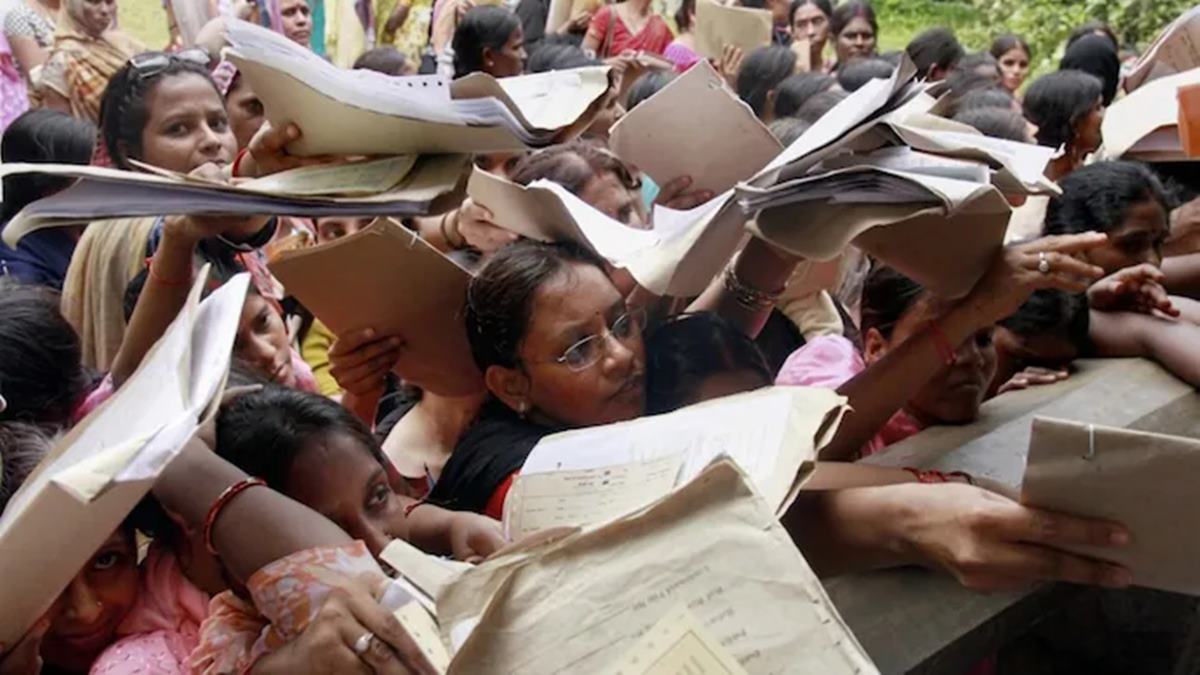
Whenever a major government recruitment drive opens for Group D or equivalent posts, lakhs of applications flood in. Among them are often candidates with qualifications far beyond what the job requires.
The jobs may involve clerical assistance, peon duties, cleaning work, maintenance work or other responsibilities that require only Class 10 or Class 12 qualifications.
On paper, this looks absurd.
Why would someone spend years earning an engineering degree, an MBA or even a PhD only to apply for a sweeper’s job?
But the answer is simple — a government job is still a government job.
It offers stability, predictable income, healthcare benefits, social prestige and long-term security. In many families, a permanent government position remains more desirable than an uncertain private-sector career.
For someone facing months or years of unemployment, a secure Group D position can appear more attractive than endlessly waiting for a job that matches their education.
And this is not a one-off phenomenon.
WHEN OVERQUALIFIED APPLICANTS FLOOD LOW-SKILL JOBS
Some of the most striking examples from recent years include:
April 2025: Rajasthan received over 24.76 lakh applications for 53,749 peon posts. Applicants reportedly included PhD holders, MBAs, law graduates and civil services aspirants.
October 2023: In Kerala, peon posts requiring only Class 7 education and cycling skills continued attracting BTech graduates and degree holders because of the security attached to government employment.
June 2023: More than 55 lakh candidates applied for SSC MTS recruitment, including graduates, engineers and postgraduates competing for Group D jobs.
October 2020: Engineering graduates, master’s degree holders and research scholars applied for forest assistant posts in West Bengal that required only a Class 8 qualification.
November 2019: Around five lakh candidates, including engineers, MBAs and postgraduates, applied for gardener and watchman posts in Bihar Vidhan Sabha.
November 2019: Nearly 7,000 engineers, graduates and diploma holders applied for 549 sanitary worker positions in Coimbatore.
February 2019: Tamil Nadu Assembly Secretariat received 4,600 applications for sweeper and sanitary worker jobs, including many candidates with professional degrees.
July 2018: Around 5 lakh applicants, many of them engineers and PhD holders, competed for just 4,257 guest teacher vacancies in Bihar government schools.
August 2016: Around five lakh applicants, including graduates and postgraduates, competed for 3,275 sweeper posts in Kanpur.
January 2016: Nearly 19,000 graduates and postgraduates applied for sanitation worker posts in Amroha, Uttar Pradesh.
Taken together, these incidents reveal something important. This is not merely a recruitment anomaly. It is a recurring feature of India’s labour market.
INDIA’S EDUCATED UNEMPLOYMENT PROBLEM
The numbers help explain the desperation.
India’s overall unemployment rate may not appear alarming, but educated unemployment tells a very different story.
According to the latest Periodic Labour Force Survey, graduate unemployment stood at 11.2%, more than three times the national unemployment rate.
The situation becomes even more concerning among young people.
The State of Working India 2026 report by Azim Premji University found that nearly 40% of graduates aged 15-25 were unemployed, while roughly 20% of graduates aged 25-29 remained jobless.
The report estimated that around 1.1 crore graduates aged between 20 and 29 were unemployed in 2023.
Perhaps the most striking finding was this: nearly two-thirds of unemployed young Indians are now graduates.
For years, unemployment was often associated with lack of education.
Today, the face of unemployment increasingly holds a degree certificate.
THE GREAT INDIAN EDUCATION PROMISE
For decades, Indian families were told a simple story.
Study hard, get a degree, get a good job, move up the social ladder — that promise shaped millions of households.
Parents who never completed school pushed their children towards college. Families borrowed money for higher education because it was seen as the safest route to a better life.
For a long time, that logic worked.
But higher education has expanded much faster than high-quality job creation.
Universities have multiplied. College enrolment has surged. Every year, millions of new graduates enter the labour market.
Yet graduate-level jobs have not grown at the same pace.
The result is a strange paradox.
In previous generations, families often told children, “At least pass Class 10.”
Today, many families say, “At least get a graduation degree.”
But if a bachelor’s degree becomes the minimum expectation rather than a competitive advantage, is graduation slowly becoming the new Class 10?
The comparison may sound extreme, but it reflects a real shift. A generation ago, completing Class 10 was seen as an achievement. Today, many families treat a bachelor’s degree as the bare minimum.
The problem is that while educational expectations have risen dramatically, graduate-level opportunities have not grown at the same pace.
IS THE DEGREE LOSING ITS POWER?
A degree hasn’t lost its power completely in India. It still improves earning potential and remains essential for many professions. But it no longer guarantees employment.
That distinction matters.
Employers today increasingly focus on skills alongside qualifications.
Can the candidate code?
Can they analyse data?
Can they communicate effectively?
Can they solve problems?
Can they adapt to new technology?
Industry surveys have repeatedly highlighted gaps between what graduates learn and what employers need. At the same time, employers complain of talent shortages while graduates complain of job shortages.
Both can be true.
But another global trend is worth watching.
In several Western countries, rising tuition costs and changing hiring practices have triggered debates about whether a traditional degree is worth the investment for everyone. Major technology leaders, including Elon Musk, have publicly argued that skills and demonstrated capability matter more than formal qualifications for many jobs.
Large employers increasingly hire based on portfolios, certifications, work samples and practical assessments.
Online learning platforms, AI tools such as ChatGPT, global courses and skill-based certifications have made it easier than ever to learn outside a traditional classroom.
India is not there yet.
A college degree still carries immense social value here. But young people are beginning to ask difficult questions.
If a graduate ends up driving a cab, delivering food or preparing for government exams for years after college, what exactly did the degree deliver?
There is nothing wrong with any honest profession. The problem is the mismatch. Most people naturally hope that the years they spent studying will eventually align with the work they do.
If degrees become more common while suitable jobs remain scarce, students may increasingly ask whether four years in college offer a better return than learning specific skills online and entering the workforce earlier.
That is why rulings like the Supreme Court’s can create anxiety. For some young people, it may feel as though even the fallback options are disappearing.
After all, if a graduate cannot find a graduate-level job and is also prevented from competing for jobs meant for lower-qualified candidates, some will inevitably begin asking whether higher education is opening doors or closing them.
THE PROBLEM IS BIGGER THAN SKILLS
However, blaming everything on skills would be too convenient.
If millions of graduates remain unemployed, the explanation cannot simply be that millions are individually unemployable.
Job creation matters too.
The State of Working India report argues that the central challenge is the shortage of stable salaried jobs rather than educational expansion itself.
Many graduates eventually find work, but often in temporary roles, informal employment or jobs that make little use of their education.
In other words, they are employed but underemployed.
An engineering graduate delivering food, a postgraduate preparing for government exams for years, or an MBA working in a role that requires only basic schooling all point to the same issue.
The economy is not fully absorbing the talent it is producing.
That makes the problem a double-edged sword. India faces skill mismatches in some sectors while facing a shortage of suitable jobs in others. Both realities can exist together.
That is what makes the situation so difficult to solve. India appears to have both a skills gap and an opportunity gap. Some graduates struggle because they lack the job-ready skills employers want. Others struggle because there simply are not enough suitable jobs for the growing number of degree holders entering the workforce every year.
The result is a generation caught between rising educational expectations and a labour market that often cannot absorb them. If someone spends years earning a degree only to find that graduate-level jobs are scarce, while lower-qualification jobs are increasingly out of reach, frustration is inevitable.
There is nothing wrong with driving a cab, delivering food or taking any honest job. But most people pursue higher education in the hope that it will open more doors, not fewer.
When engineers, MBA holders and PhDs start competing for peon and sweeper posts, the real story is not about those jobs. It is about what that competition reveals about the state of job opportunities in India.
WHAT THE SUPREME COURT RULING REALLY EXPOSES
The Supreme Court judgment was about recruitment rules. But it unintentionally shines a spotlight on a much bigger challenge.
If highly qualified candidates should not compete for jobs meant for lower-qualified workers, society must also ask whether enough suitable jobs exist for those highly qualified candidates.
Because telling graduates not to apply for peon jobs is easy. Creating meaningful employment opportunities for them is much harder.
The judgment protects opportunities for lower-qualified candidates, and there is a strong argument for why it should. Yet it also exposes a paradox at the heart of modern India.
The country has spent decades encouraging young people to study longer, earn more degrees and become more qualified. Millions followed that advice.
Today, many of them are not competing for dream jobs. They are competing for any available job.
That may be the most important question hidden inside this court case. The real issue is no longer whether graduates should apply for Group D posts. It is why so many feel they have to.
If highly qualified young people are increasingly shut out of lower-qualification jobs, the pressure to create more graduate-level opportunities becomes even greater.
Otherwise, India risks creating a generation that did everything it was told to do, earned every qualification it was asked to earn, and still ended up wondering whether the degree was worth it.