













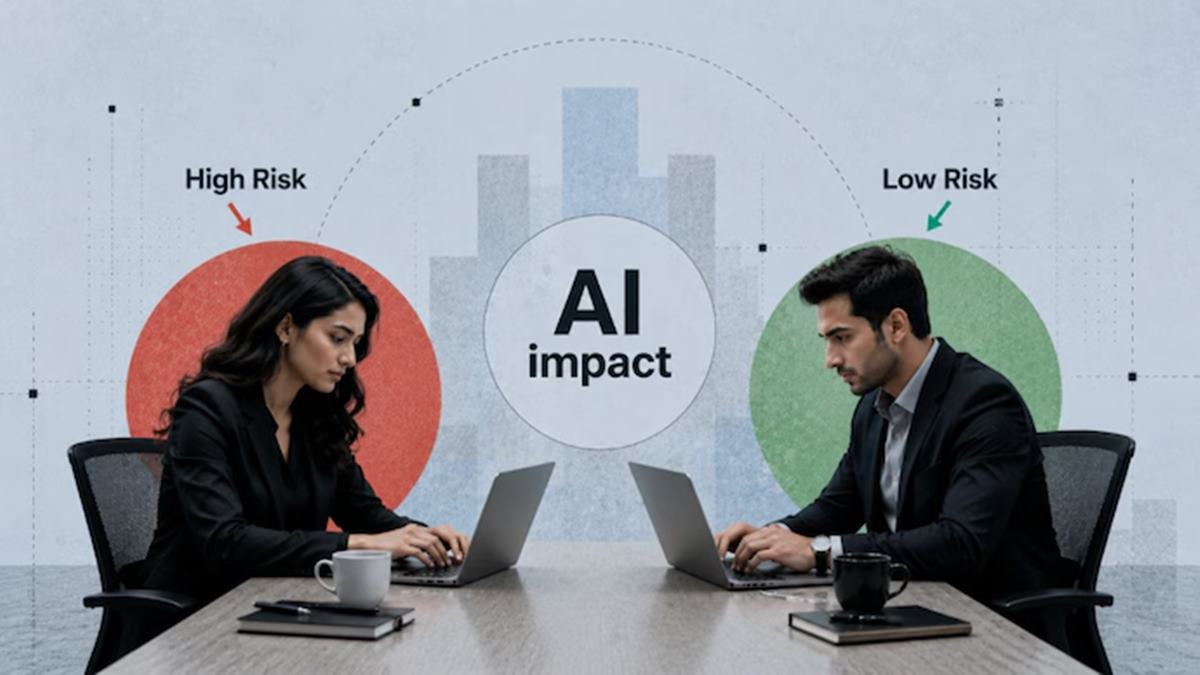
Artificial intelligence (AI) is changing the world. Almost every major company is investing in AI, which in many cases, has often resulted in layoffs or job cuts. Be it Amazon, Meta, Oracle, companies across the board have reduced their workforce in the last few months. And now, a new study suggests that when it comes to losing jobs, women may be the one with a higher risk than men.
A study by the US National Partnership for Women & Families claims that AI could be more of a threat for women workers. The study claims that while women make up roughly 47 per cent of the US workforce, they account for 83 per cent of workers in 15 occupations that are deemed most vulnerable to AI.
While it focusses on the US workforce, it gives us some clue about what we can expect even in the Indian workforce.
Women workers likely to be more vulnerable to AI
The study focusses on 15 occupations that are likely to be the most vulnerable to AI. This includes secretaries, receptionists, office clerks, insurance agents and more. It states that around 6 million women work in these AI-vulnerable occupations. These women are likely to have lower adaptive capacity and resources, which can make it even more difficult to adjust to a more AI-driven future.
Now, in some cases, women are concentrated in care sectors such as nursing, child care and home health care, where jobs are less likely to be fully automated simply because they require human connection, physical presence and interpersonal skills. But the study indicates that even in those sectors, workers may still be affected by AI through management and surveillance systems.
These management systems, sometimes described as bossware, can be difficult for workers to understand or challenge, and may worsen job quality even where jobs are not eliminated.
Underrepresentation, gender bias in AI
Another issue here, the report says, is the fact that women remain underrepresented in the AI development workforce — be it software engineering or leadership roles. The study states, “This underrepresentation means women have less influence over how AI systems are designed, deployed and regulated – even as these systems increasingly shape their work lives.”
The report points to research showing that biased training data can produce biased outputs. In one experiment, ChatGPT generated resumes using typically male and female names and produced resumes for women that presented them as younger and less experienced. When the AI was later asked to evaluate those resumes, it rated older men’s resumes higher.
Women more likely to be targeted with AI
While women may be behind in terms of AI adoption, the study claims that they may also face stronger professional penalties for using AI at work. It cites a case in which participants judged identical code snippets labelled as written either with or without AI assistance. When a woman was believed to have used AI, the competency penalty was more than double that applied to a man for the same output.
And the problems don’t end just in the professional landscape. As per the study, AI has opened up new ways to target women. There have been incidents online when users have used AI to generate inappropriate deepfakes of women. Grok, chatbot of Elon Musk’s xAI, was infamous for stripping people to bikinis on X when prompted by users.
Are women using AI less than men?
As per the research, there was a 25 per cent gap in the use of generative AI tools by women compared with men across 18 studies. It also suggested that women are less likely to report using AI tools at work.
Though, on the other hand, the report also indicates that overall use of generative AI by women has been rising. Users with typically female names accounted for 42 per cent of ChatGPT’s 200 million users between 2022 and 2024, and by July 2025 likely women users made up a slight majority.
The brief says they were more likely to use the tool for writing tasks and practical guidance, but notes that more than 70 per cent of ChatGPT use is not work-related, making workplace adoption harder to measure precisely.
While AI’s impact on women workers is not fixed at the moment. The study claims that the future will depend on policy choices and workplace practices. And how these systems are followed.