






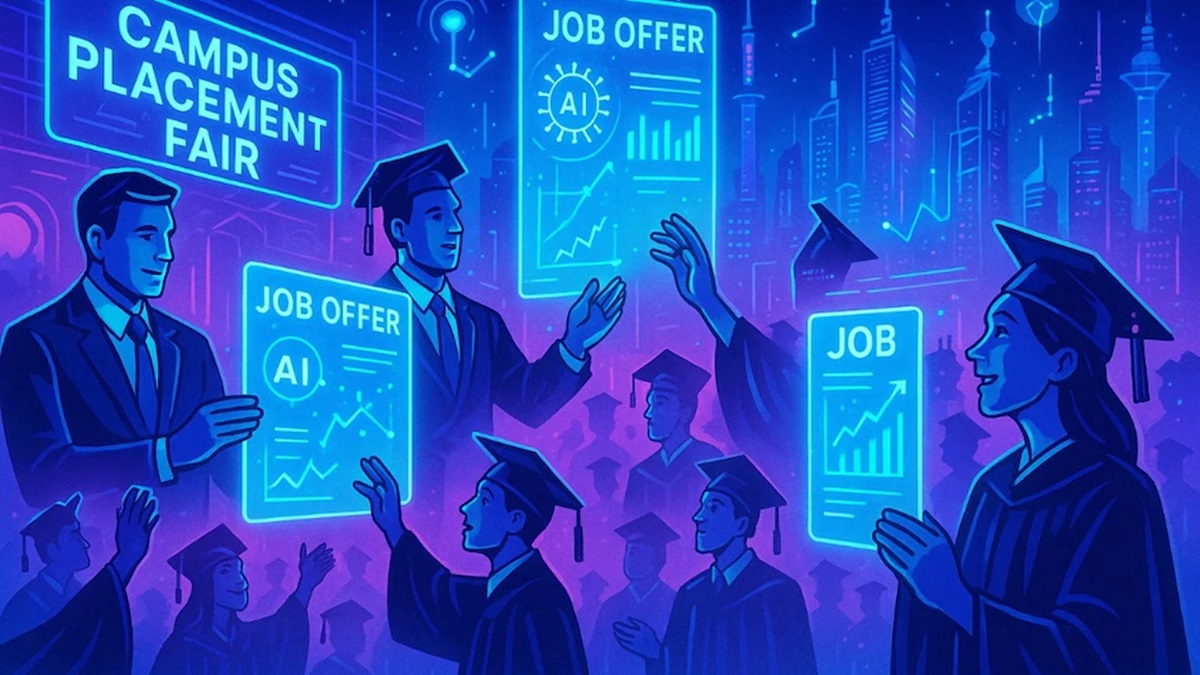













The New Year 2026 begins with new hopes, challenges, and countless goals. These goals may be long-term or short-term, and hopefully, you have already set targets for the year. However, it would be unrealistic to think about achieving these targets without considering the role of Generative Artificial Intelligence (AI).
Thanks to AI, your promotion, salary increases, and even job security will increasingly depend on how effectively you use it. If you are a businessman, your profits and losses will be influenced by AI. Even farmers will see their productivity and income affected by AI. From kitchens to transportation, AI is transforming every aspect of life.
AI’s impact on education
AI has profoundly changed education. Relying solely on books, notes, and memorization is now a thing of the past. Teachers must adapt to new AI tools and help students learn how to find information efficiently, draft emails quickly, plan tasks, and prepare presentations using AI.
To succeed in 2026, you will need to be an AI expert
India, with its population of over 1.4 billion, is gradually recognizing the importance of AI across society, systems, and infrastructure. One clear sign of this shift is that AI will be introduced in schools starting from class three. NCERT is also preparing textbooks for classes 11 and 12 that include special modules on AI. Students trained in traditional methods may find it difficult to secure their future in this rapidly changing world.
Smartphones have put AI in the hands of everyone
Artificial intelligence is now part of daily life. Smartphones, powered by the internet, have put generative AI within easy reach. Anyone can leverage these tools to improve skills, efficiency, and productivity. Early exposure to AI helps children integrate technology into their studies and projects. Classes 11 and 12 will teach AI in greater depth.
The national program “Skilling for AI Readiness” has been launched to raise awareness among students from classes 6 to 12 and familiarize teachers with new technologies. AI education is not limited to schools and colleges. Police are using AI to catch criminals and reduce crime, and officers are being trained to use it effectively.
Across industries, AI is transforming jobs. Students must learn AI from the start and remain adaptable, developing skills to experiment and embrace change. People of all ages should have practical pathways to update their skills according to technological advancements.
A few weeks ago, I met an engineering aspirant who said: “Even if I get admission to IIT, NIT, or any good engineering institute, what difference does it make? The engineering studies I work hard on for four years might already be outdated by the time I graduate.”
This concern is valid. There is no guarantee that what students learn today will be useful tomorrow. Regardless of their field, students must focus on two things: becoming experts in AI and being lifelong learners, ready to acquire new skills.
Tech tycoon Elon Musk has predicted that in the next 10–20 years, AI and robotics may advance to a point where human labor becomes largely unnecessary. Office stress could decrease as AI-driven robots handle construction, manufacturing, and services. Driverless cars will dominate transport, and by 2026, humanoid robots may be operating in various sectors across India.
Possible Changes in work culture
Offices will increasingly rely on Generative AI. Companies aiming to cut costs and improve productivity will adopt AI and robotics. By 2026, employees who can leverage AI effectively will be the most successful. Managers who can delegate tasks to machines and monitor AI-driven operations will be in high demand.
Robots will gradually enter domestic spaces as well. Companies are developing AI-powered robots that can cook and clean, personalized to serve owners efficiently without fatigue. Trained with large language models, these robots will understand human instructions quickly and assist households by 2026.
Humanoid robots the future
Humanoid robots performing household chores are gaining attention. Tech companies worldwide have been training robots for domestic work for years. AI-equipped humanoid robots are being developed to follow commands and complete tasks efficiently. With just a few hours of data, these robots could fold clothes, sort trash, perform kitchen work, serve guests politely, and manage cleaning, making them capable household assistants.
Global development of humanoid robots
From the U.S. to China, humanoid robot development is progressing rapidly. Tesla’s Optimus humanoid robot currently costs $20,000–$30,000 (₹18–27 lakh), while China produces robots priced between ₹5–25 lakh. By 2050, there could be 300 million to 1 billion humanoid robots globally. Bank of America estimates that by 2060, there could be 3 billion robots worldwide, meaning one robot could serve every three humans.
In India, adoption of humanoid robots is slower due to high costs, limited trust, and safety concerns. AI could also be used to monitor employee performance by tracking typing speed, mouse clicks, and screen activity.
AI in agriculture
India relies heavily on agriculture, with nearly half the population depending on farming. AI is transforming this sector, helping farmers reduce costs and increase production. AI can provide data on wind speed, rainfall, temperature, humidity, and soil health, and recommend optimal crops, sowing and harvesting times, irrigation, and fertilizer use. Drones and cameras can monitor crops continuously and alert farmers to pests or diseases.
Use of AI in sugarcane cultivation
In Maharashtra’s Baramati region, farmers are using AI in sugarcane cultivation. High-tech sensors measure soil conditions and send updates to farmers’ smartphones. These alerts have helped increase yields by around 30% across India. This is especially beneficial for farmers with small fields, allowing them to maximize output.
To increase the number of high-tech farmers, AI adoption is essential. It reduces costs, mitigates risks, and boosts overall profits. Studies suggest AI could increase global productivity by up to 40%, but it may also widen societal divisions.
With AI, the wealthy have easier access to technology, allowing them to gain monetary advantages. According to the 2026 World Inequality Report, the top 1% in India owns 40% of the wealth, the top 10% share 58% of the income, and the bottom 50% earn only 15%. Generative AI may further widen this gap.
Historically, economic inequality has posed a greater threat to democracies than dictatorships, fostering discontent, resentment, and unrest. In 2026 and beyond, AI has the potential to create a prosperous and innovative future, but it must be implemented responsibly. While tech tycoons race to reshape the world with AI, it is equally important to ensure these advancements are socially responsible and human-centric