


















In 2022, Rishabh Mishra joined a high-ranking engineering college in India’s Jabalpur with the most predictable dream in global tech: study computer science, write code, and one day make it to Silicon Valley.
Three years later, Mishra faces a sobering reality.
Artificial intelligence has gutted entry-level roles in the tech industry that Mishra and his classmates were counting on. Among his 400 classmates at the Indian Institute of Information Technology, Design and Manufacturing, fewer than 25% have secured job offers. His course ends in May 2026, and there’s a sense of panic on the campus.
“It is really bad out there,” Mishra told Rest of World. “Everyone is so panicked — even our juniors. As the degree end nears, the anxiety is heightened among all of us.” Some of his classmates are exploring the option of pursuing higher studies before entering the job market. “But after one year, if you return to the job market, your degree is even more irrelevant,” he said.
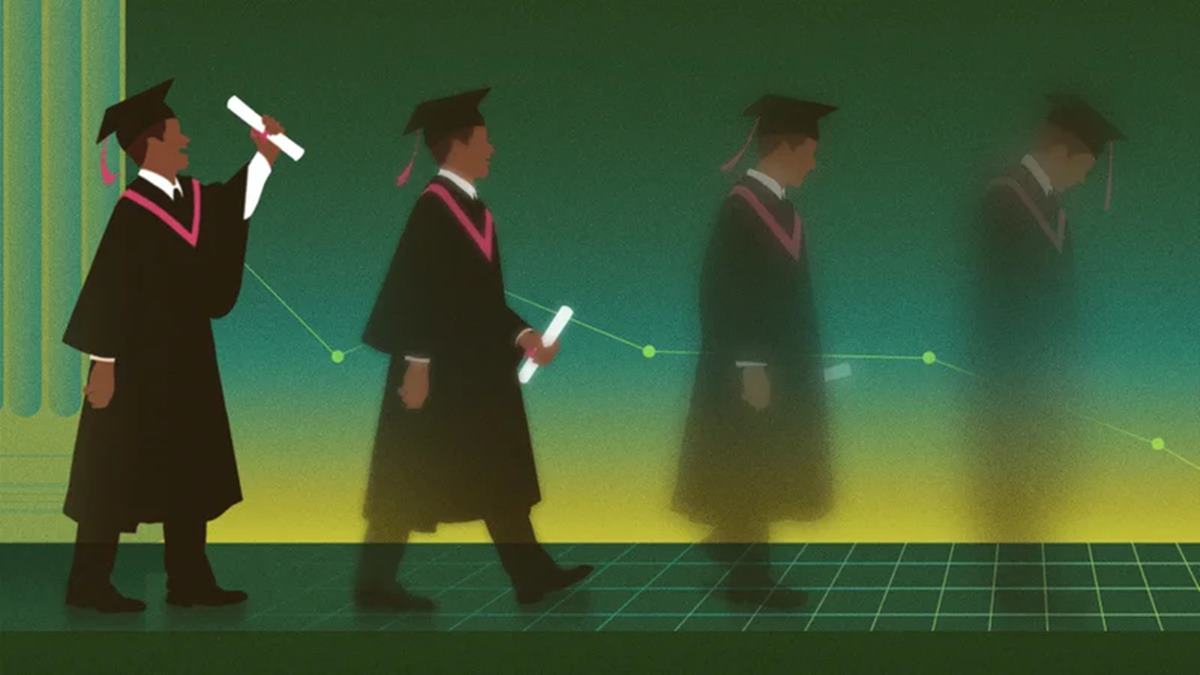
Students at engineering colleges in India, China, Dubai, and Kenya are facing a “jobpocalypse” as artificial intelligence replaces humans in entry-level roles. Tasks once assigned to fresh graduates, such as debugging, testing, and routine software maintenance, are now increasingly automated.
Over the last three years, the number of fresh graduates hired by big tech companies globally has declined by more than 50%, according to a report published by SignalFire, a San Francisco-based venture capital firm. Even though hiring rebounded slightly in 2024, only 7% of new hires were recent graduates. As many as 37% of managers said they’d rather use AI than hire a Gen Z employee.
“As demand for junior roles declines, even highly credentialed engineering graduates are struggling to break into tech, especially at the Big Tech companies,” the report said.
Even highly credentialed engineering graduates are struggling to break into tech.”
Indian IT services companies have reduced entry-level roles by 20%–25% thanks to automation and AI, consulting firm EY said in a report last month. Job platforms like LinkedIn, Indeed, and Eures noted a 35% decline in junior tech positions across major EU countries during 2024.
The World Economic Forum’s Future of Jobs Report 2025 warned that 40% of employers expect to reduce staff where AI can automate tasks.
“Five years ago, there was a real war for [coders and developers]. There was bidding to hire,” and 90% of the hires were for off-the-shelf technical roles, or positions that utilize ready-made technology products rather than requiring in-house development, said Vahid Haghzare, director at IT hiring firm Silicon Valley Associates Recruitment in Dubai.
Since the rise of AI, “it has dropped dramatically,” he said. “I don’t even think it’s touching 5%. It’s almost completely vanished.” The company headhunts workers from multiple countries including China, Singapore, and the U.K.
While high-paying jobs at coveted brands like Apple, Microsoft, Amazon, and Meta rarely cross his desk these days, companies that hire recent engineering graduates expect them to execute “additional responsibilities,” like managing a project or leading sales. “They have to face the customer and have customer communications and maybe even do some selling,” Haghzare said.
Some engineering students have realigned their ambitions to meet such demands from employers. Nishant Kaushik, who studied computer science at another well-ranked college in eastern India, has decided to look for roles in sales or marketing.
The rise of AI has also rendered engineering degrees less relevant: Workplace demands now differ from what is taught in colleges.
When Rita Sande Lukale enrolled in an electronics engineering program at the Technical University of Kenya in 2021, she hoped to land a role in the system architecture sector after graduation. Over the past few years, however, she has seen such roles disappear.
Entry-level jobs such as handling data logging, system diagnostics, or code writing have been replaced by AI, Lukale told Rest of World. Now, fresh graduates “must possess higher-level skills, necessary to understand algorithms and use the engineering judgement to troubleshoot the complex and automated systems,” she said.
While she doesn’t consider AI to be a “job destroyer,” it has fundamentally changed the type of engineers that companies need to hire, Lukale said. She feels she needs to adapt and learn more to land a job.
Not only are fresh graduates expected to understand and use the latest tools efficiently, “they are asked to up their output by 70% because ‘they are using AI,’” Liam Fallon, who heads the product division at GoodSpace AI, an AI-powered recruiting company, told Rest of World. As a result, students face a rapidly changing industry that requires them to upskill outside the curriculum on their own. Experts believe universities are unable to align their academic practices fast enough to meet AI-driven industry demands.
The current system, where a student commits three to five years to learn computer science and then looks for a job, is “not sustainable,” Haghzare said. Students are “falling down a hole, and they don’t know how to get out of it.”
Source – https://restofworld.org/2025/engineering-graduates-ai-job-losses/