
















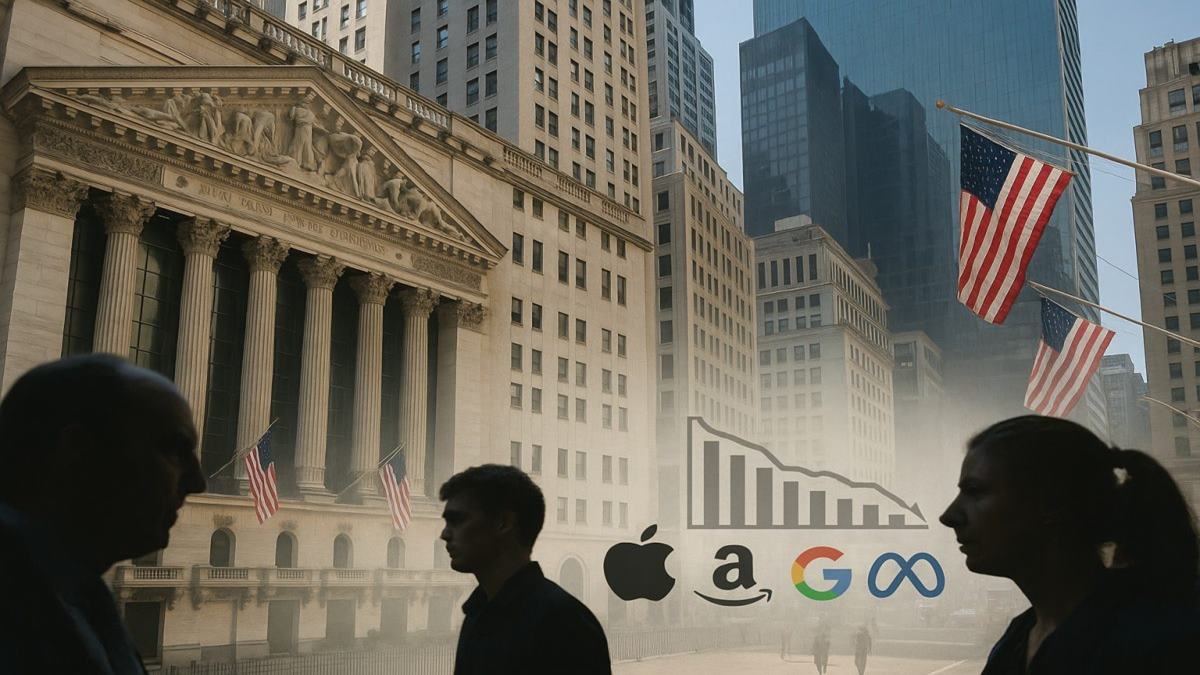
Americans celebrated Thanksgiving last week under gathering economic clouds. No sector is more under stress today than the U.S. tech industry.
In recent months, several major tech and logistics giants, including Microsoft, Amazon, Meta, Intel, Google, Salesforce, UPS, Target, and IBM, have announced job cuts numbering in the tens of thousands.
A report released Thursday by the career transition firm Challenger, Gray & Christmas revealed that tech job cuts surged 175% in October compared with a year ago, marking one of the sharpest spikes since the early pandemic years.
This raises an important question: What’s driving this new phase of layoffs, when the broader economy is in decent health?
The first driving factor lies in a familiar story: the correction that follows excess. In the aftermath of COVID-19, technology companies went on a historic hiring spree, anticipating that much of human activity would permanently shift online.
Companies poured billions into cloud infrastructure, logistics, and digital platforms, scaling operations as though pandemic-era demand would never fade. The result was a period of overcapacity across nearly every sector of the digital economy.
When reality returned to normal, demand cooled, but payrolls didn’t. Since 2022, tech giants have been shedding the overbuilt capacity of the pandemic years, trimming teams in marketing, recruiting, and even software engineering.
Much like the inflation caused by the pandemic’s fiscal surge, the consequences of that over-hiring have proved stubborn, lingering long after the initial shock faded.
The second major driver is the rapid rise of artificial intelligence, which is fundamentally reshaping corporate priorities and job structures.
As AI tools increasingly automate functions once handled by humans — from content generation and data analysis to coding — companies are engaged in an aggressive restructuring of workforces to align with the new technological capabilities.
Jobs that were once essential are now redundant. Companies are not just laying off employees to save costs; they’re redesigning themselves around automation.
The third factor is economic uncertainty, which is magnified by unpredictable policymaking by the Trump administration. President Donald Trump, who campaigned on restoring economic stability, has instead brought tariffs, trade turbulence, and unpredictability.
Tariffs on key imports from China, Mexico, and India have driven up costs for U.S. manufacturers and tech companies alike, adding pressure to already tight margins. The administration’s new $100,000 H-1B visa fee, aimed at discouraging foreign hiring, has added further uncertainty for both employers and workers.
Many companies, wary of unclear trade rules and regulatory headwinds, have quietly implemented unofficial hiring freezes, waiting for policy clarity.
Meanwhile, inflation continues to linger. The Federal Reserve’s persistence in keeping interest rates high to tame prices has made capital more expensive, discouraging both corporate investment and hiring.
The current wave of layoffs, while painful, is not as devastating as the Great Recession of 2008 (which erased nearly 9 million jobs) or the COVID-19 job market meltdown of 2020 (which cost 22 million).
It more closely resembles the dot-com crash of the early 2000s, when roughly 400,000 tech jobs vanished as overvalued internet startups collapsed. The present correction hasn’t reached that scale, but the structural parallels are striking.
What’s remarkable about the current moment is the paradox it presents: a relatively strong economy with weak hiring.
Unemployment remains near historic lows, and GDP growth is steady. Yet, job creation has slowed, and layoffs continue. In previous cycles, laid-off tech workers could typically land a new job within weeks. This is no longer the case.
Even highly skilled professionals are facing months of unemployment. Among the most vulnerable are H-1B visa holders, who have just 60 days to find a new job after losing one, or risk deportation. For many, especially those with families and children in U.S. schools, the anxiety is crushing.
Adding to their distress is a renewed wave of anti-immigrant sentiment fueled by political rhetoric. Supporters of the administration have pushed the false narrative that companies are firing American workers to hire cheaper Indian labor on H-1B visas.
This has emboldened new legislative pushes on Capitol Hill and in several states to restrict visa programs further. Combined with the already-high fees and compliance burdens, the environment for foreign professionals has grown increasingly hostile.
The American job market is at an inflection point, not due to a formal recession, but because of a structural transformation.
In summary, the post-pandemic hiring frenzy, the accelerating power of artificial intelligence, and policy uncertainty under the Trump administration have converged to reshape the nature of work itself.
For now, the labor market remains resilient. But beneath the surface, the churn is real and the adjustment painful.
As history shows, each technological revolution comes with winners and losers. The question for America is not whether it can adapt, but how humanely and intelligently it manages that adaptation.
Source – https://americanbazaaronline.com/2025/11/30/tech-layoffs-whats-really-driving-it-470780/