










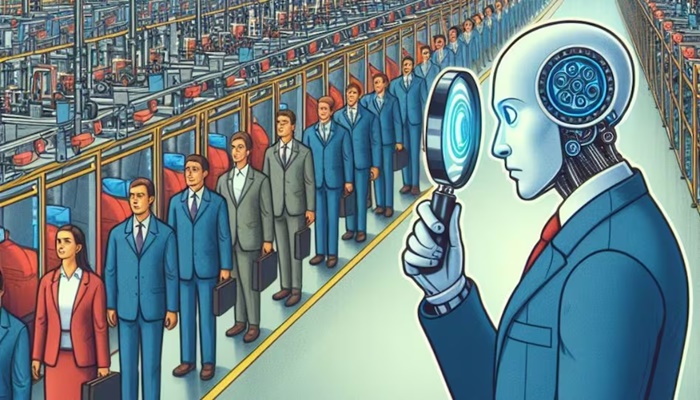








Artificial intelligence (AI) is reshaping succession planning for most Canadian employers, according to new research.
In a survey of 1,500 hiring managers across six professional fields in Canada, 84% said AI is starting to affect their succession planning, indicating that the technology is now a significant factor in how organisations design their future leadership pipelines.
Succession planning can no longer be an annual, box‑ticking exercise. In a world of hypergrowth, AI and constant change, it must become a living, future‑focused discipline, according to a previous report.
Promotion patterns, leadership profiles shift
More than half (54%) of the Canadian hiring managers said that AI is accelerating advancement for employees with strong technical capabilities, according to the Robert Half survey of 1,500 hiring managers.
The research also found that AI is changing the profile of tomorrow’s leaders. Another 54% of hiring managers said AI has “changed the skills needed for future leaders”, suggesting organisations are increasingly prioritising digital and AI‑related capabilities in their leadership criteria, Robert Half said.
At the same time, nearly half of respondents pointed to a potential long‑term risk in the leadership pipeline. The report noted that 45% of hiring managers believe AI has “created gaps in future leadership pipeline through reduced entry‑level positions”, as automation and new technologies alter or displace early‑career roles that have traditionally fed into management.
The impact of AI on succession planning varies by company size, according to Robert Half’s findings. While many organisations are already seeing direct effects, smaller businesses appear less affected so far than their larger counterparts.
Robert Half’s data show that 36% of small businesses said AI has so far made no significant impact on their succession planning. By contrast, only 11% of medium‑sized businesses and 14% of large businesses reported no significant impact.
Employees see both opportunity and change
Robert Half also conducted a separate survey of 1,482 professionals to gauge how AI is affecting careers from the employee perspective. Their responses point to a mix of optimism about new opportunities and recognition that skill requirements are evolving.
Among those respondents, 25% said AI is “creating advancement opportunities”, while another 25% said it is “changing skills needed for advancement”.
In addition, 17% reported that AI is “creating new positions that are of interest to them”.
Can AI help employers improve succession planning?
AI can help employers in succession planning by making leadership selection more merit‑based and data‑driven, rather than dependent on politics or visibility, according to one expert.
Tomas Chamorro‑Premuzic, Chief Science Officer at Russell Reynolds, writes in a Forbes article that “AI can mitigate this by analyzing vast amounts of historical performance data… and finding hidden patterns that connect each candidate with different success profiles,” allowing real contributions such as financial results, strategic insights and collaboration patterns to be more accurately captured.
By evaluating “real contributions—financial results, operational efficiencies, strategic insights” and even signals in language and social networks, AI can help capable but less visible employees demonstrate their leadership potential, giving them a fairer shot at advancement.
AI can also expand and diversify the pool of workers considered for future leadership roles. Chamorro‑Premuzic notes that AI‑driven assessment can “analyze broader datasets to uncover hidden gems, ensuring organizations consider leaders from different backgrounds, functions, and geographies,” while innovations in assessments have “leveraged AI to improve the candidate experience, reduce test-taking time, and increase the speed and efficiencies” of evaluating more people.
At the same time, AI can help “flag potential biases in hiring and promotion decisions,” and, when trained on diverse high‑performing examples, can support models that “prioritize competence and potential over legacy and favoritism.” For workers, that means a better chance to be considered on their merits, more accessible assessment processes, and leadership decisions that are less bound by traditional stereotypes and in‑group preferences.
One expert previously told HRD that “it is important to continue to invest in experiential development, global exposure, coaching, and succession planning that reflects future — not past — demands.”