











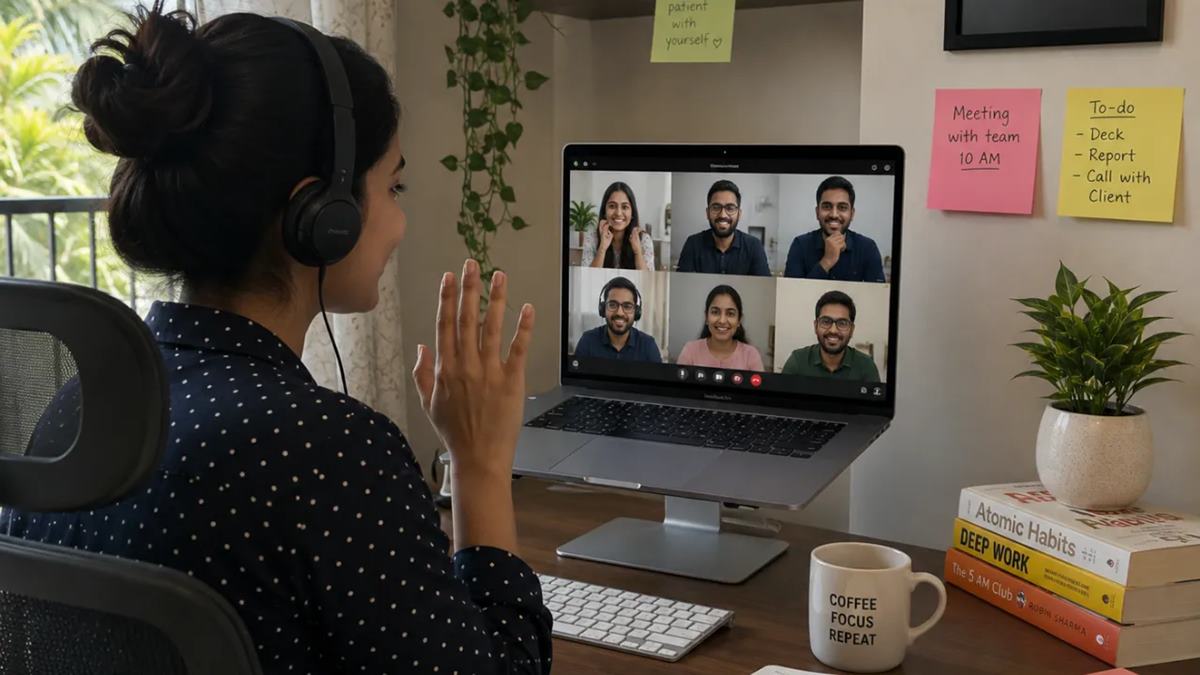
When Prime Minister Narendra Modi recently urged citizens and organisations to reduce fuel consumption, avoid unnecessary travel, and consider working from home wherever possible, it unexpectedly revived a conversation many believed had already settled post-pandemic.
What began as an appeal tied to fuel conservation and economic caution amid global uncertainty quickly spiralled into a larger internet-wide conversation around flexible work. Employees across sectors took to social media to discuss the possibility of revived hybrid schedules, reduced commute hours, and whether India might once again see a shift towards a remote working culture.
The conversation intensified further after the Delhi government introduced a mandatory two-day work-from-home policy for state government employees and urged private organisations to adopt similar measures under its Mera Bharat, Mera Yogdaan campaign focused on fuel conservation. The campaign also includes measures such as Metro Monday in Delhi, reduced fuel allowances for officials, and a broader push toward online meetings and public transport usage.
The industry is no longer debating whether WFH works
Across the advertising industry, the response to the PM’s comments has been less about returning to a pandemic-style remote culture and more about rethinking flexibility with greater intention.Pragati Agarwala, Partner, Three Fourth Solutions (advertising agency based in Kolkata), says the conversation internally has not been about returning to full-time remote work, but about refining flexibility in a smarter and more sustainable way.
“We see the Prime Minister’s comments more as a timely appeal linked to energy security and efficiency rather than a directive for industries to return to full-time remote work,” she says. “For us as an agency, it has prompted an important internal reflection, as we believe the future is not fully remote or fully office-led but a more balanced hybrid model where flexibility is aligned with productivity, collaboration, and employee well-being.”
This balanced approach appears to be emerging across agencies. Sajid Khan, Founder and Creative Director at AdVinciCode (a martech agency from Mumbai), says the announcement acted as a reminder that productivity and creativity are no longer tied to one fixed format of working.
“While there haven’t been any immediate policy changes, it has definitely sparked internal conversations around making flexibility more structured, intentional, and role-specific rather than one-size-fits-all,” he says.
Vibhor Gulati, Co-Founder, Defodio Digital (a digital agency based out of Delhi), believes the larger shift is that the industry no longer sees productivity as tied purely to physical presence. “The conversation is really about finding a working style that keeps the team flexible without losing the energy that comes from collaborating closely,” he says.
The industry’s tone today is notably different from the urgency-driven remote transitions of 2020. That reassessment is also being shaped by employee expectations. Multiple workplace studies over the past two years have shown that hybrid work continues to remain the preferred model for a large section of urban professionals. A recent study found that 57% of respondents said flexible working hours would improve their quality of life, although only about half currently have access to such arrangements.
At the same time, agency leaders say implementing flexibility in creative businesses comes with practical challenges. Hemal Majithia, Founder and Chief of Oktomind at OktoBuzz (a digital marketing agency based in Mumbai), says the agency is still evaluating what a workable flexible structure would realistically look like.
“We are still figuring it out. We haven’t taken any major policy decisions yet. If we do move toward flexibility, it may begin with one work-from-home day a week across teams,” he says. “It could help reduce certain operational costs slightly, but creative businesses also come with practical challenges. Not every designer or team member has the same setup or infrastructure at home. So for us, the decision has to make sense operationally, creatively and economically.”
Cities are responding differently
While the debate is national, city responses reveal how deeply local infrastructure and work culture influence attitudes toward flexibility. In Kolkata, Agarwala says the response has been practical and balanced, driven largely by employees valuing time efficiency and reduced commute stress.
“The question is no longer whether work-from-home works; it clearly can, but how to design systems that preserve collaboration, speed, and creative energy while offering employees greater autonomy,” she says.
Mumbai consistently ranks among the world’s most congested cities in global traffic studies, ranking third in India, with employees often spending hours commuting daily. That reality has made even limited hybrid work deeply attractive for urban professionals. Naturally, flexibility has found support among employees and businesses alike. “The response in Mumbai has been fairly positive because commute fatigue is a very real issue in the city,” says Hemal Majithia.
But Majithia also believes cities like Mumbai cannot sustain a fully remote future indefinitely. “Cities like Mumbai thrive on physical ecosystems — offices, local businesses, transport systems, restaurants and everyday movement,” he says.
Globally, too, governments and companies have begun reassessing aggressive remote-work structures after seeing the impact on commercial districts and office ecosystems. Several international companies have pushed employees back into offices, while major urban centres continue trying to revive commercial activity.
“So from what I’m seeing, Mumbai’s response is more in favour of balanced flexibility rather than a fully remote future,” Majithia adds.
Similarly, Delhi is another city where long commutes and traffic congestion heavily shape employee routines. Gulati says the response across Delhi has been ‘cautious but fairly positive’, especially because commute fatigue and rising travel costs have significantly changed how employees view work-life balance. He adds, “For creative industries, especially, the challenge is maintaining collaboration and culture while still giving people flexibility. So the conversation in Delhi right now is less about “office versus remote” and more about finding a healthier long-term balance.”
Sharath Dasari, Co-Founder & COO, Flutch (an influencer marketing agency based in Bengaluru) said, “In a city like Bengaluru, the conversation around flexible work is already quite evolved, particularly across technology and knowledge-driven sectors. While flexible work models can be effective in enabling better autonomy and productivity, agency businesses function differently in many ways.”
Creativity vs flexibility
For agencies, the biggest tension remains creative collaboration. Operationally, most agencies are significantly more prepared for hybrid work today than they were during the pandemic. Digital workflows, virtual pitching systems, collaboration platforms, and remote review structures are now deeply integrated into everyday operations.
But creatively, leaders believe the equation is far more complicated. For many agencies, the conversation also revives memories of the pandemic years, when creative businesses rapidly adapted to virtual workflows. Yet by 2022 and 2023, most agencies had actively pushed employees back into offices, arguing that creative spontaneity, mentorship, and cultural exchange suffered in prolonged remote settings.
“Operationally, the industry is far more prepared today with better digital systems and workflow discipline,” says Agarwala. “Creatively, however, the equation is more nuanced because advertising still thrives on collaboration and spontaneous idea exchange.”
Gulati agrees that agencies are operationally better equipped today than they were in 2020, but believes creativity still benefits heavily from physical proximity. “The best creative breakthroughs often come from unplanned conversations or spontaneous exchanges that are difficult to fully recreate on a Google Meet,” he says.
Khan echoes that sentiment. “Agencies still thrive on real-time collaboration and cultural exchange,” he says. “A hybrid structure works best when it combines the flexibility of remote work with the creative momentum that comes from physical collaboration.”
Majithia believes the challenge has become even sharper in an AI-driven industry landscape. “Especially today, when AI and technology are evolving almost daily, adaptation requires far more fluid, spontaneous and unplanned conversations,” he says. “That creative energy is much harder to replicate fully online.”
Ironically, at a time when AI tools are accelerating creative production, agency leaders say human collaboration and informal exchange have become even more valuable.
Designed flexibility
One major shift in industry thinking is that agencies no longer see flexibility as an informal perk. If hybrid work becomes more permanent again, leaders believe agencies will need significantly stronger internal systems to support it effectively.
Majithia describes this as a shift from ‘permission-based flexibility’ to ‘designed flexibility.’ “That means work-from-home cannot just be a casual arrangement where people are available online,” he says. “Agencies will need sharper briefs, clearer daily outcomes, stronger review systems and better infrastructure support.”
The shift also requires agencies to rethink how mentorship, knowledge-sharing, and team culture function in distributed environments. “With AI changing tools, formats and workflows almost every week, agencies will need more deliberate learning rhythms,” says Majithia. “Otherwise, remote work can quietly create silos.”
Agarwala similarly believes agencies will need both stronger technology infrastructure and consciously nurtured hybrid cultures. “The focus has to move from measuring physical presence to measuring accountability, output, and impact,” she says.
At the same time, leaders acknowledge that younger talent still benefits enormously from informal exposure, spontaneous conversations, and in-person mentorship that are difficult to replicate digitally. This balancing act may ultimately define the next phase of work culture in advertising.
A wider industry shift
Beyond employee convenience, agency leaders believe flexible work could reshape hiring structures and operating models across the industry itself.
“A stronger work-from-home culture could fundamentally reshape the agency business by widening access to talent and improving employee retention,” says Agarwala.
The implications could be especially significant for agencies operating outside India’s largest metros. “Flexible work expands access to specialists and creative professionals beyond metro hubs,” she says. “For cities like Kolkata, this becomes a clear advantage, enabling agencies to build national teams without requiring relocation.”
Gulati similarly believes flexibility could significantly widen the talent pool available to agencies. “If flexible work becomes the norm, agencies can work with strong talent across cities without asking people to relocate,” he says.
Majithia also sees the industry slowly moving toward a more outcome-driven culture. “It could push the industry further toward a ROWE mindset, Results Only Work Environment, where the focus shifts more toward ownership and outcomes rather than physical presence,” he says.
There are operational advantages, too. Agencies point toward potential reductions in overhead costs, healthier teams with lower burnout, and more agile structures. At the same time, leaders remain cautious about the long-term trade-offs, preserving creative culture, avoiding communication silos, maintaining quality control, and ensuring collaboration does not weaken in distributed systems.
For now, the industry does not appear to be moving toward another remote-first era. But PM Modi’s comments and the policy discussions that followed have clearly reopened a more layered conversation around flexibility. Unlike 2020, the question is no longer whether work-from-home is possible. The question now is what parts of it are actually worth keeping.