


















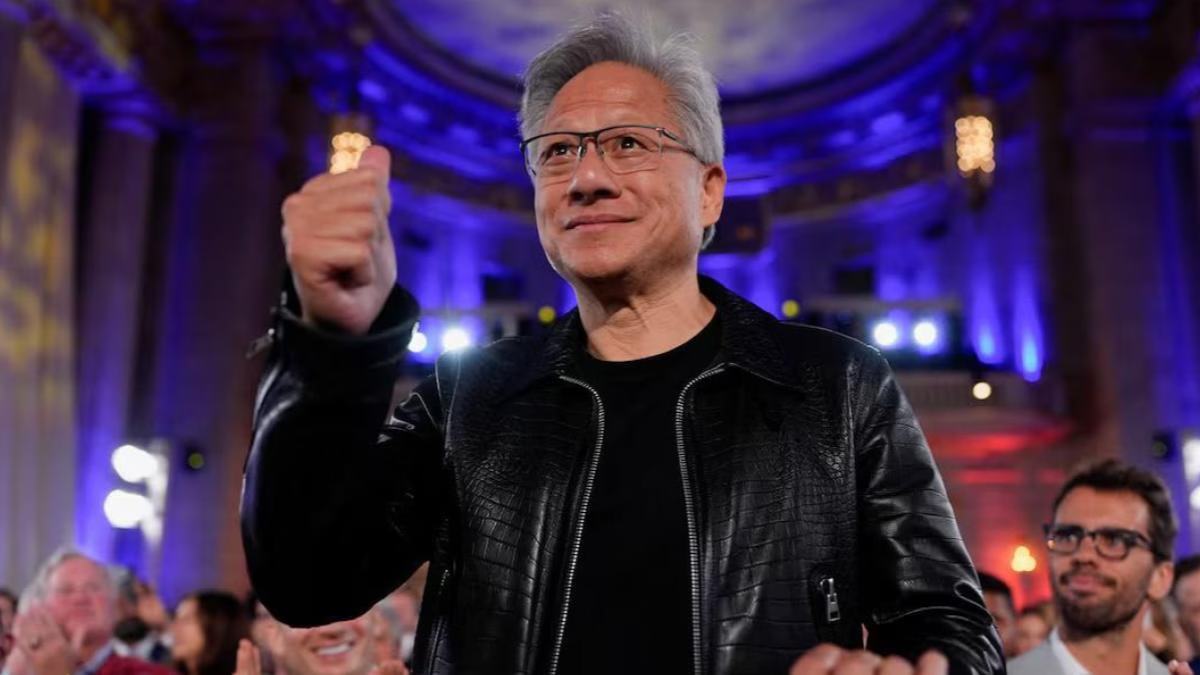
Nvidia CEO Jensen Huang has strongly rejected growing fears surrounding AI and how it will wipe out software engineering jobs. In an earlier interview at a public conversation held at the Stanford Graduate School of Business, Huang called such narratives “false” and argued that they harm America’s competitiveness in the AI space.
Huang, who has been advocating for implementing AI in most walks of professional life, directly addressed concerns that AI — particularly agentic AI systems — would replace human coders. “The narratives of AI destroying jobs is not going to help America — It’s false,” Huang stated.
“Somebody said that AI is going to destroy all of the software engineering jobs … We now have agentic AI inside Nvidia … The software engineers are busier than ever,” he assured all those who doubted AI’s role in the human workspace.
AI keeping engineers busier than ever
Huang’s comment comes at a time when there’s an intensifying debate in the tech industry about AI’s impact on the workforce. While some tech leaders have warned of rapid displacement due to AI, Huang positioned AI as a productivity multiplier that increases demand for skilled engineers rather than eliminating their roles.
Nvidia itself has been internally deploying advanced AI tools. The company, which powers much of the world’s AI infrastructure through its GPUs, has integrated agentic AI systems that handle complex coding and development workflows. Far from reducing headcount, Huang said these tools have accelerated work and expanded the scope of what engineers can achieve.
This is not the first time Huang has downplayed AI-driven job losses. In the past, he has consistently argued that new technologies create more opportunities than they eliminate, especially in high-skill fields like software engineering.
His latest statement, however, stresses Nvidia’s belief that AI acts as a collaborator, not a replacement. It enables teams to ship features faster and tackle more ambitious projects with the same or smaller headcounts.
Is AI taking away IT jobs? Who said what
While Nvidia CEO Jensen Huang insists AI is making software engineers “busier than ever,” several prominent tech leaders have issued stark warnings that AI could soon automate large portions of coding work, particularly for junior and mid-level roles. It has been argued that this shift will displace routine programming roles. However, the same leaders also suggest that AI will create demand for higher-level positions that will require talent to focus on AI orchestration, system architecture, creative problem-solving, and human-AI collaboration.
Anthropic CEO Dario Amodei has been among the most vocal in this regards, stating in early 2026 that AI models could handle “most, maybe all” of what software engineers currently do within the next 6–12 months. He highlighted internal changes at Anthropic, revealing that the company may eventually need fewer traditional software engineers as AI handles core development. At the same time, Amodei and others at Anthropic have pointed to emerging roles in overseeing AI agents, refining model outputs, and building complex AI-driven systems that require human judgment and strategic oversight.
Meta CEO Mark Zuckerberg spoke about the same in a January 2025 interview, stating that by 2025, large-scale tech firms would have AI systems capable of performing the work of mid-level engineers. “AI can take over coding tasks,” he said, “allowing human engineers to focus on higher-level problem-solving and creativity.” Zuckerberg emphasised that this would free people to “do kinda crazy things,” signalling a move towards new roles in innovation, AI system design, and advanced product architecture.
Former Google CEO Eric Schmidt had also forecasted in 2025 that “in one year, the vast majority of programmers will be replaced by AI programmers,” with autonomous agents taking over routine development. He has also noted that this transformation will spawn new high-value jobs in areas like AI safety, ethical deployment, large-scale system integration, and training the next generation of AI models — roles that demand deep technical expertise combined with strategic thinking.
Lastly, OpenAI CEO Sam Altman also described the change as “gradual but accelerating,” arguing there is a high probability that AI will replace much of traditional coding work. However, Altman has consistently backed that every software engineer “will just do much, much more,” shifting into roles that involve directing AI tools, defining complex requirements, and innovating at the frontiers of what AI alone cannot achieve.
The general consensus among tech leaders is that AI will not eliminate engineering talent but will rather elevate it, creating opportunities in AI supervision, prompt-to-system engineering, ethical AI governance, and cross-disciplinary innovation that did not exist before the current wave of agentic tools.