


















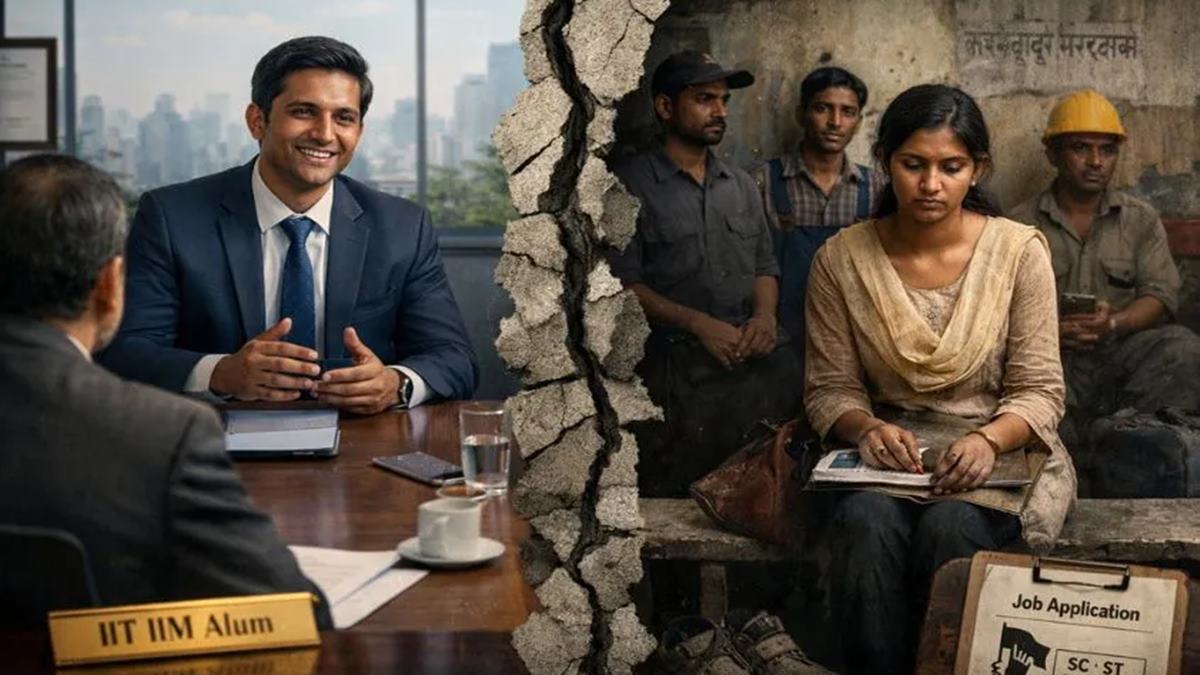
Picture two candidates walking into the same Gurugram interview. Same degree. Same years of experience. One went to Delhi Public School, speaks English with a rounded accent, and has a father who once worked at a multinational. The other studied at a government school in Lucknow, speaks English with a Hindi inflection, and is the first in her family to wear a suit. The interviewer, almost always from the first candidate’s world, smiles warmly at one and types faster at the keyboard when the other speaks. She does not get a callback. Welcome to the meritocracy.
India’s corporate sector has long sold itself on the idea of hustle and talent. But the data, drawn from some of the world’s most credible research institutions, tells a sharply different story: who rises in Indian corporate life is deeply, structurally determined by who your parents were, what school you attended, which language you speak, and which caste you belong to.
The Wealth Wall That Decides Everything
Before one can understand bias in the boardroom, one must understand the economy it sits inside. India is not merely unequal, it is, by serious scholarly measurement, operating at levels of concentration that surpass the extractive era of British colonial rule.
Income and Wealth Inequality in India, 1922–2023: The Rise of the Billionaire Raj, World Inequality Lab Working Paper states, the top 1 per cent of earners captured 22.6 per cent of national income in 2022–23 — the highest recorded since data collection began in 1922, including during the height of the British Raj. The top 1 per cent also held 40.1 per cent of India’s total national wealth, while the bottom 50 per cent of the population owned a mere 6.4 per cent.
The report concludes that the “Billionaire Raj headed by India’s modern bourgeoisie is now more unequal than the British Raj.” That inequality does not sit outside the corporate world. It determines who enters it. Wealth buys access to the educational infrastructure that feeds the top-tier corporate market — the IITs, the IIMs, the private school coaching belt, the GMAT centres. The corporate ladder begins long before any job application is filed.
Oxfam India’s Survival of the Richest (2023) adds a sharper edge: SC/ST workers earned only 55 per cent of what advantaged social groups earned in 2018–19. The bottom 50 per cent of the population pays 64 per cent of India’s total GST, while corporate tax cuts since 2019 have handed large companies a reduced rate of 22 per cent — with new firms paying as little as 15 per cent. The fiscal resources foregone could have funded the schools and hospitals that determine who is “corporate-ready” in the first place.
The Accent Is the Test
Ask any HR professional, off the record, whether the way a candidate speaks English affects their hiring prospects. The answer arrives quickly: of course it does. The tragedy is that confident, fluent English in India is almost perfectly correlated not with intelligence, but with class — with which school your parents could afford, whether there was a television at home, and whether a private tutor was ever in the picture.
The Pearson Global English Proficiency Report 2024 drawn from approximately 750,000 English language tests globally shows India’s finance and banking sector scoring 63 on average English-speaking ability against a global benchmark of 56, while the healthcare sector, which draws from a broader social base, scores only 45. India’s National Capital Territory, home to the elite private school belt, leads all Indian regions with a speaking score of 63.
The proximity to privilege predicts the score. Indian organisations are now embedding voice-based English testing into formal learning and development programmes — institutionalising the accent as a measure of professional suitability. For a first-generation English speaker from a government school, this is a structural wall dressed up as a skills gap.
In today’s global economy, English proficiency is not just a skill — it is a strategic asset that business leaders use to make hiring decisions and benchmark candidates.
The Caste Ceiling Nobody Mentions
No account of class in Indian corporates can avoid caste — they are distinct but deeply entwined. Research compiled under “Corporate Boards in India: Blocked by Caste?” (Donker et al., cited in MIT Sloan Management Review, November 2023) found the caste diversity index among top 1,000 Indian companies effectively at zero. SCs and STs together hold just 3.5 per cent of director seats while constituting nearly 25 per cent of India’s population. Only 3.8 per cent of directors come from OBC backgrounds.
The same research documented that two board directors sharing caste identity increases the likelihood of a company entering a merger-and-acquisition deal — demonstrating that caste networks actively shape capital flows and corporate transactions, not just staffing. Caste is not merely a social fact. It is a business infrastructure.
Women Pay Double — For Being Women and for Being Poor
Gender in Indian corporates is its own story of structural failure — and it intersects brutally with class. The KPMG–AIMA Women Leadership in Corporate India Report 2026, surveying 200-plus professionals, found that 46 per cent of organisations still have only 10–30 per cent women in leadership roles. Only 1 per cent of women respondents hold board positions, despite 79 per cent expressing ambitions to lead. Satisfaction with leadership development programmes has fallen from 63 per cent in 2024 to 53 per cent in 2026, retreating while the paperwork advances.
Deloitte’s Women in the Boardroom: A Global Perspective (8th Edition, 2024), covering 18,085 companies across 50 countries, found India’s female board representation at 18.7 per cent — below the global average of 23.3 per cent and driven almost entirely by SEBI’s regulatory mandate rather than genuine cultural change. At the current rate, gender parity on Indian boards is not projected before 2038.
The DEI Report That Nobody Reads
Diversity, equity, and inclusion now appears in almost every Indian corporate’s annual report. But PwC’s Global Diversity and Inclusion Survey found that approximately 80 per cent of organisations have not adopted the practice of gathering and analysing compensation and promotion data by dimensions of diversity. Among those that do, business leaders are far more aware of these efforts than regular employees — suggesting that D&I data collection, where it exists, is a leadership signalling exercise, not a ground-level transformation.
Deloitte’s 2024 Global Human Capital Trends report makes a pointed intervention: the prevalent practice of assessing “cultural fit” in interviews often leads to “post-hire misalignments in cultural expectations.” In the Indian corporate context, the singular culture being tested for is remarkably specific — upper-middle-class, English-speaking, urban, implicitly upper-caste. The candidate who does not reflect this culture faces a perception deficit that compounds at every stage of the career ladder. The bias has gone underground. It has not gone away.
The Mirror Won’t Lie
India in 2026 has the world’s largest population, one of its fastest-growing economies, and according to the World Inequality Lab, an income distribution in which the top 10 per cent capture 58 per cent of national income while the bottom 50 per cent takes home 15 per cent. Its boardrooms give SCs and STs 3.5 per cent of seats. Its female workforce earns 63 paise to every male rupee. Its hiring culture sorts candidates by English accent before it reads their resumes.
This is not a market imperfection that growth will eventually correct. It is a designed system, maintained by those who benefit from it, periodically decorated with the language of meritocracy. The question is whether anyone with the power to change it is paying attention.
The numbers don’t lie. The question is whether we are listening.
India’s corporates can keep producing billionaires while excluding millions, or choose to become the meritocracy they claim to be. The data to begin that work already exists. What remains is the will.