



















For decades, the story of workplace safety in America was largely a story of physics. Workers were crushed by machinery, felled by falls from scaffolding, undone by repetitive motion. The hazards were brutal but, in a sense, predictable — subject to engineering controls, personal protective equipment, and loss-prevention protocols refined over a century.
That story is changing. A new report from the National Council on Compensation Insurance (NCCI), the nation’s largest provider of workers’ compensation data and research, documents a sharp and sustained rise in workplace assaults. Nonfatal assaults climbed at an average annual rate of 5.3 percent between 2011 and 2021–22, according to the NCCI’s analysis of Bureau of Labor Statistics data. The rate of assaults per 10,000 full-time equivalent workers jumped 62 percent over that span — far outpacing the 13 percent increase in the national aggravated assault rate over the same period.
The share of assaults among all days-away-from-work cases rose from 1.3 percent in 2011 to a peak of 2.3 percent in 2019. After dipping during the pandemic years, it rebounded to 3.0 percent in 2023–24, according to the NCCI.
These are not random incidents. They are, increasingly, a defining feature of what it means to go to work in America.
From the factory floor to the front lines
To understand why workplace violence is rising, it helps to trace how the American economy has shifted over the past century. Gregory McKenna, national practice leader for the public sector at Gallagher Bassett, a leading claims management company, has spent years thinking through this arc.
For much of the 20th century, the workplace was defined by its physical environment: manufacturing floors, construction sites, facilities where the dominant hazards were gravity, heat, friction, and sound. From the 1960s onward, the economy shifted toward services, and then, from roughly 2005 onward, toward what economists now call an on-demand economy — one shaped by digital networks, delivery platforms, and an expectation of instantaneous service.
That transformation has moved millions of workers out of controlled physical environments and into direct, often unpredictable, contact with the public.
In an interview with Insurance Business’s Gia Snape, McKenna argues that the nature of the workplace has been fundamentally transformed. As the economy shifted from manufacturing to services and then to an on-demand model, a far larger share of workers now spend their days in direct, often unpredictable, contact with the public. The forces causing injury have changed with it.
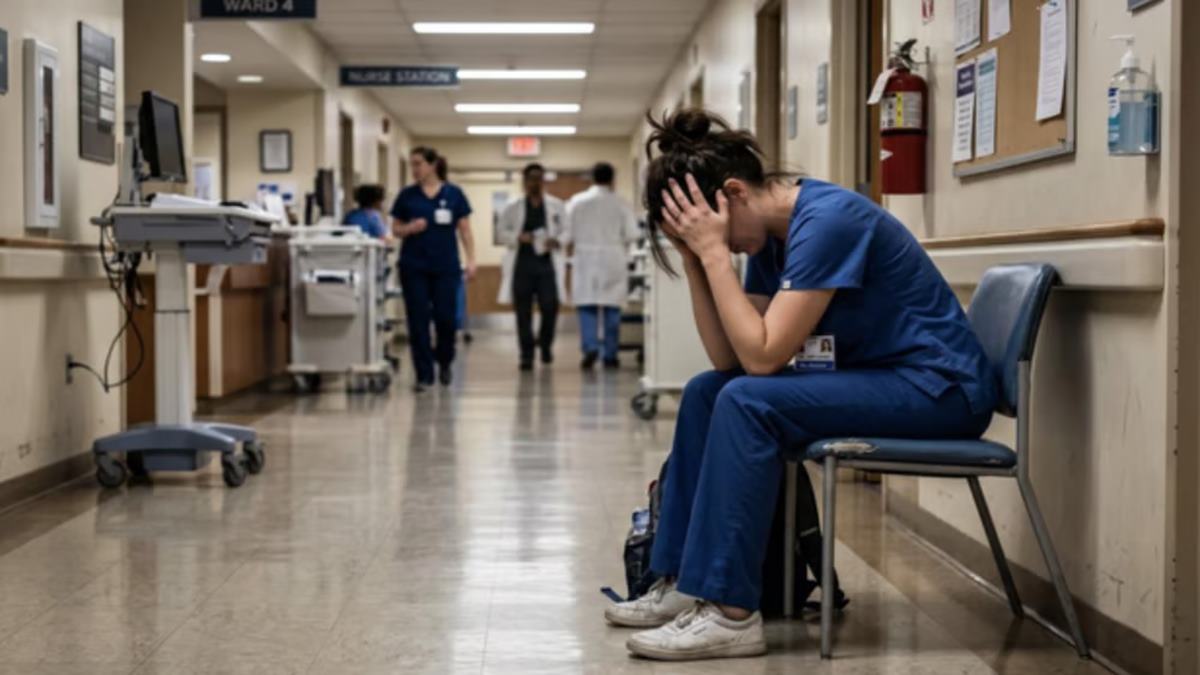
He points to a set of forces that have grown harder to ignore: declining patience among the public, heightened expectations around speed and service, and broader social and economic pressures that have made volatile interactions more common. A nurse confronted by an agitated patient. A teacher struck by a student. A retail worker caught in an escalating dispute at the checkout counter. These are not the hazards that a century of workplace safety regulation was designed to address.
Health care leads, but the problem is widespread
The NCCI data reveals a striking concentration. Health care and social assistance accounted for roughly 18,860 annualized assault cases in 2023–24 — a figure ten times higher than retail trade, the next most affected sector, which recorded approximately.
1,835 cases. The industries that have historically placed workers in close proximity to the public — law enforcement, emergency services, hospitals, schools — bear a disproportionate share of the burden.
The demographics of risk follow a clear pattern. Women accounted for roughly two-thirds of all assault victims in the data, despite comprising 47 percent of the private-industry workforce — a disparity explained in part by the fact that women make up about 78 percent of the health care and social assistance workforce, the highest-risk sector. Workers aged 20 to 34 also experienced a disproportionate share of assaults relative to their presence in the labor force, likely reflecting their concentration in entry-level, high-contact roles.
While most assault cases involve being struck by a fellow worker or patient — incidents with below-average severity — the NCCI’s own claims data shows that rarer events carry outsized costs. Gunshot-related workers’ compensation claims had the highest average severity among assault-related injury categories. Claims classified as “in act of crime” also ranked among the most severe.
The new complexity of the assault claim
Beyond raw frequency, what has changed in recent years is the nature of the claims themselves. McKenna and his colleagues at Gallagher Bassett have been running a longitudinal study of workplace violence across their public-sector client base — cities, counties, municipalities, and public schools — since 2017. The findings are striking.
Among K–12 educators, claims involving teachers injured by students rose by approximately 25 to 26 percent in the two years following the return to in-person learning after the pandemic. More troubling, those claims have not returned to pre-pandemic levels. They have plateaued at a higher baseline.
In workers’ compensation, a “complex” claim is a term of art with real financial implications. It typically involves multiple injured body parts, a psychological trauma overlaid on a physical injury, extended time away from work, and, increasingly, legal representation. Intentional acts — assaults — produce these features at higher rates than slips, falls, or repetitive-motion injuries.
“They tend to involve more complex injuries, more mental health impacts, longer recovery periods, and in some cases more permanent impacts,” McKenna said.
A worker who sustains a physical injury in a fall may, with proper treatment, return to the same job without residual fear. A worker who is assaulted may struggle to reenter the environment where the assault occurred. That psychological dimension — now increasingly recognized as compensable in jurisdictions across the country, particularly
for first responders experiencing PTSD — has added new layers of cost and duration to assault-related claims.
What HR leaders and employers can do
The challenge for employers, risk managers, and HR professionals is that workplace violence does not yield to conventional loss-control strategies. You cannot install a guardrail against human rage.
California, which has often served as a bellwether for workplace regulation, enacted a comprehensive Workplace Violence Prevention Program requirement that took effect July 1, 2024. The law requires employers to conduct formal risk assessments of physical locations, establish confidential incident reporting mechanisms, create documented procedures for following up on reported concerns, and maintain records that allow them to track their baseline exposure over time.
The principle underlying that framework — that incidents rarely emerge without warning signals — is one McKenna and other practitioners emphasize. A sharp verbal altercation, minor physical contact, an escalating pattern of behavior: these are often precursors to more serious events, and organizations that create safe channels for reporting them may interrupt the trajectory.
Labor organizations have begun to act on this insight. The National Education Association and other teacher unions have been encouraging members to report incidents that they might once have absorbed quietly, whether out of sympathy for a struggling student or reluctance to trigger disciplinary processes. The message has shifted: protecting yourself is not a betrayal of your colleagues or your students. It is a professional obligation.
At industry conferences and in exhibit halls, McKenna has observed a growing market for de-escalation training — skills once reserved for law enforcement now being adapted for hospitals, schools, and retail environments. Teaching frontline workers to recognize and respond to signs of agitation, to use verbal and physical techniques to reduce the temperature of a confrontation before it becomes an assault, represents what he describes as a new age of risk control.
A trend that is not reversing itself
The forces driving workplace assault are not, in any obvious sense, abating. The on-demand economy continues to expand. Public-facing roles continue to multiply. The social pressures that McKenna describes — impatience, volatility, the expectation of frictionless service — have not diminished.
For those responsible for managing risk, that means accepting that workplace violence is not a spike to be waited out but a structural feature of the modern labor market — one requiring the same sustained attention that previous generations devoted to slip-and-fall prevention or ergonomic injury.
“I don’t think it’s going to return,” McKenna said, “unless there are some counteracting forces. Just like risk control has always been an important part of preventing workplace accidents.”
What those counteracting forces look like — whether legislative, cultural, or organizational — remains an open question. What is no longer in question is the scale of the problem.