
















Are you thinking of appearing for a government exam? But are you aware of its reality? Every year, tens of millions of people appear and reappear for government exams only to face a system that often fails to keep up with their efforts.
Government jobs may bring stability and security, but with them comes along an ocean of ‘ifs’.
The belief in stability, respect and long-term security draws millions of aspirants into an increasingly competitive and evolving recruitment system.
However, the reality today paints a very different picture. Behind that curtain of promise lies a system marked by delays, leaks and uncertainty.
EXAM PREPARATION AND FAILING SYSTEM
For millions of people across India, preparing for government exams is not just a phase, but it’s a way of life, spending years in a small room, studying hard, giving mock tests.
Preparation today is hyper-structured, digital-first and intensely competitive. People are juggling between multiple exams; SSC, Railway, Banking and UPSC, because clearing one exam is no longer enough to bet their future on.
But after all this diligence, is the system failing its aspirants?
One of the most visible failures is the recurring issue of paper leaks and exam cancellations. Time and again, recruitment exams are being compromised, forcing authorities to cancel the examination with a delayed rescheduling process.
From 2017 to 2024, 70 confirmed exam paper leaks were documented across 15 states, which affected 1.7 crore applicants.
Various recruitment examinations saw a significant rise in paper leaks and technical glitches in 2024 and 2025.
In 2024 alone, five of the 14 major exams conducted by the National testing agency (NTA), were hit by serious irregularities, including paper leaks, delays, and technical glitches during the tests.
When exams are scrapped after months of preparation, aspirants are forced to restart the same cycle, wasting months and sometimes years of pressure.
These irregularities not only cost them academically but also personally. Financial strain from coaching fees and, for some, even living expenses, combined with years of uncertain outcomes.
Moreover, the mental burden is immense, continuous preparation without guaranteed results leads to burnout.
Sandas Bhanjare, 28, is currently preparing for a competitive exam while simultaneously working at Sale Steel plant on contract: “Exam cancellations have a severe emotional and practical impact on students. They invest years of hard work, time, and money in preparation.”
He adds: “When exams are cancelled, it feels like all their efforts go to waste. It also delays their future plans and causes stress, disappointment, and frustration.”
And to top it all off, the sudden changes in the pattern create a lot of confusion rather than clarity. Aspirants are forced to constantly adapt, not just to the competition but also to the instability.
Though the system remains unpredictable and reliable, people are ready to take that risk in the hope of having stability and security.
JOB OPPORTUNITIES VS EX[ANDING ASPIRANT POOL
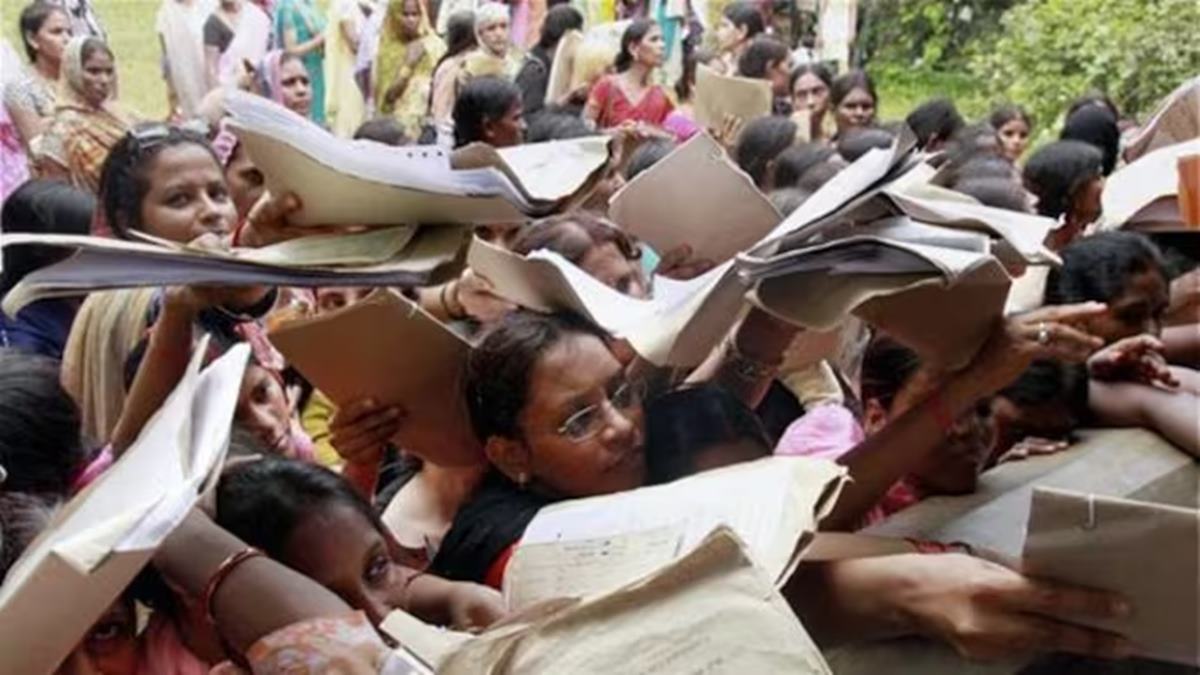
With approximately 7 crore applications per year, how many are able to go get a job is the real question?
According to Reuters, from 2014 to 2022, roughly 220 million applications were registered for government jobs out of which only 722,000 were selected. That’s a 0.3% selection rate.
And yet India sees a massive surge in demand for government jobs. Despite a booming private sector, the public sector never goes out of the market.
The Naukri Jobspeak January 2026 report shows a 57% year-on-year hike in government and defence hiring, with job postings rising from 6872 in Jan 2025 to 10761 in Jan 2026. This is seen as the highest growth rate among all sectors.
Ritu Gupta, 25, had appeared for several competitive exams but could not clear them and later stepped away from the process, states, “I believe the opportunities themselves are not entirely limited, but the number of available seats compared to the number of applicants is very low. This makes it difficult for everyone to secure a position.”
Although the number of vacancies is seen to be soaring, so is the number of applicants every year. The number of applications has multiplied from a lakh to a crore per year, increasing the competition for the same number of seats.
A single government role attracts candidates from multiple exam streams and the same pool of aspirants overlaps across exams, which naturally multiplies the competition as the same candidates are applying for multiple exams simultaneously.
Candidates spend around 3-6 years attempting for the exams, resulting in the same individuals reappearing every year. Freshers just add up to the already existing pool of applicants. This increases the competition and decreases the possibility of getting a job.
With applicant numbers rising rapidly and a slow rise in vacancy rates, the percentage drops sharply. In many exams, the success rate falls below 1%, even the qualified candidates face very low odds.
Selection often comes after multiple years of attempts. Persistence increases chances but doesn’t guarantee success.
WHY EXACTLY IS THE CRAZE OF IT STILL ON?
Even after being aware of all the issues in the system and hearing the failure stories, why exactly are people still ready to risk it?
‘Sarkari naukri’ is still seen as prestigious, especially in small towns. It brings family pride and societal validation. Society automatically sees them as superior. This emotional and social reward keeps the aspirants in the race.
Besides, government jobs offer stability, fixed income and low risk of layoffs. In this case, job security outweighs system flaws.
Parents often view government jobs as the safest and most respectable career path, shaping their children’s choices from an early age.
For many, growing up means constantly hearing about preparing for SSC/UPSC, so much so that these paths begin to feel less like options and more like predetermined decisions.
This decision is driven by “log kya kahenge” rather than aptitude. Aspirants prepare without any genuine interest, just out of parental pressure.
Additionally, government jobs are rarely affected by sudden job cuts which provide long-term employment assurance. Government jobs also provide fixed and structured salaries with regular increments and pay commissions.
It also provides post-retirement security through pensions which ensure income even after active service. And finally, fixed working hours. All of these things bring stability within the family, which is beneficial for the longer run.
Muskesh Kumar Gupta, 31, who was successful in clearing the government exam and is currently working as junior engineer at Sale Steel Plant, shares his views, “Even today, people are strongly attracted to government jobs because they offer stability and long-term security.”
“Unlike private jobs, which proved uncertain during COVID-19 with widespread job losses, government roles provide reliability. They also help individuals consistently support their families,” he continues.
There is a built perspective that government jobs ensure the household runs smoothly. Stable earnings allow aspirants to take responsibility for their entire family.
For many aspirants, a government job is not just a career choice, it’s a promise of stability they can offer to their family.
Government exams today reflect a clear contradiction: rising effort from aspirants and a system that often fails to support it.
With delays, paper leaks, and limited vacancies, success depends not just on merit but also on endurance and luck.
Yet, the demand persists. Because, beyond all the flaws, government jobs still represent stability, security, and a better future for families, making the risk one that many are still willing to take.