











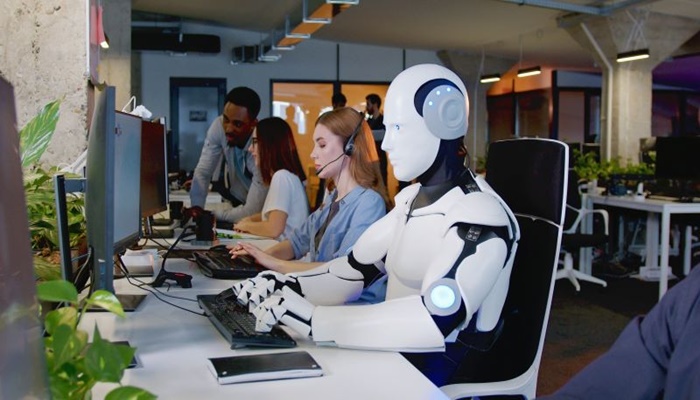







If you talk to any working professional these days, one anxiety seems to be common across industries: getting replaced by AI. That fear did not emerge simply because AI can now write, reason, and interact in ways that often appear human. It has also been fueled by a growing number of companies that have cited AI while announcing layoffs. Tech giants such as Cisco, Atlassian and Cloudflare, among others, have linked artificial intelligence to workforce reductions. However, one economist believes the evidence tells a different story.
‘Zero evidence’ of AI-related job losses
In a blog post published on Friday, Torsten Slok, Partner and Chief Economist at Apollo Global Management, said there is “zero evidence of job losses because of AI,” citing data from the ADP National Employment Report.
Instead of replacing workers, Slok argues that companies are increasingly looking for people who can help them implement and work with AI.
“Many firms are hiring AI implementation experts, and the data center buildout is putting upward pressure on salaries for AI experts and on prices of semiconductors, equipment and energy,” Slok wrote.
Why Slok thinks AI could create more jobs
Slok believes that the surge in AI spending is boosting both employment and inflation. His view is based on an economic concept known as Jevons paradox, which suggests that when a technology becomes more efficient and cheaper to use, demand for it often rises rather than falls.
He made a similar argument in an April blog post.
“When steam engines made coal more efficient, Britain didn’t burn less coal, it burned more,” he said. “The same pattern is happening for cheaper legal services, consulting services and financial services.”
In his latest blog post, Slok wrote that nonfarm payrolls for May could come in significantly higher than the 95,000 expected by economists.
“It is Jevons paradox playing out in real time: cheaper technology is creating more demand and more jobs,” he added.
Other tech leaders are saying something similar
Slok’s comments are increasingly aligning with views expressed by several prominent figures in the technology industry.
Last week, OpenAI CEO Sam Altman admitted that some of his earlier concerns about AI-driven job losses may have been misplaced. Speaking virtually at a conference hosted by Commonwealth Bank of Australia in Sydney, Altman said AI has not replaced as many workers as he expected, particularly in entry-level white-collar roles.
Jeff Bezos has also argued that AI is more likely to make workers more productive than replace them entirely.
In an interview with CNBC, Bezos pushed back against claims that professions such as software engineering or radiology will disappear because of AI tools. According to him, AI can automate some tasks, but humans will still be needed to identify problems, think creatively, and design systems.
Using software engineers as an example, Bezos said that writing code is only one part of the job. The larger responsibility is deciding what needs to be built and why.
Then why are so many people worried?
The anxiety around AI and jobs is not without reason.
Over the past year, several companies have linked layoffs to artificial intelligence. Cisco, Atlassian, Cloudflare, Coinbase, IBM, and Snap are among the firms that have cited AI while discussing workforce reductions. More recently, Wix, known for its do-it-yourself website building platform, has announced plans to cut significant portions of their workforce because of advancements in artificial intelligence.
But not everyone is convinced that AI is the real reason behind those cuts.
Altman has described the practice of attributing layoffs to AI as “AI washing.” Nvidia CEO Jensen Huang has also criticised executives who use AI as the explanation for job reductions.
“I think the narrative that connects AI to job loss for many of the CEOs that are doing it, it is just too lazy,” Huang said in an interview with Singapore broadcaster CNA.
According to Huang, many layoffs may be more closely tied to cost-cutting measures, restructuring efforts, or broader business challenges than to AI itself.
Over the past few weeks, Zoho founder Sridhar Vembu has repeatedly voiced similar concerns on X. He has argued that actual productivity gains from AI remain limited and that some companies are using AI as a convenient explanation for layoffs that are really being driven by economic pressures and investor expectations.