
















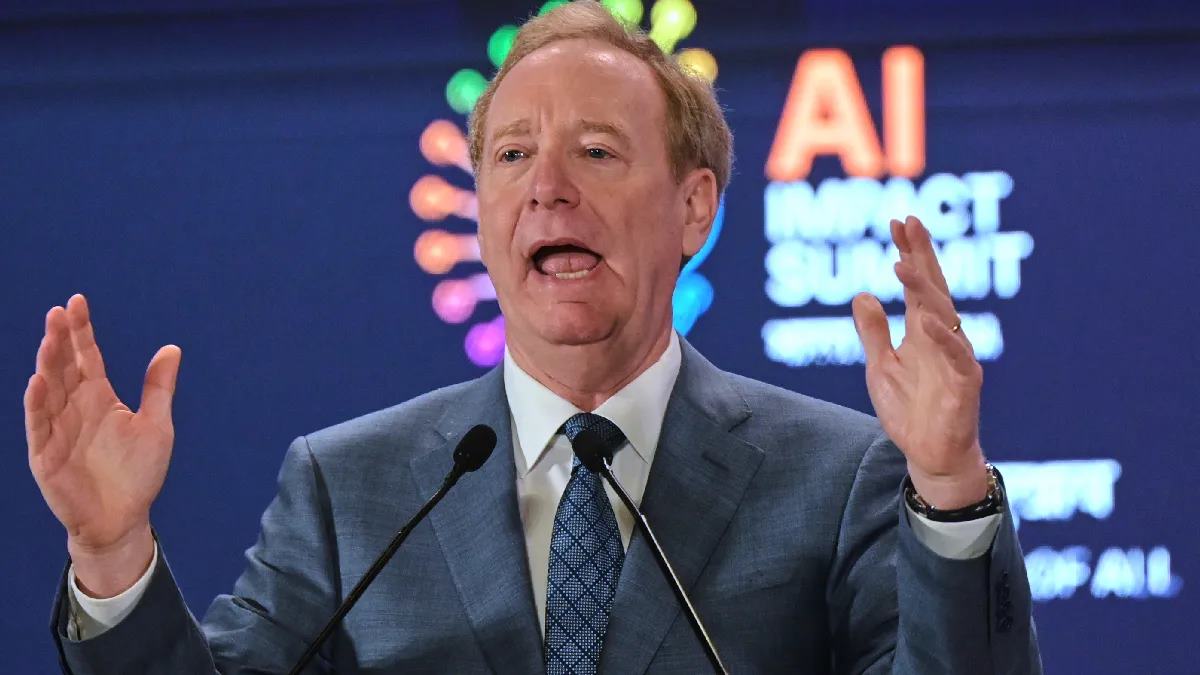
Artificial intelligence should not replace software engineers or IT professionals but instead enhance their skills and creativity, said Brad Smith, President of Microsoft, addressing concerns about widespread job losses in the technology sector. In an interview, Smith, one of the highest-ranking executives at the Redmond, Washington-headquartered Microsoft, spoke about IT services, potential job displacement, and AI’s impact on cognitive work, weighing in on one of the most debated issues in the industry.
‘Technology should help people get smarter’
Smith emphasised that Microsoft’s goal is to build technology that helps people become smarter and more capable.
According to him, AI can take over repetitive coding tasks, freeing developers to focus on higher-level responsibilities such as product design, system architecture, testing, and security. This, he said, effectively “uplevels” the software engineering profession rather than diminishing it.
Rather than reducing employment, Smith argued that AI could make jobs more engaging and fulfilling, potentially increasing demand for skilled professionals and driving higher wages.
Focus on clear goals for AI
Smith expressed frustration with technology leaders who concentrate solely on building “machines that are smarter than people”. While acknowledging the importance of advancing machine intelligence, he stressed that the broader objective should be to create tools that enhance human abilities.
“We should always start by asking ourselves, what are we trying to accomplish?” Smith said, urging the industry to define clear goals for AI development. He added that while AI should boost productivity and economic growth, it must also be directed toward creating higher-quality jobs.
According to Smith, achieving these outcomes depends on making them deliberate priorities.
AI in IT services and software development
Smith noted that technology reaches its full potential when it strengthens human interaction. AI, he said, can improve how people listen, read, and communicate.
Referring to recent discussions with Indian government officials in Delhi about human communication, he highlighted the role of technology in bridging language gaps, including translating 22 Indian languages to foster better engagement.
Applying this concept to IT services, Smith said AI can significantly improve software creation. As AI automates routine coding tasks, developers are freed to focus on product design, system architecture, project management, testing oversight, and security alignment.
“We’re not talking about using AI to replace software engineers,” Smith said. “We are talking about using AI to change the art of software engineering, to uplevel the people in this extraordinarily important profession”.
Higher skills, higher wages?
Smith added that aligning skill sets with the demands of future jobs will be critical. He suggested that as AI enhances productivity, demand for skilled professionals may increase, potentially leading to higher salaries.
“Usually, when that happens, you find you want more people who can do this work. You’re even willing to pay them more than in the past,” he said.
Smith concluded that governments also have a role to play in ensuring AI development supports productivity, economic growth, and better job creation, reinforcing that these outcomes must remain central goals for the industry.