






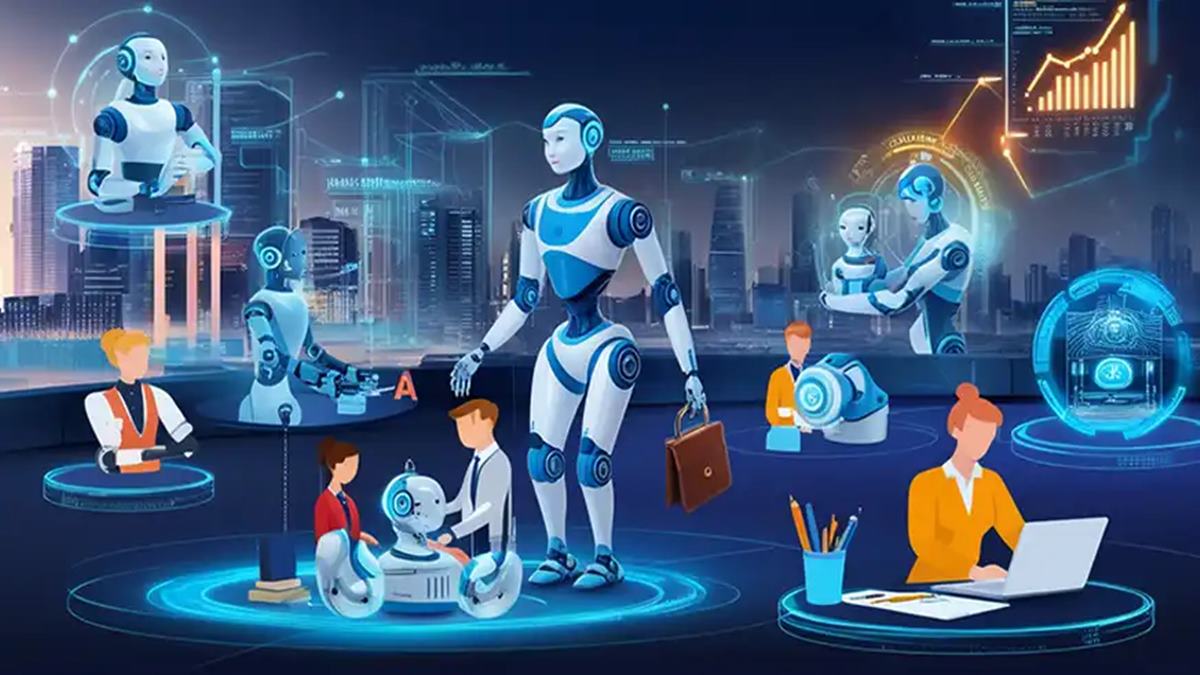











Amazon employees say the company’s aggressive push to integrate artificial intelligence into daily workflows is forcing workers to spend more time correcting machine-generated errors than completing their own tasks.
Several current and former corporate staff told the Guardian that AI tools introduced across teams frequently produce flawed output that must be reviewed, rewritten or discarded entirely. Workers say the result is longer workflows, repeated debugging and growing frustration inside the company’s white-collar workforce.
Dina, a software developer in New York, said her role has shifted from writing code to fixing mistakes made by the internal AI coding assistant employees are expected to use. The tool, known internally as Kiro, often generates inaccurate or “hallucinated” code, forcing engineers to sift through outputs and repair them manually.
“It feels like trying to AI my way out of a problem that AI caused,” she told the Guardian.
She added that management has strongly encouraged the use of AI tools in order to increase development speed. “I and many of my colleagues don’t feel that it actually makes us that much faster,” she said.
Another employee, Lisa, a supply chain engineer with more than a decade at Amazon, said the tools are helpful only intermittently. She estimated they work properly in roughly one out of three attempts, often requiring additional verification from colleagues.
“It often takes longer to check and correct the output than to just do the task yourself,” she said.
Pressure to adopt AI across the workplace
According to the Guardian, more than half a dozen Amazon employees across roles ranging from software engineering to user experience research said teams are increasingly expected to integrate AI into everyday tasks. Workers say managers routinely ask whether assignments can be completed using AI tools, even when the technology may not be suited to the task.
Denny, a software engineer working in Amazon’s retail division, said the expectation to use AI has become routine.
“The pressure to use it has resulted in worse quality code and more work for everyone,” he said.
In one instance, a colleague reported that an internal AI agent had saved nearly a week of development time on a new feature. However, when the code was reviewed, dozens of comments from engineers flagged errors and inconsistencies that required extensive corrections.
The result, Denny said, was that the development cycle ended up taking as long — or longer — than before.
Employees also told the Guardian that many AI tools were developed quickly during internal hackathons and are still immature. Engineers often spend additional time testing the tools themselves and completing internal feedback surveys.
“These tools are often half-baked,” Denny said. “You spend more time validating them than actually using them.”
Layoffs and the wider AI shift
The complaints come amid significant restructuring at Amazon. The company has laid off about 30,000 corporate workers in recent months, roughly 10% of its corporate workforce of around 350,000 employees.
The reductions are part of a broader wave of technology-sector job cuts tied to the rapid expansion of artificial intelligence. Companies including Block, Pinterest and Autodesk have also reduced headcount while increasing investment in AI initiatives.
Amazon has said its recent layoffs were not directly driven by AI. However, chief executive Andy Jassy has previously warned that productivity gains from automation could lead to a smaller corporate workforce.
In a company-wide message last year, Jassy urged employees to familiarise themselves with AI tools and experiment with them across projects.
Amazon also plans to spend around $200bn this year on AI infrastructure and recently announced a $50bn investment linked to OpenAI, according to company disclosures.
Surveillance concerns inside teams
Some employees say the AI rollout has also introduced new forms of workplace monitoring.
According to the Guardian, managers have access to internal dashboards that track how frequently team members use certain AI tools. The Information previously reported that some teams track weekly AI usage metrics, while internal surveys now regularly ask employees how often they rely on AI systems.
Workers say these systems create pressure to demonstrate enthusiasm for AI adoption.
Lisa said internal promotion documentation has also begun asking employees to explain how they have used AI in their work.
“I think they want to keep people who support this investment,” she said.
Amazon spokesperson Montana MacLachlan said employee experiences vary widely and that many teams are seeing benefits from AI adoption.
“We have hundreds of thousands of corporate employees across different businesses, each using AI in different ways,” MacLachlan said in a statement to the Guardian. “The vast majority of teams tell us they’re getting significant value from the tools they use day to day.”
A broader test of AI in white-collar work
Researchers say the tension reflects a broader challenge facing companies attempting to integrate generative AI into knowledge work.
Ifeoma Ajunwa, director of the AI and Future of Work Program at Emory University, told the Guardian that forcing employees to adopt new tools can undermine productivity.
“Employees are often in the best position to determine what tools actually help them work better,” she said.
For Amazon, the stakes are particularly high. As the second-largest employer in the United States and one of the world’s most influential technology companies, its approach to automation could shape workplace practices across industries.
For many workers inside the company, the outcome of this AI push remains uncertain.
“If you automate even part of someone’s job,” one former employee told the Guardian, “the next question becomes how much of that role you still need.”