














As artificial intelligence becomes embedded in both college classrooms and the job market, a new report from Handshake finds a rapidly closing gap between student adoption of AI tools and employer demand for those skills.
The job platform’s Class of 2026 report drew on data collected last month from 1,248 bachelor’s degree students graduating this year from nearly 500 institutions nationwide. It shows AI adoption among seniors has shifted from equally split to nearly universal: 85 percent now report using AI tools—up 31 percentage points from two years ago—and more than a third say they use them daily.
At the same time, employer demand for such skills is accelerating. More than 10 percent of active internships on the job platform now mention AI-related skills, while the share of full-time job postings referencing AI has nearly doubled year over year to 4.2 percent.
That growth spans industries. Nearly a third of tech job postings now mention AI—more than triple the share from two years ago. More than 7 percent of financial services job postings mention AI, along with roughly 5.5 percent of media and marketing roles; both sectors hovered just above 1 percent two years ago. AI mentions in government, health care and education job postings—near zero two years ago—have risen to roughly 3 percent each.
Christine Cruzvergara, chief education strategy officer at Handshake, said the Class of 2026 is the first cohort to have experienced college fully in the era of generative AI and, as a result, is largely self-taught. That shift, she said, presents a clear opportunity for colleges and universities to play a more intentional role in preparing students for an AI-driven workforce.
“Employers across the board, regardless of industry or sector or even role type, are all looking for candidates that have some level of AI intelligence, AI literacy, AI skill and, at the very least, AI curiosity,” Cruzvergara said. “The opportunity here is for institutions to essentially close that gap—they can do more to infuse AI literacy into the curriculum and provide AI tools to all of their students.”
“That alone will help minimize how much students are having to do completely on their own, versus still doing some of that independently but with institutional support,” she added.
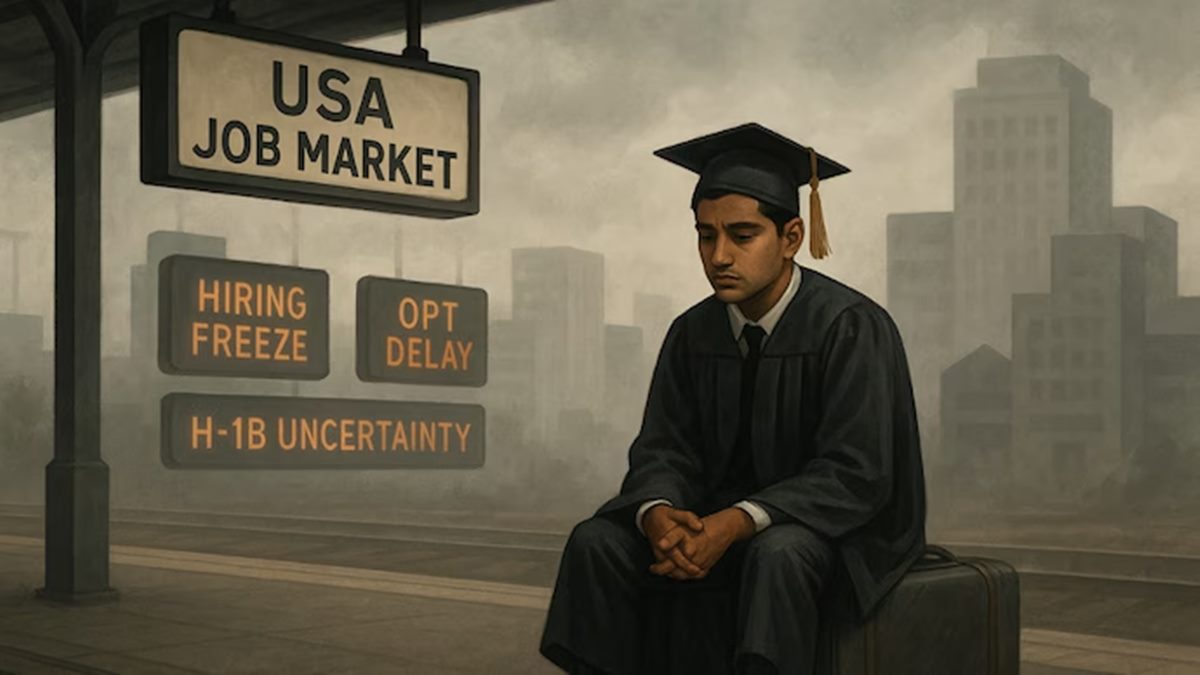
Job market pessimism: Even as AI adoption rises, the job market for early-career workers remains tight. Job postings on Handshake are down 2 percent from last year and 12 percent below pre-pandemic levels.
That contraction is shaping how graduating seniors view their job prospects. The share of fourth-year students who feel pessimistic about starting their careers has climbed 16 percentage points, from 46 percent two years ago to 62 percent today.
Among those expressing concern, anxiety about AI is rising quickly. About 50 percent cite it as a factor, up from 34 percent in 2024—the steepest increase of any concern tracked in the report.
Still, students’ top worry is more immediate: 75 percent of respondents cited companies hiring fewer entry-level workers as their biggest concern.
Cruzvergara said the unease reflects a moment of transition, as both students and employers adjust to the rapid emergence of AI.
“Naturally, when everything is so new and people are trying to figure [AI] out, it’s just going to feel a little bit messy,” Cruzvergara said. “I don’t know if it’s so much a mismatch as it is all of us trying to create whatever the new structure is going to be. We’re redefining what entry-level jobs will look like.”
She added that while job postings are still down year over year, the pace of decline is slowing. This year’s 2 percent decline is much smaller than last year’s 15 percent.
“We’re starting to see it kind of bottom out a little bit,” she said. “It’s still a competitive job market, but we are starting to see things level off.”
Institutional response gap: Colleges and universities are still figuring out their role in the emerging AI-driven landscape. The report suggests many seniors have had to navigate mixed signals—encountering environments that both restrict and encourage the use of AI tools—while preparing for a labor market that increasingly rewards those same skills.
Just 28 percent of seniors say AI has been meaningfully integrated into their academic experience. By contrast, 58 percent believe they will need a deeper understanding of AI to succeed in the workplace—a 30-percentage-point gap between what students say they need and what institutions are delivering, the report said.
Cruzvergara said that divide reflects how quickly AI has outpaced traditional teaching models.
“There are two different types of learning—assimilation and accommodation—and the way in which students are learning AI is precisely accommodation,” Cruzvergara said. “It’s so new that it doesn’t necessarily fit into any existing framework that any of us currently have in our brains, and so it requires us to rewire and restructure things in order to accommodate this new skill.”
“I don’t think it’s something institutions can ignore,” she added. “I think it’s just a matter of time and depth of commitment in terms of what that’s going to look like exactly for different institutions.”
Grappling with change: Faced with a challenging job market and the rapid rise of AI, many students are reconsidering their next steps. The report found that about 43 percent of seniors plan to continue their education, with 41 percent of those citing the stagnant job market as a driving factor.
Entrepreneurship is also gaining traction. About 58 percent of seniors expressed at least some interest in starting a business, and among them, roughly 60 percent said AI has influenced their thinking.
“Do those businesses grow, or do they use it as a launching-off point to get back into what we might call the more traditional job market?” said Cruzvergara. “That part is hard to know because it’s so early right now, but I do love that this generation is looking at AI as an opportunity and as a tool they can use to accelerate their learning, their work or their career, rather than seeing it as purely an obstacle.”
Even so, students’ outlook on their own futures remains largely intact. About 70 percent of those planning to enter the workforce say they believe they can build the career they want, and 59 percent expect to meet their financial goals.
“Institutions looking at our data should see this as an opportunity,” Cruzvergara said. “Higher ed has to figure out what partnerships it needs with industry—whether that’s with AI labs or technology providers—to keep everything relevant and fresh.
“It’s going to be very difficult for higher ed, based on the way it is structured, to keep up with the pace of change around AI,” she added. “But that doesn’t mean institutions can’t still close that gap and provide those opportunities for students. It just means they may need to do it differently.”