













Two architect brothers from New Delhi walked away from conventional corporate careers, relocated to a remote Himalayan village and spent three years building a mud house by hand — a project that has now turned into one of the most unusual Airbnb stays in the region.
Ansh Kumar, 29, and his elder brother Raghav Kumar, 32, left city life behind and moved to a village near Rishikesh, where they constructed a two-bedroom home using mud, stone, straw and other natural materials sourced largely from the surrounding area.
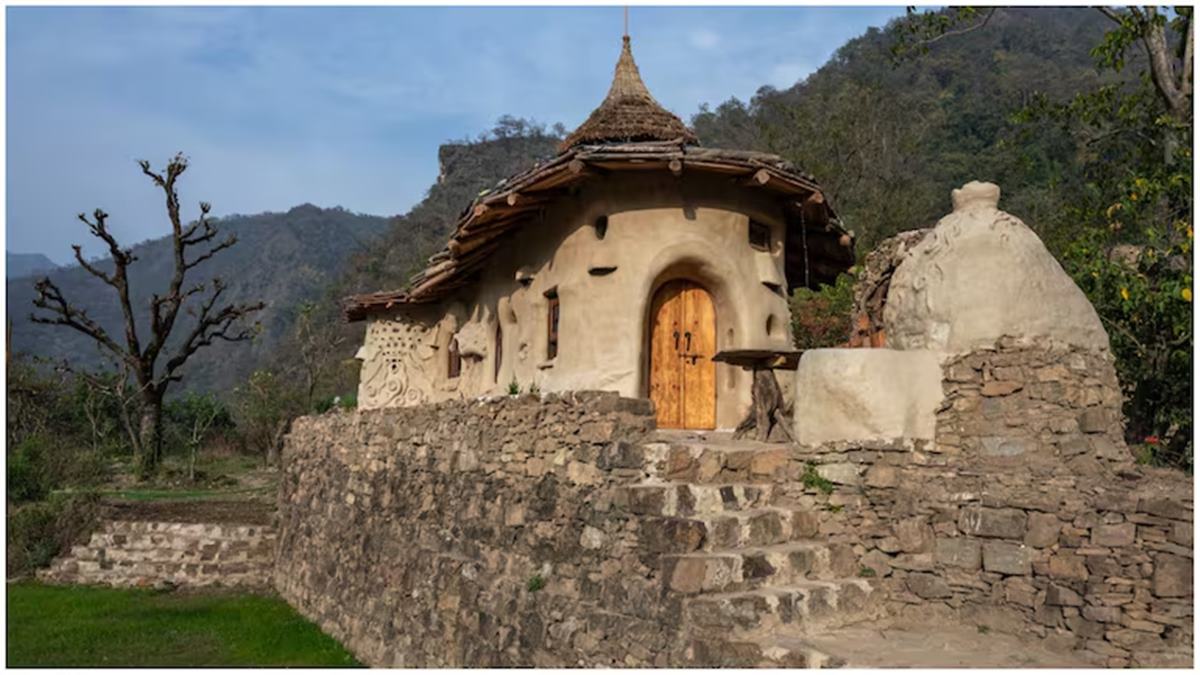
Positioned on a hillside overlooking forests, mountains and a river, the structure has drawn attention online for its curved walls, earthy interiors and storybook-like design.
“Someone sees it as a Harry Potter house, someone sees it as a hobbit house, someone sees it as a fairytale house,” Raghav said while speaking to Business Insider about how visitors describe the property.
“For us, it’s a labour of love, and every curve tells the story of all the beautiful people who had come and put in the effort,” he added.
The brothers’ decision to leave urban life behind emerged after years spent working in architecture firms and sustainable design projects. Raghav had interned with a German architectural company before taking up a full-time role with another German firm operating from Ahmedabad. While he said he appreciated the work culture and organisational structure, the workload gradually became overwhelming.
“When you’re in a corporate setup, the environment makes you believe that the longer you work, you can wear that as a badge of honour,” he said.
“There were days when I ended up working 48 hours at a stretch trying to cope with all the side deadlines.”
Beyond exhaustion, Raghav said he also became increasingly aware of the disconnect between architects designing projects in offices and the labourers physically constructing them on-site.
“The architect sits in this air-conditioned office, designing and dreaming visionary things, whereas the labourer who builds the project doesn’t get any credit,” he said.
“As architects, we’re not able to comprehend or appreciate that labour that goes into a project.”
During his three years with the company, he increasingly began travelling to remote mountain regions across India during breaks from work.
“I realised I was living for the weekends,” he said. “That’s when I realised I didn’t want to climb the corporate ladder.”
His younger brother Ansh followed a different route into sustainable architecture. After interning in Germany, he worked independently on environmentally conscious construction projects in rural and mountainous parts of India, where he developed a strong interest in slower, nature-oriented living.
The brothers said the Covid-19 pandemic ultimately became a turning point. While quarantining together in New Delhi, they began experimenting with natural building materials from home. They explored the use of mycelium grown from mushrooms and also studied cob construction — a traditional technique involving soil, straw and water.
“Covid showed us life is short,” Raghav said. “We agreed that we needed to take a leap of faith.”
They eventually chose Rishikesh, located in the foothills of the Himalayas around 150 miles northeast of New Delhi, as the location for their project.
Known historically as a spiritual and pilgrimage destination situated along the banks of the Ganges, the town has also evolved in recent years into a hub for yoga retreats, remote workers, cafes and wellness tourism.
The pair leased a plot of land from a family acquaintance with the promise that they would create a sustainable structure on the site. In March 2021, they moved into a nearby village and began work.
Accessing the location itself proved difficult.
“From where the car drops you off, you have to cross a tributary of the Ganga on foot via a wooden bridge,” Ansh explained.
“Then you hike for more than a mile to reach the village. So that was another challenge altogether.”
Unlike their earlier architecture work, which relied heavily on software and digital modelling, the brothers approached the mountain project manually. Instead of computer-generated plans, they marked layouts directly onto the land using sticks and stones.
Construction then began with physically transporting materials to the isolated site. The brothers carried thousands of rocks themselves, while sand was transported using mules. Most of the remaining materials were sourced locally.
To support the construction process, they turned to Workaway, a platform connecting travellers with hosts in exchange for accommodation and meals.
Over the course of the project, the brothers said more than 100 volunteers from 18 countries participated in the construction alongside approximately 20 local labourers employed for the build.
The project cost around $30,000 (Rs 28,72,524 approximately), funded through their personal savings and financial support from their parents.
“You can see the progress every day; the house was getting taller daily, by about six inches to a foot,” Ansh said.
“So that is quite rewarding compared to eight hours of work in front of the laptop in the corporate world, where you feel exhausted but also like you didn’t get anything done.”
The house was completed in 2024.
Describing the finished structure, Raghav called it a “living sculpture”. The home features rounded forms, spiral motifs and a thatched roof, while the interiors are designed with earthy tones and natural textures.
The brothers listed the property on Airbnbin April 2024 at approximately $140 per night (Rs 13,405 approximately).
The listing warns guests that the house is not accessible by car and requires a 1.5-kilometre forest hike carrying personal luggage.
“There’s no WiFi in the forest, but you’ll get a stronger connection with yourself, your loved ones, and your passions,” the listing states.
According to the brothers, the property is occupied around 60 per cent of the time.
Following the success of the project, the pair established an architecture and design studio in Rishikesh and have begun working on additional natural building projects across India.
Life in the mountains, however, continues to come with practical difficulties. Internet connectivity remains inconsistent, and the area surrounding the property includes forest zones frequented by wild elephants.
Despite those challenges, the brothers said the move has significantly improved both their physical and mental wellbeing.
“We’ve become the fittest version of ourselves, living here,” Raghav said.
He recalled how physically demanding even a single uphill walk felt when they first arrived in the village.
“On the first day, just the hike up to the site winded us both,” he said, adding that they can now comfortably complete multiple trips daily.
“You don’t even know when you clock 10,000 steps. You have nature all around you, better air, and you feel your anxiety melt away.”