



















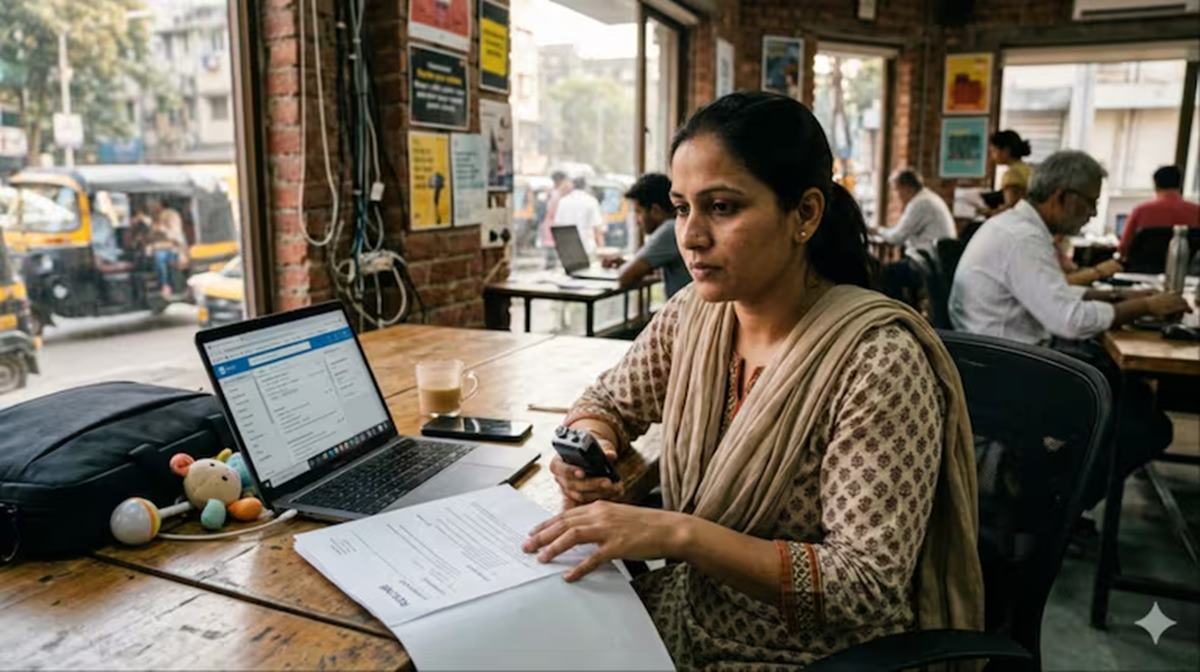
A Mumbai-based journalist, who says she was forced to quit during her pregnancy, has spent nearly three years struggling to re-enter the workforce, alleging that recruiters are fixated on a gap in her résumé and using it to justify lower salaries.
Nisha Nawaz (name changed), who previously worked with a city tabloid, told Moneycontrol that her job search since her child was three months old has been marked by repeated scrutiny over her career break.
“It seems like the first thing that catches recruiters’ eye in my resume is the gap,” she said, adding that offers made to her have often been below market standards. According to Nawaz, hiring managers frequently position the gap as a weakness in salary negotiations. “They want me to settle with a minimal salary and have often used the career gap as a reason that I should settle for less,” she said.
She has applied across journalism, content writing, and research roles, but says the response pattern has remained consistent.
Nisha Nawaz (name changed), who previously worked with a city tabloid, told Moneycontrol that her job search since her child was three months old has been marked by repeated scrutiny over her career break.
“It seems like the first thing that catches recruiters’ eye in my resume is the gap,” she said, adding that offers made to her have often been below market standards. According to Nawaz, hiring managers frequently position the gap as a weakness in salary negotiations. “They want me to settle with a minimal salary and have often used the career gap as a reason that I should settle for less,” she said.
She has applied across journalism, content writing, and research roles, but says the response pattern has remained consistent.
Exit during pregnancy
Recalling why she was forced to quit her last job at a popular Mumbai tabloid, Nawaz said she informed her editors about her pregnancy during the first trimester and initially received support, including limited work-from-home flexibility. But, health challenges — including severe nausea, back pain, and long commutes — made work increasingly difficult.
After taking a short medical leave, she said she was called into what she described as an unexpected performance review with senior editors.
“I could immediately sense a shift in my seniors’ attitude,” she said, adding that despite delivering around 15 cover stories during her nine-month tenure — while others were expected to provide one cover story a month — her performance was questioned over minor contributions.
She also alleged that her request for continued flexibility was denied.
“I had a note from the doctor that advised rest. I was nauseous almost all the time and had a back pain. I did not say no to work but just wanted a little flexibility. A hybrid system would have made it much easier for me to take care of myself and my work. But both my editors and the HR, who were all women, put their foot down.”
This surprised Nawaz because there were at least two employees in the office who were allowed to work from home.
“It wasn’t like I was the only person requesting for some flexibility. The organisation had already made exceptions for two other employees,” she said.
Pressure builds after appraisal meeting
Since the office had denied a hybrid work system, Nawaz asked the senior editors if she could take a couple of months leave without pay along with her maternity leave. They allegedly said no. The following week as marked by “immense pressure,” leaving her with what she felt was no viable option but resignation.
“It seemed that the only way to protect myself and my baby was to quit,” Nawaz said, adding that the organisation accepted her resignation immediately and waived her notice period, which surprised her.
Long-term impact on career
Nawaz says the lack of maternity-linked job security has had cascading effects — from lost benefits to stalled career progression.
“I was snatched away from a professional system that would have been in place for me had I not been forced to resign,” she said.
She also pointed to the challenges of job-hunting while raising a child without family support in a large city. “Sifting through jobs… while I take care of a young child… has been traumatising,” she said.
‘Gap added skills, not reduced them’
Despite hiring bias, Nawaz argues that the career break has strengthened her abilities.
“That gap has not only brought forth a new human being but also taught me better time management, multi-tasking and other life skills,” she said.
Nawaz is currently interviewing for roles and remains hopeful that employers will evaluate her on skills rather than the career break.