

















AI won’t cause mass unemployment in India. It may do something far worse
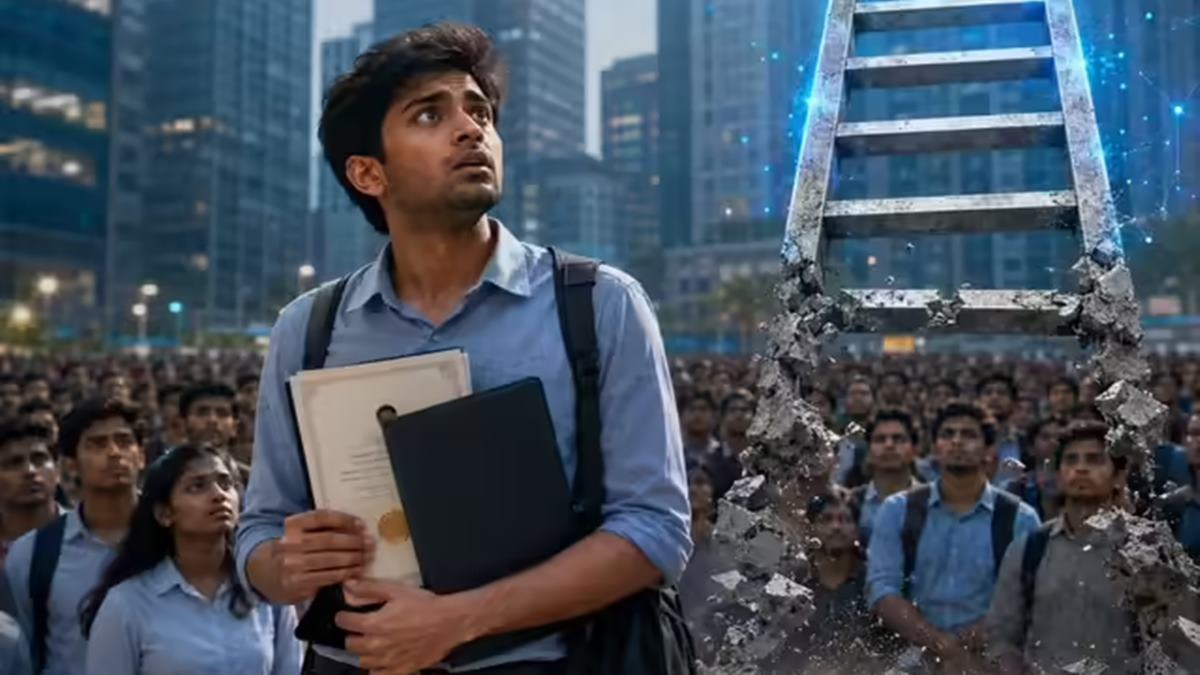
The real threat artificial intelligence poses to India is not a jobs apocalypse. It is something subtler and more damaging, the quiet destruction of the ladder that has carried millions of Indians from education into the middle class. When that ladder narrows, the consequences ripple across an entire generation.
India’s economy runs on a promise AI is about to break
For decades, India’s development story followed a reliable path: study hard, get a degree, land an entry-level IT or back-office job, join the urban middle class. AI is now targeting exactly those entry-level roles, junior analysts, coders, testers, process workers, compliance staff, documentation teams. The sector may become more valuable. But it will absorb far fewer people on the way up.
The hourglass economy: Big at the top, big at the bottom, Hollow in the middle
AI is reshaping labour markets into an hourglass. At the top, a smaller group becomes dramatically more productive and better paid. At the bottom, human-facing service jobs, delivery, care, hospitality, repair, remain. The middle, where education converted into stable formal income, shrinks. In advanced economies, that is a distribution problem. In India, it is a development crisis.
The skills crisis is worse than anyone is admitting
Only 42.6% of Indian graduates are employable today, according to Mercer’s India Graduate Skill Index 2025. AI does not fix that gap, it widens it. Students from elite colleges with strong English and networks can use AI as a tool that multiplies their advantage. Students from weaker institutions face a market where the fallback roles they once relied on are disappearing faster than new ones are being created. The return on an ordinary degree is quietly collapsing.
Gig work is growing, but growth is not the same as mobility
India’s gig workforce is expected to more than double, from 10 million workers in 2024 to 23.5 million by 2030. That sounds like opportunity. But there is a critical difference between workers being pulled into gig work by better options and being pushed into it because formal pathways have closed. The same category can mean flexibility for one worker and disguised underemployment for another. Headline employment numbers may look fine while the real development bargain quietly breaks down.
What India must do before the window closes
Protecting old jobs from AI is neither possible nor desirable. But preserving mobility is. India needs three things urgently: a live labour-market intelligence system that detects which entry-level roles are shrinking before it shows up as unemployment; a serious apprenticeship infrastructure that rebuilds the on-the-job learning AI is removing; and a publicly transparent skilling system that discloses actual placement rates, starting wages, and retention, not just enrolment numbers. Policy that cannot measure outcomes cannot improve them.
India will have plenty of work in the age of AI. That is not the point
The optimistic scenario is real; AI could help India upgrade services, expand global capability centres, deepen digital exports, and create high-skilled roles. But the pessimistic scenario is not mass unemployment. It is a more unequal equilibrium: high productivity at the top, crowded low-wage services at the bottom, and a broken bridge between education and security. India’s real test is not whether AI creates jobs. It is whether those jobs still do what jobs once did, turn a degree into a livelihood, and a livelihood into a life.