














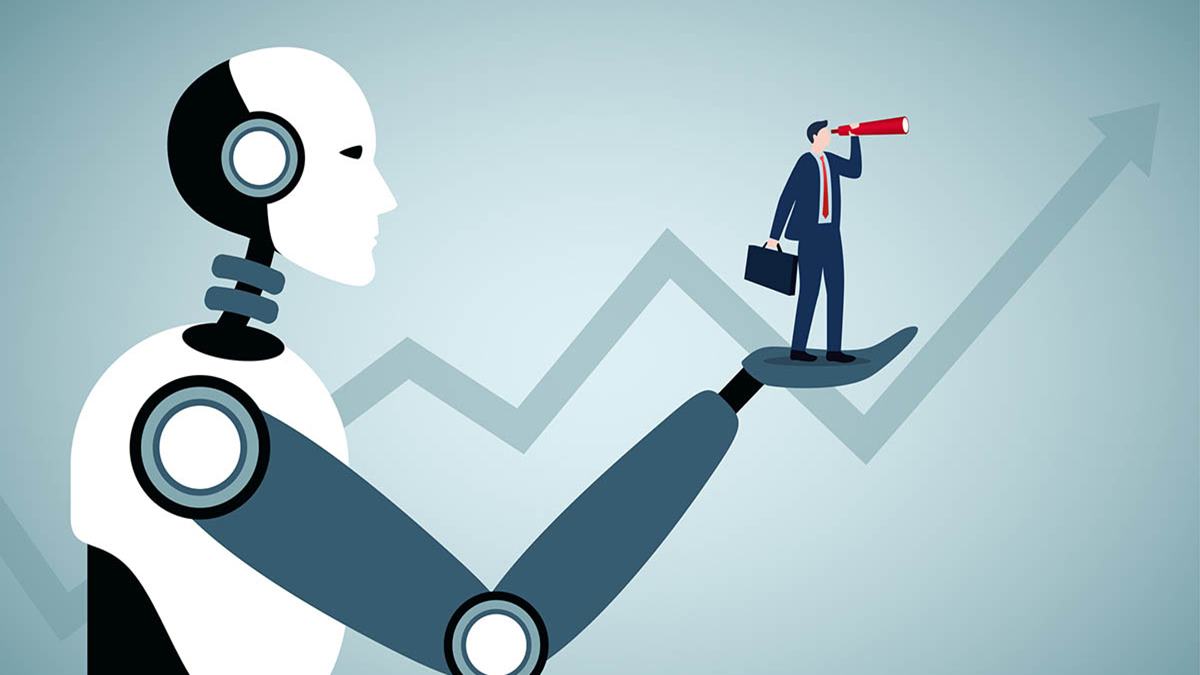


Not all white-collar jobs face equal risk from artificial intelligence. As AI continues hollowing out the knowledge economy, the risks are concentrated in specific roles — and the pattern is counterintuitive: seniority and credentials offer less protection than the nature of the work itself.
Here’s what to know.
The research consensus
The most widely cited framework for mapping AI exposure comes from a 2023 paper by researchers at the University of Pennsylvania and OpenAI, published in the journal Science. Analyzing more than 1,000 occupations against the capabilities of large language models, the study found that roughly 80% of U.S. workers have at least 10% of their job tasks affected by AI, and about 19% face exposure of 50% or more.
Occupations most exposed share a common profile: They involve processing and synthesizing text, analyzing structured data, or generating routine written output. Legal work, financial analysis, business operations, and content production rank highest — not because these workers lack skills, but because their core tasks map closely to what current AI systems do well.
A separate analysis from Goldman Sachs $GS +1.71% estimated that about two-thirds of jobs in the U.S. and Europe face some degree of AI automation exposure, with roughly a quarter of all work potentially automatable outright. Administrative and legal roles ranked highest; jobs requiring physical manipulation, complex judgment, or novel problem-solving ranked lowest.
The roles most exposed
Across major research efforts, several categories surface consistently.
Legal services — paralegals, legal assistants, and junior associates whose work centers on document review, contract analysis, and legal research — appear at or near the top of most exposure rankings. Law firms have already begun deploying AI tools that perform these tasks at a fraction of the cost.
Financial analysis and accounting show similarly high exposure for entry- and mid-level positions. Tasks such as data reconciliation, report generation, and routine financial modeling are early candidates for substitution, according to Goldman Sachs.
Content and marketing roles — copywriters, content strategists, and communications coordinators — face acute exposure, given that text generation is among the most mature current AI capabilities.
Human resources, particularly in recruiting and talent screening, also ranks highly. Tools for resume review, candidate matching, and initial screening are already in widespread commercial deployment.
Where humans retain an edge
The picture is more favorable for roles combining domain expertise with judgment, relationship management, or novel problem-solving. Senior attorneys, investment bankers managing client relationships, and executives making strategic decisions under uncertainty all involve tasks that current AI handles poorly.
The University of Pennsylvania research found that roles requiring complex physical tasks, real-time situational judgment, or deep interpersonal trust face the lowest AI exposure — a category that includes surgeons, skilled tradespeople, and therapists alongside senior knowledge workers.
The emerging consensus: AI exposure tracks task profile more reliably than job title, industry, or credential level. A senior paralegal and a junior software engineer may carry similar credentials and salary bands — but their exposure to displacement is not remotely similar.
Source – https://qz.com/white-collar-jobs-ai-displacement-risk-042026